
P.D. Grushin’s next aircraft, the “BB-MAI,” was developed at MAI as a ground attack aircraft and short-range bomber. The machine was somewhat smaller in size and featured a classical scheme, but was equipped with a more powerful M-105 engine (1050 hp). The aircraft was designed between 1938 and 1939 to serve both as a ground attack platform and a short-range bomber.
The BB-MAI’s wing was a two-spar design, made from three C-shaped sections molded from bakelized plywood. When these sections were inserted into each other, their leading edge formed the spar wall, and their shelves became the wing skin. The sections and the entire wing were assembled using VIAM B-3 adhesive, resulting in a monolithic caisson structure.
Innovative Design and Features
The skin thickness at the wing’s leading edge was 5 mm, tapering to 3 mm at the trailing edge, and reaching up to 25 mm between the spar walls. The fuselage was a monocoque type, also constructed from bakelized plywood with the same adhesive. Like its predecessor, the BB-MAI’s surface was polished to a high sheen. Specialists from VIAM assisted in mastering the production technology for bakelized plywood structures.
The aircraft was equipped with a retractable turreled installation, and the engine featured a CIAM supercharger powered by exhaust gases. The BB-MAI was the first aircraft in the USSR to be fitted with a three-post landing gear system, including a nose wheel. The radiator was positioned behind the nose wheel, and the main wheels retracted into the wing towards the fuselage, with the wheels rotating relative to their struts.
The wing was relatively small, with an area of 15.2 square meters and a taper of 3.5. With a take-off weight of about 3500 kg and its small wing area, the specific wing loading was approximately 210 kg/sq.m. This high loading was adopted to increase the maximum flight speed, and the wing also featured automatic leading-edge slats.
Development and Fate
Construction of the aircraft, which began in 1939, was completed in late 1940. A.A. Lebedinsky served as the leading construction engineer for the machine, and A.A. Manucharov was the leading test engineer. The test pilot was A.N. Grinchik, a graduate of MAI.
The prolonged construction meant that its first flight did not occur until December 1940, by which time the VVS (Soviet Air Force) had lost interest in the aircraft. By then, Grushin himself had been appointed chief designer of the Design Bureau at Kharkiv Aviation Plant No. 135, and the MAI Design Bureau, which had served for several years as a “nursery” for future engineers and designers, was closed.
Technical Specifications
| Modification | BB-MAI |
| Wingspan, m | 10.00 |
| Length, m | 9.60 |
| Wing area, m2 | 16.80 |
| Empty weight | 2965 |
| Normal takeoff weight | 3490 |
| Engine type | 1 Piston engine M-105 |
| Power, hp | 1 x 1050 |
| Maximum speed, km/h | 550 |
| Practical range, km | 500 |
| Service ceiling, m | 9000 |
| Crew | 2 |
Image and diagram gallery of the BB-MAI
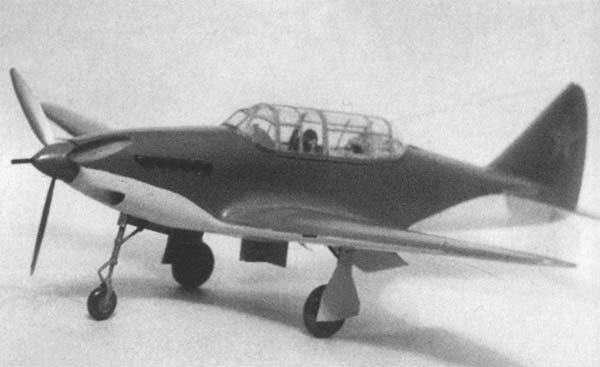 BB-MAI |
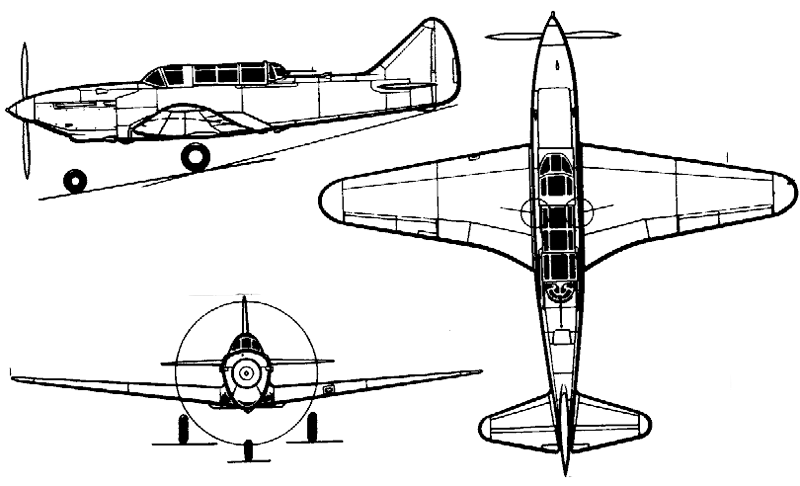 BB-MAI |
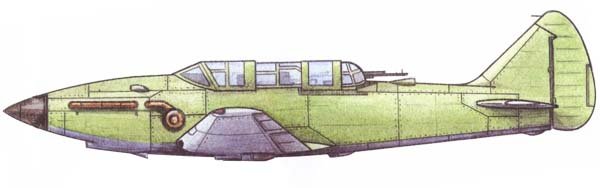 BB-MAI |