
Among Soviet aircraft designers, Boris Ivanovich Cheranovsky holds a special place due to the unusual schemes of his gliders and aircraft. Cheranovsky is the pioneer of tailless aircraft in our country and of the thick-profile flying wing realized in practice worldwide. Throughout his design career, he designed about 30 aircraft and gliders, but Cheranovsky gained fame for his “Parabolas”—aircraft with a parabolic wing shape in plan.
The point was not in the name or the curve outlining the wing, as he also had trapezoidal wings. What was important was that, for the first time in our country and globally, the properties of a thick-profile flying wing in its purest form were confidently demonstrated in numerous flights. In 1921, Cheranovsky proposed a flying wing aircraft project with an aspect ratio of 1.5, outlined as a parabola.
The Origins of the БИЧ-1
Many TsAGI aerodynamicists did not believe in the feasibility of such a wing shape and objected to its introduction. However, wind tunnel tests of this type of wing with aspect ratios of 1.5, 3, and 6 generally refuted the expressed concerns. The realization of this Cheranovsky-designed aircraft was largely thanks to the support of the Moscow glider club “Paryashchy polyot” (Soaring Flight), chaired by military pilot K.K. Artseulov.
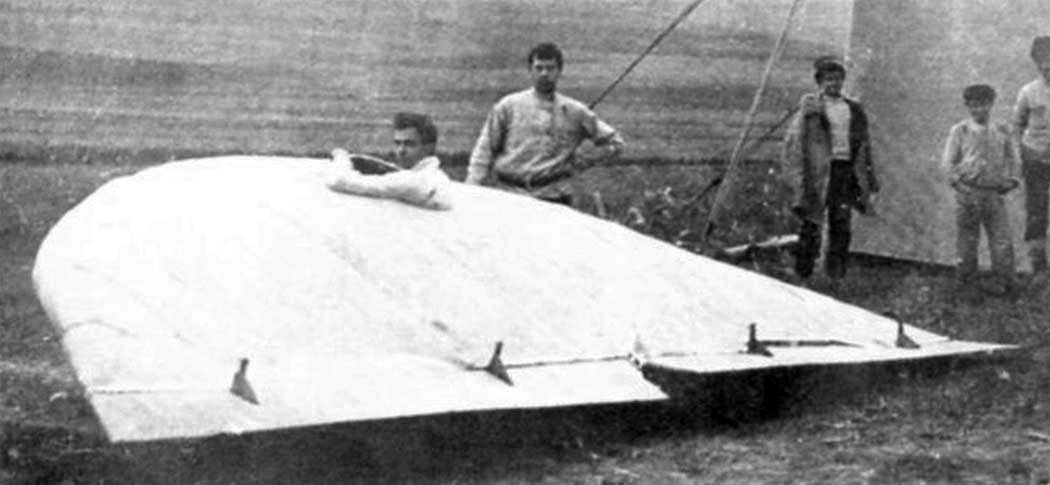
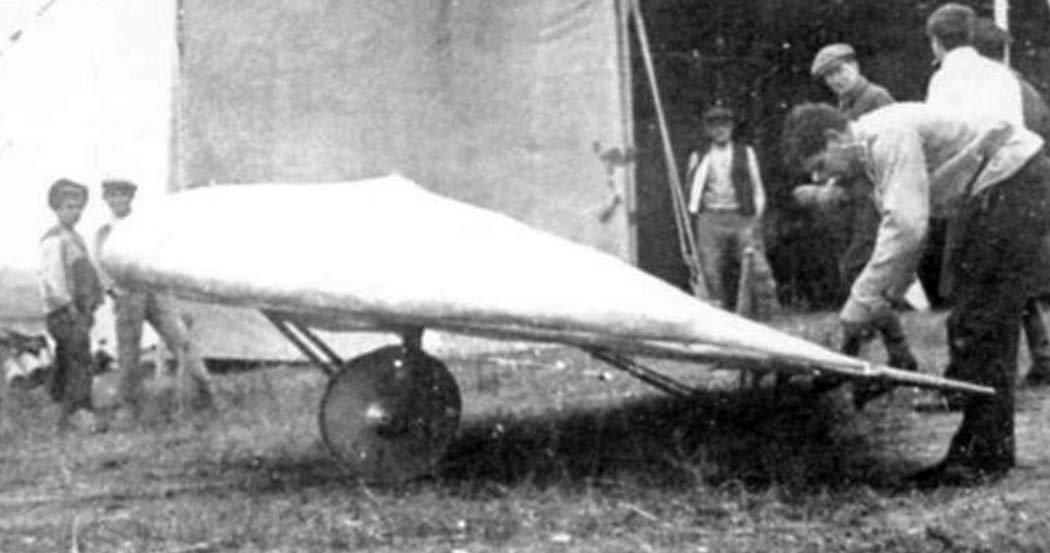
This small glider, designated БИЧ-1 and representing the first “flying wing,” was built by spring 1923. In later records, the project’s author himself noted that the act on the preliminary trials of this first “parabola” was approved on March 16, 1923. According to other preserved documents, the preliminary trials took place on April 1, 1923, at the airfield of the Moscow Aviation School (eastern part of Khodynka).
Competitions and Unique Design
Despite the poor condition of the airfield—snow had almost melted and there were puddles of water everywhere—the glider was tied to an aerosledge and towed along the airfield, observing its stability and controllability. It was found that the glider maintained good lateral stability, and the rudders showed sufficient responsiveness. The act of preliminary trials was approved by glider club members Artseulov, Nadashkevich, and Mikheev.
On November 1, 1923, the first Soviet glider competitions opened on the southern coast of the Crimean Peninsula in Koktebel, where 10 gliders were presented (out of 20 announced). Cheranovsky’s glider participated under No. 7, simply named “БИЧ,” without the numerical index. Aviation popularizer Evgeny Burche (also known as the author of Soviet protective color schemes and camouflages) wrote in “Vestnik Vozdushnogo Flota” No. 6/1923 regarding this glider: “A monoplane consisting of a single continuous thick-profile wing, parabolic in plan.
Challenges and Further Development
Structurally, it is made as a truss. Conventional rudders are absent; they are replaced by large, full-span ailerons, which, in addition to mutually opposite movements, also have combined movements.” During the first takeoff attempts by pilot V.F. Denisov in very weak wind, the glider did not lift off the ground.
Cheranovsky continued to improve his design, in particular equipping a rudder. However, in the last days of the competitions, due to a shortage of flight personnel, the glider was not tested.
Technical Specifications
| Modification | BICH-1 |
| Wingspan, m | 4.90 |
| Length, m | 3.26 |
| Aspect ratio | 2 |
| Wing area, m2 | 12.00 |
| Empty weight | 32 |
| Crew, crew members | 1 |
Image and diagram gallery of the БИЧ-1
 BICH-1 |
 BICH-1 |