
Early Aerodynamic Innovation
Advanced aircraft designers, from the beginning of the last century, were interested in aerodynamic configurations that would allow minimizing air resistance while maximizing available engine power. While this was relatively straightforward for single-engine machines, twin-engine aircraft presented various design possibilities.
The Canton et Unne No.1 Concept
Consider, for example, the No.1 aircraft designed by Georges Canton and Georges Unné. This machine featured a single ‘front’ – a fuselage where both engines were housed, powered by their own 80 hp five-cylinder engine design. This configuration aimed to drastically reduce frontal drag compared to classic ‘three-front’ twin-engine aircraft, which typically include a fuselage and two engine nacelles.
Performance Challenges and Design Flaws
In principle, this solution was quite reasonable, especially since the airflow from the rear propeller wouldn’t impede the aircraft. However, the two triplane wing boxes, with their combined drag, completely negated any aerodynamic gains. Consequently, the flight performance characteristics of the resulting machine were quite modest. Even the propellers were, frankly, quite shoddy; had an ordinary biplane been built using this scheme, there might have been some real potential.
Technical Specifications
| Modification | No.1 |
| Wingspan, m | 12.80 |
| Empty weight | 520 |
| Engine type | 1 Piston engine Canton et Unné |
| Power, hp | 1 x 80 |
| Crew | 1 |
Image and diagram gallery of the Canton et Unne No.1
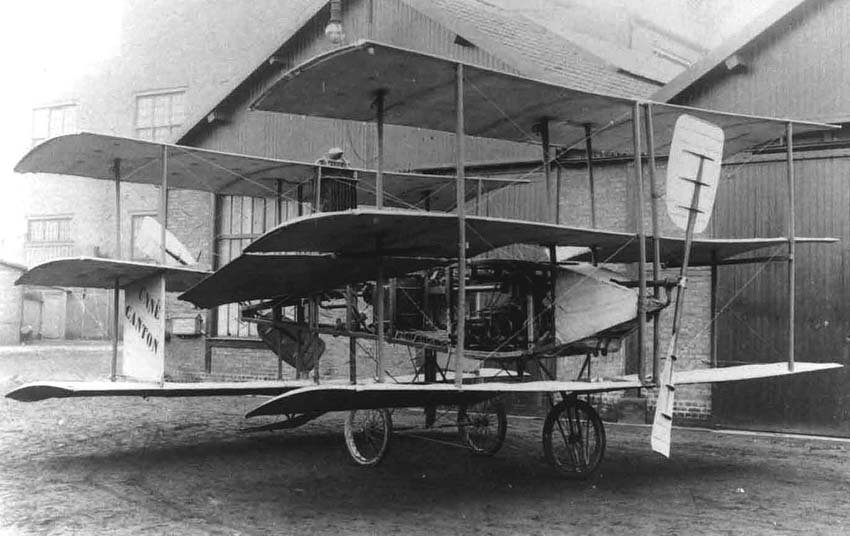 Canton et Unne No.1 |