
The Ornithopter Concept
An ornithopter, or flapping-wing aircraft, is a heavier-than-air flying machine propelled by flapping wings. Birds, insects, and bats fly in this manner, and humans have long sought to emulate their flight. Interest in ornithopters stems from the theoretical possibility of vertical take-off and landing, similar to helicopters, and achieving efficiency comparable to airplanes in horizontal flight.
However, applying modern calculation methods to flapping wings reveals they are even less efficient than a helicopter’s main rotor. This is because a helicopter blade describes a full circle without reciprocating motion, whereas a flapping wing must inevitably stop at the beginning and end of each stroke. At these moments, its speed relative to the air, and thus its lift, is zero. Furthermore, a flapping wing is significantly more complex structurally than a helicopter blade, making it much heavier.
Cheranovsky’s BCH-18 Musculoplane
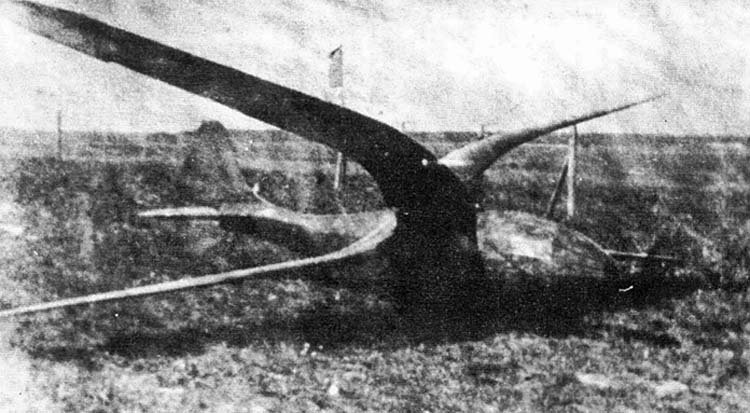
In 1921, 1934, and 1935, B. I. Cheranovsky conducted experiments with ornithopter-gliders, the third of which was named BCH-18. On August 10, 1937, the BCH-18 musculoplane, designed by B. I. Cheranovsky, made its first flight. On that day, pilot R. A. Pishchuev completed four sorties.
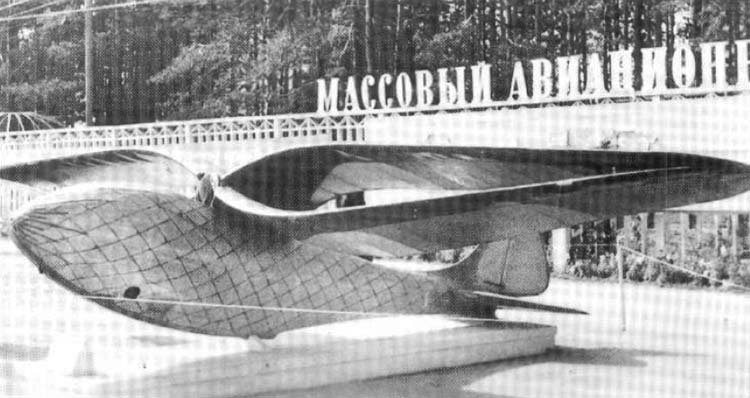
The BCH-18 was a biplane with hinged wings actuated by the pilot. The wings converged over the fuselage at a single hinge, around which their motion occurred. The flapping motion involved the alternating convergence and separation of the wings, forming a “double scissors” type of design.
The musculoplane BCH-18 had a wingspan of 8 meters, an aspect ratio of 7 when the wings were horizontal, and a total wing area of 10 square meters (upper and lower wings had equal areas). The wing loading was 13 kg/m², the empty weight was 72 kg, and the flight weight was 130 kg. The BCH-18 featured classic control surfaces, with steering managed via a stick and wheel. The wings were operated by the pilot pushing suspended pedals connected to rods.
Testing and Limitations
The BCH-18 underwent testing according to a specially developed program, which first involved trials as a glider and then as an ornithopter. The glider tests revealed good qualities, with satisfactory stability and control regardless of wing position. However, the second phase of testing showed that the flapping mode did not provide a significant effect.
The primary reason for this inefficiency was the constant angle of incidence of the wings and their rigid aerodynamic profile. Later, the designer implemented modifications, making the wings elastic, but significant vibrations were observed during flight tests. Ultimately, the tests of the BCH-18 remained unfinished.
Technical Specifications
| Modification | BICH-18 |
| Wingspan, m | 18.80 |
| Wing area, m2 | 10.00 |
| Empty weight | 72 |
| Flight weight | 130 |
| Max. aerodynamic quality | 18 |
| Crew | 1 |
Image and diagram gallery of the BCH-18
 BICH-18 |
 BICH-18 |