In 1937, the Canadian government signed a contract for the licensed production of the “Blenheim” Mk IV at Fairchild Aircraft Limited, under the designation “Bolingbroke”. Externally, the Canadian “Bolingbrokes” did not differ from their English “relatives,” but some of the aircraft were equipped with American instruments and equipment.
The first of four “Bolingbroke” modifications, designated Mk I, was produced in 1939, with 18 aircraft (serial numbers 702 – 719) manufactured. The aircraft was equipped with 840 hp “Mercury” VIII engines. Deliveries of the new aircraft to the Royal Canadian Air Force (RCAF) began on November 15, 1939, with the first machine handed over to the 8th Squadron, based in Sydney, Nova Scotia, engaged in anti-submarine patrolling in the Atlantic.
Standard armament consisted of five 7.7 mm machine guns (one in the left wing console, two in a mechanically operated dorsal turret, and two remotely controlled on a mount under the nose for firing into the rear hemisphere). It could carry up to 454 kg of bombs in the bomb bay and 145 kg on external hardpoints.
Development and Variants
Many of the early production “Bolingbroke” Mk Is were used by Fairchild for research and development work. Aircraft 702 and 717 were converted into “Bolingbroke” Mk III prototypes, equipped with Edo floats. The floats were attached to the fuselage, wing, and main landing gear mounting points using streamlined struts. Although tests of these machines were successful, no order for serial production of the “Bolingbroke” Mk III followed, and in 1942, the aircraft reverted to conventional landing gear.
Bomber 712 was restored after an accident and, under the designation “Bolingbroke” Mk II, was used for testing American instruments and equipment. Aircraft 712 and 718 received dual controls and were converted into training aircraft.
The next series of 151 aircraft (serial numbers 9001 – 9151), designated “Bolingbroke” Mk IV, was equipped with 905 hp “Mercury” XV engines and American instruments and equipment. Deliveries of “Bolingbroke” Mk IVs to the Canadian Air Force began in January 1941.
Some aircraft in this batch (9005, 9010 – 9023) were fitted with American Pratt & Whitney “Wasp Junior” engines of 825 hp with Hamilton Standard propellers. This was done as an insurance against interruptions in the supply of “Mercury” engines. However, since this did not happen, no more American engines were installed on the aircraft. To distinguish these machines, a new designation was introduced: “Bolingbroke” Mk IV-W.
Another bomber (9074) received a 900 hp Wright “Cyclone” Gr-1820-G3B engine and the designation “Bolingbroke” Mk IV-C. Since the installation of the new engine did not affect the machine’s flight characteristics, work in this direction was stopped. A number of late-production Mk IVs were equipped with “Mercury” XX engines. Aircraft 9086 underwent testing of ski landing gear, which was subsequently widely used on Canadian “Bolingbrokes.”
The last modification of the “Bolingbroke” was the Mk IV-T trainer, built between 1942 and 1943. Most aircraft of this type were equipped with “Mercury” XV engines. This modification became the most numerous, with the Canadian Air Force receiving 457 aircraft, and another 51 machines not completed.
Operational Service in the RCAF
The “Bolingbrokes” were used only by the Canadian Air Force and only in Canada and the Aleutian Islands. As mentioned, the 8th (reconnaissance-bomber) Squadron was the first to receive them, followed by other units. Primarily, “Bolingbrokes” were used for anti-submarine patrolling over the Atlantic and Pacific Oceans.
Two Canadian Air Force squadrons were transferred to the joint American-Canadian forces defending the Aleutian Islands and the western coast of Alaska from Japanese attacks. The 115th Squadron arrived in the Aleutians in April 1942 and engaged in anti-submarine patrolling and reconnaissance. In June 1942, twelve “Bolingbroke” Mk IVs from the 8th Squadron were deployed to the islands. The aircraft departed from Sea Island base and, after covering 1600 km, landed on Yakutat Island on June 3.
Upon arrival, the red circles on the aircraft’s roundels were painted over to avoid confusion with Japanese “Hinomaru” national insignia. Later, the aircraft received additional identification marks in the form of a 35-cm wide blue stripe on the rear fuselage. The terrible weather in the Aleutian Islands proved to be a worse enemy than the Japanese, and many “Bolingbrokes” were lost in the dense Alaskan fogs. The aircraft’s usual combat load consisted of three 136-kg depth charges, and two machines were always kept on the airfield ready for takeoff. The 8th Squadron, in conjunction with the US Navy, destroyed one Japanese submarine. A “Bolingbroke,” piloted by Flight Sergeant P.M.G. Thomas, attacked and damaged the submarine, after which arriving warships sent it to the bottom.
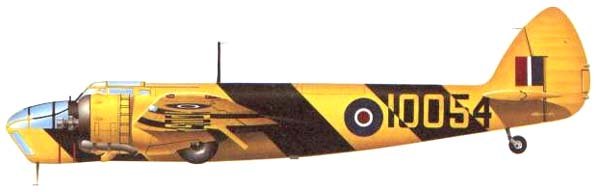
Most “Bolingbrokes” never participated in combat operations. They were used for training crews and technical personnel as part of the British Commonwealth Air Training Plan. Some machines, which received highly visible paint schemes, were used as target tugs for training air gunners and anti-aircraft gunners.
Technical Specifications
| Modification | Bolingbroke Mk I |
| Wingspan, m | 17.20 |
| Length, m | 12.98 |
| Height, m | 3.00 |
| Wing area, m2 | 43.57 |
| Empty weight | 4065 |
| Normal takeoff weight | 6576 |
| Engine type | 2 Piston engine Bristol Mercury XV |
| Power, hp | 2 x 920 |
| Maximum speed, km/h | 422 |
| Cruising speed, km/h | 344 |
| Practical range, km | 3138 |
| Rate of climb, m/min | 462 |
| Service ceiling, m | 8660 |
| Crew, crew members | 3 |
| Armament | five 7.7-mm machine guns (1 in the left wing console, 2 in the mechanically operated dorsal turret and 2 with remote control on a mount under the nose section for firing at the rear hemisphere); up to 454 kg of bombs in the bomb bay and 145 kg on external hardpoints. |
Image and diagram gallery of the Bolingbroke
 Bolingbroke |
 Bolingbroke |
 Bolingbroke |
 Bolingbroke |
 Bolingbroke |
 Bolingbroke |
 Bolingbroke |
 Bolingbroke |
 Bolingbroke |
 Bolingbroke |
 Bolingbroke |
 Bolingbroke |
 Bolingbroke |
 Bolingbroke |
 Bolingbroke |
 Bolingbroke |
 Bolingbroke |
 Bolingbroke |
 Bolingbroke |
 Bolingbroke |
 Bolingbroke |
 Bolingbroke |
 Bolingbroke |
 Bolingbroke |
 Bolingbroke |
 Bolingbroke |
 Bolingbroke |