
In early 1941, Germany’s Air Ministry (RLM), anticipating the US entry into the war, launched a program for ultra-long-range aircraft. This “America Bomber” program aimed for bombers capable of delivering 20,000 kg of bombs 7,000 km or 4,000 kg 10,000 km, targeting the US Atlantic coast. The aircraft were also envisioned for strategic reconnaissance.
Given the expected moral rather than material impact of raids on US cities like New York, the initial production order for this class was limited to just 24 aircraft.
The America Bomber Program
Several German firms submitted designs for the competition. Blohm & Voss proposed the BV P.184 and BV-250, Focke-Wulf offered the Fw-300, Junkers presented the Ju-290, and Messerschmitt put forward the Me-264 and Li P.08. Only two of these, the BV P.184 and Li P.08, were entirely new designs, with the others being modernizations of existing platforms.
RLM specialists ultimately selected the BV-250, Fw-300, Ju-290, and Me-264 projects for further evaluation. They believed that adapting existing designs would significantly expedite the construction of prototypes.
BV-250 Design & Evolution
The BV-250 was a land-based variant of the BV-238, the heaviest flying boat of its time, which Blohm & Voss had been developing since November 1940. It differed from its predecessor by lacking a step (redan), with a bomb bay installed in its place, and featuring a bicycle landing gear configuration.
Initially, the plan was to equip the BV-250 with four Jumo 223 engines, each producing 2500 hp. However, by July 1940, due to delays in engine deliveries, the project was re-designed to use six DB 603D engines, each with 1900 hp.
Armament and Production
Its armament included an upper front and a tail turret, two forward and two rear side turrets, all equipped with twin MG 131 machine guns. Additionally, four side windows each housed a twin MG 131 machine gun. The bomber could carry a bomb load of up to 5000 kg. Four prototype BV-250 aircraft were assembled concurrently with the BV-238 flying boats.
Technical Specifications
| Modification | BV.250 |
| Wingspan, m | 60.20 |
| Length, m | 43.40 |
| Height, m | 12.80 |
| Wing area, m2 | 349.00 |
| Empty weight | 54500 |
| Normal takeoff weight | 90000 |
| Maximum takeoff weight | 95000 |
| Engine type | 6 Daimler-Benz DB-603D engines |
| Takeoff power | 6 x 1900 |
| Power at altitude | 6 x 1560 |
| Maximum speed, km/h | 420 |
| Cruising speed, km/h | 320 |
| Practical range, km | 7800 |
| Practical ceiling, m | 7000 |
| Crew | 10 crew members |
| Armament | twenty MG 131 machine guns; bomb load – 5000 kg |
Image and diagram gallery of the Blohm & Voss BV-250
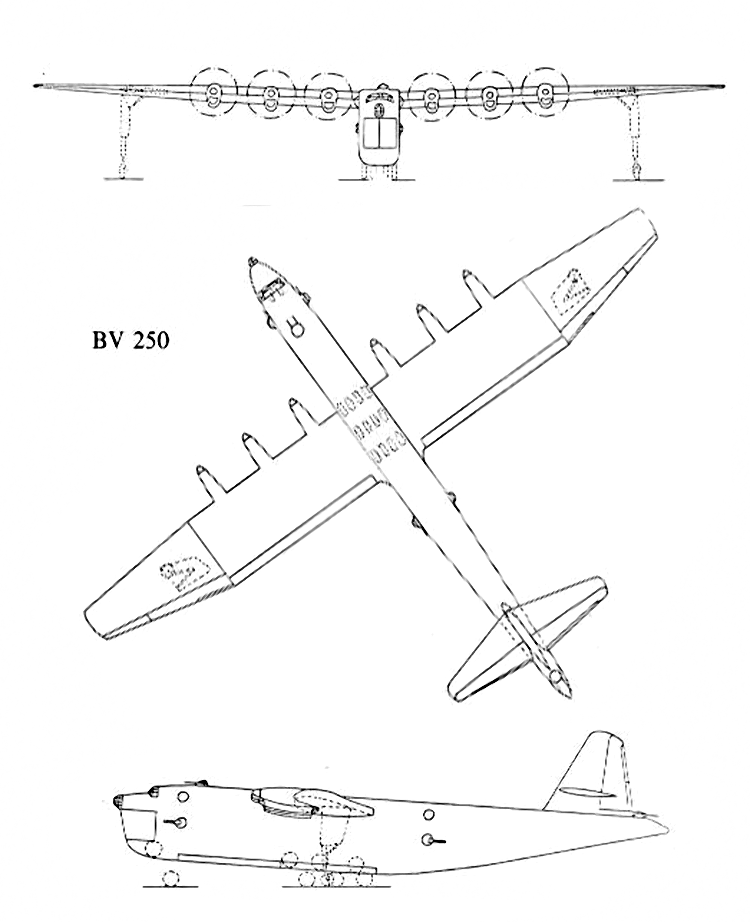 BV.250 |