
The career of the Curtiss C-46 Commando was quite successful, yet it always remained in the shadow of the smaller, more popular Douglas C-47 Skytrain. For many years, the C-46 was plagued by rumors of unreliability. Many American veterans recall the C-46 only in connection with aircraft explosions during takeoff, attributing them to an unreliable fuel system.
However, there is another memory of the C-46. It proved to be an absolutely essential transport for ferrying goods across the Himalayas to China. After the war, it operated for a long time in countries such as Chile and Japan.
The Birth of an Aerial Giant
The CW-20 project, later designated C-46, was very expensive even for the Curtiss company. Development began in 1936 under the leadership of George A. Page, with the goal of creating a new airliner to replace the Curtiss Condor and other biplanes.
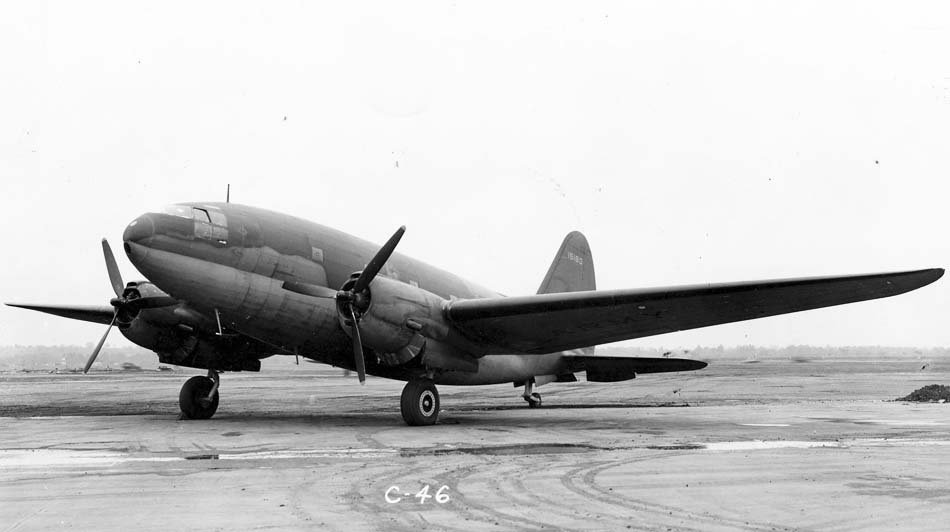
At this time, the Douglas DC-3 was already flying for American Airlines and other companies, but Curtiss gambled on a faster, higher-capacity aircraft. It was equipped with two 18-cylinder Pratt & Whitney R-2800-17 Double Wasp engines, each rated at 1650 hp. Designers engineered the machine with a fuselage whose cross-section was formed by two conjoined semicircles, making the aircraft appear double-decked.
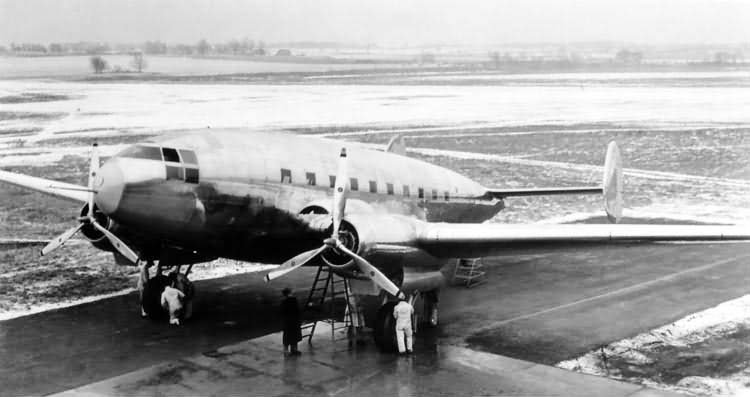
The twin-tailed prototype, featuring stabilizers with vertical endplates and a transverse V, was powered by two Wright R-2600 Twin Cyclone radial engines delivering 1700 hp each, and was built at the Curtiss factory in St. Louis. Its maiden flight occurred on March 26, 1940, with Edmund T. Allen as the crew commander. Curtiss announced the new model on April 11.
The aircraft received a new purpose on December 7, 1941, following the Japanese attack on Pearl Harbor. The design’s military potential was evident, but now it became paramount. A modification of the original prototype, featuring a straight stabilizer and a single vertical tail, along with minor improvements, was evaluated by the U.S. Army under the designation C-55. This C-55 was then transferred to the British Overseas Airways Corporation (BOAC), which used the aircraft for communication between Gibraltar and Malta until its decommissioning in October 1943 due to a lack of spare parts. Thus, the CW-20 went into production as the C-46 Commando.
The cargo compartment could accommodate 40 fully equipped soldiers, 33 wounded on stretchers, five Wright R-3350 engines, or an equivalent mass of cargo. Loading and unloading operations were not easy, as hinged fuselage tips, lowering ramps, or rollers in the cabin floor simply did not exist at the time.
In September 1940, when the U.S. Army ordered 200 C-46s, cabin pressurization was abandoned. Designers had a number of problems to solve, but the main one — leaky wing tanks — had not yet manifested.
The first C-46 entered the Air Force on July 12, 1942, by which time the U.S. had been at war for eight months. Production was moved to the Curtiss plant in Buffalo, New York. The original order was revised upwards, which was the first step towards a series of 3181 Commandos.
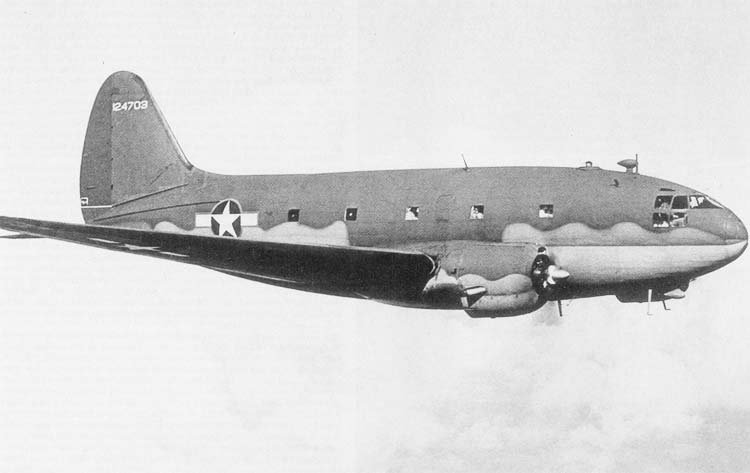
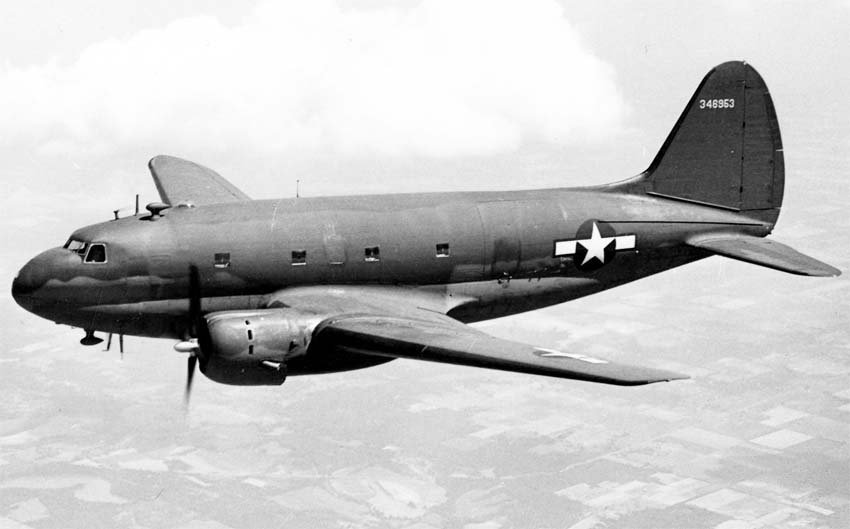
Adapting the aircraft to military requirements proved complex. Only after the 25th machine was assembled did the C-46A appear, featuring a large side door, a reinforced cargo compartment floor, and folding seats.
Curtiss had to modify its production program and build a new plant in Louisville, Kentucky. The workshops were equipped with air conditioning; climate control was required for working with plywood, as Curtiss planned to build entirely plywood C-76 Caravan cargo planes.
When the C-76 project was abandoned, the C-46 series production was shifted back to Buffalo, although some quantity was still produced in St. Louis. The new Louisville plant also joined the construction of the C-46.
The U.S. Army Air Forces also planned to utilize the capacities of “Higgins Industries, Inc.” in New Orleans, Louisiana, to build 500 C-46As and 500 C-76s. In reality, Higgins built only two C-46As, the first of which was delivered to the customer on October 1, 1944.
Curtiss returned to the XC-46B, a single conversion of the C-46A developed to evaluate a project with a stepped pilot cockpit windshield, equipped with R-2800-34W radial engines delivering 2100 hp. The company also built the C-46D, which received two cargo doors and differed from its predecessors by its engines. Seventeen C-46Es were built with a protruding cockpit and three-bladed (instead of four-bladed Curtiss Electric) Hamilton Standard propellers. The C-46F was a further development of the Commando, which was outwardly more similar to the earlier variants.
The AC-46K project was designed for a variant with 2500 hp Wright R-3350-BD radial engines. Single C-46G and XC-113 models (originally designated XC-46C) were used for engine testing; the XC-113, in particular, was a conversion of a C-46G to test the General Electric TG-100 turboprop engine installed in the right nacelle. Three XC-46L conversions, delivered in 1945, were fitted with more powerful Wright R-3350 radial engines.
The C-46 in Active Service
Within a few months of entering service, a fatal flaw was discovered in the C-46: leaky wing tanks, which sometimes led to explosions. Marine Corps aircraft (R5C) were used for cargo transport in the Southwestern Pacific. The culmination of the C-46’s career was the ferrying of millions of pounds of cargo, primarily for Chinese Nationalist forces.
Only C-46s were capable of flying very long distances – from India to China across the Himalayas. In the postwar years, a large number of C-46s were dispersed among civilian airlines, while some remained in the U.S. Air Force and the air forces of several U.S.-friendly countries, including China, South Korea, and Japan. Japanese command considered the C-46 extremely valuable for the country’s defense. In the 1950s, Japanese Commandos flew wing-to-wing with U.S. Air Force C-46s stationed in Japan.
The Curtiss C-46 Commando became particularly popular due to mass transports from Assam, India, to southwestern China. Flights across the Himalayas were performed by aircraft of the Indochina Air Wing of the U.S. Air Transport Command, led by Colonel Edward X. Alexander.
Flight preparation and loading were carried out under unprepared conditions; even fuel was poured into tanks manually from barrels. During the half-year monsoon season, Assam airfield turned into a swamp. On the 800 km route between Assam and Kunming, C-46 aircraft had to fly over mountains 3600-4300 m high, while wing icing began at just 3000 m.
In August 1942, several C-47 Skytrains managed to deliver only 85 tons of cargo from India to China. By December 1943, the same number of C-46s had transported an impressive 12,590 tons.
Shortages of spare parts, constant aircraft overloading, flights in difficult weather conditions at low temperatures with minimal navigation support—these were the harsh realities in which C-46 crews provided vital transport for Chiang Kai-shek’s troops and General Claire Chennault’s 14th Air Force. Several C-46s were shot down by Japanese fighters. In turn, Captain Wally E. Goude shot down a Nakajima Ki-43 “Oscar” with fire from a BAR rifle, firing through the cockpit window and killing the Japanese pilot.
C-46 aircraft were widely used in other theaters of war as well. Approximately 40 machines were delivered to the U.S. Marine Corps under the designation R5C-1 Commando. Initially, these aircraft were used by the 35th Marine Aircraft Group in the Southwestern Pacific, operating from primitive airfields on islands that lacked solid paving or had surfaces made of perforated metal sheets. Later, several Commandos, including R5C-1T trainers, were acquired by U.S. Navy aviation.
C-46s remained in service with the U.S. Army Air Forces until the end of World War II, playing a significant role in the Air Transport Command. Some aircraft were used for glider towing. C-46s were extensively used during combat operations in Korea, where Marine Corps R5C-1s also participated.
Legacy and Post-War Service
In the U.S. Air Force, C-46s were operated until the 1950s. The Air Force also involved the civilian company “Civil Air Transport” (CAT) for military transports, whose civil-registered aircraft flew to various locations, including Korea and Japan. An anti-guerrilla variant of the C-46 was developed in the early 1960s for the U.S. Air Force’s 1st Special Operations Wing; the aircraft was intended for operations in South Vietnam.
C-46s were also used in the Panama Canal Zone and served with U.S. Air Force Reserve units and Air National Guard aviation until June 1968.
The armed forces of Japan and South Korea used the C-46 until the late 1960s. Several aircraft from CAT and “Continental Air Services” performed complex and risky flights into Laos on behalf of the U.S. CIA. One civilian C-46 pilot on such a flight was captured by a Pathet Lao detachment and remained imprisoned for several years.
The C-46’s military career concluded in Southeast Asia; however, in a number of countries, the aircraft remained in service for several more years. The C-46 found a second life in civil service, particularly in Latin America, often configured as a 33-seat passenger aircraft with R-2800-43 engines. Designed on the eve of the war as a luxury airliner, the aircraft ended its aerial life as a mundane “truck.”
Technical Specifications
| Modification | C-46A |
| Wingspan, m | 32.91 |
| Length, m | 23.26 |
| Height, m | 6.62 |
| Wing area, m2 | 126.34 |
| Empty weight | 13608 |
| Normal takeoff weight | 29412 |
| Engine type | 2 Piston engine Pratt Whitney R-2800-51 |
| Power, hp | 2 x 2000 |
| Maximum speed, km/h | 435 |
| Cruising speed, km/h | 278 |
| Practical range, km | 5069 |
| Combat range, km | 1931 |
| Practical ceiling, m | 8410 |
| Crew | 3 crew |
| Payload | 54 soldiers |
Image and diagram gallery of the C-46 Commando
 C-46 Commando |
 C-46 Commando |
 C-46 Commando |
 C-46 Commando |
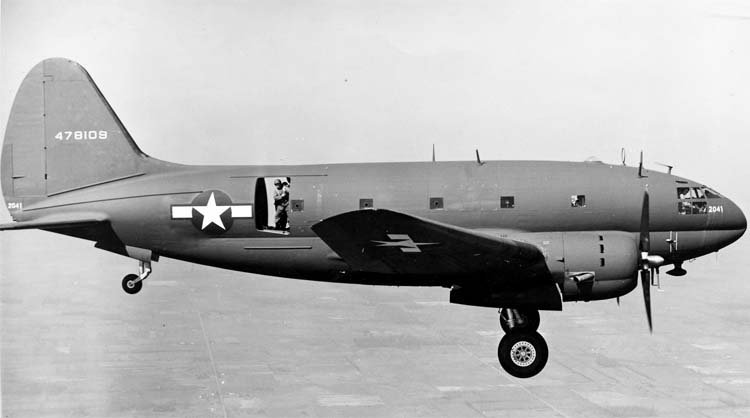 C-46 Commando |
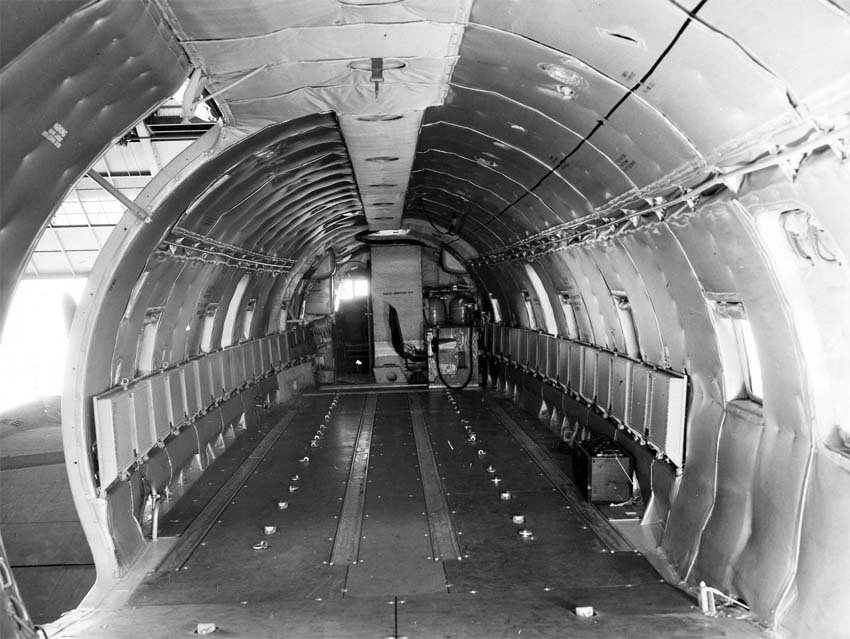 C-46 Commando |
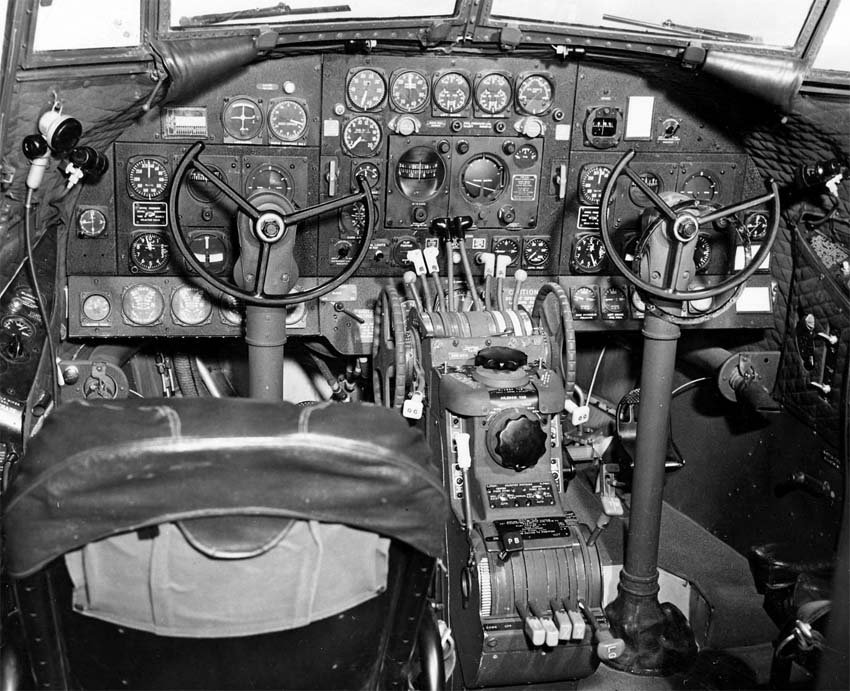 C-46 Commando |
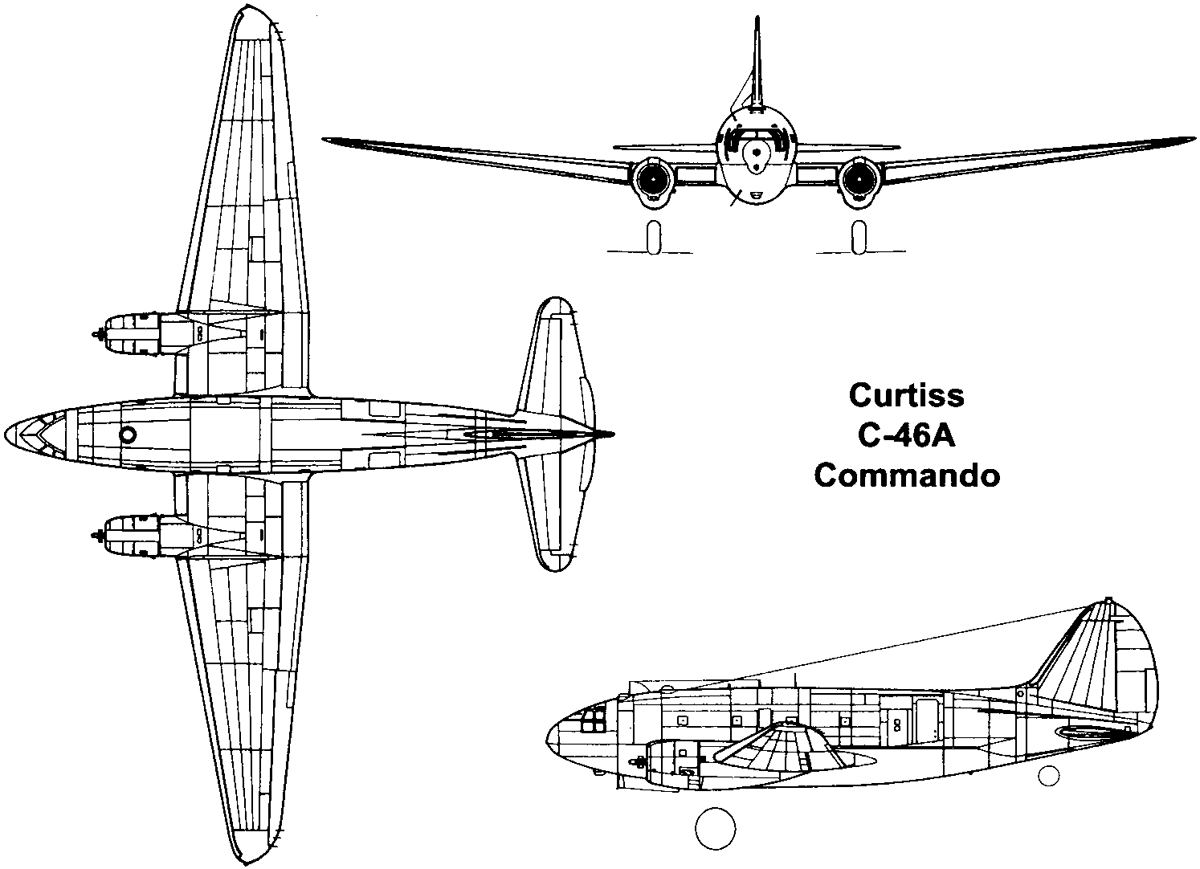 C-46 Commando |
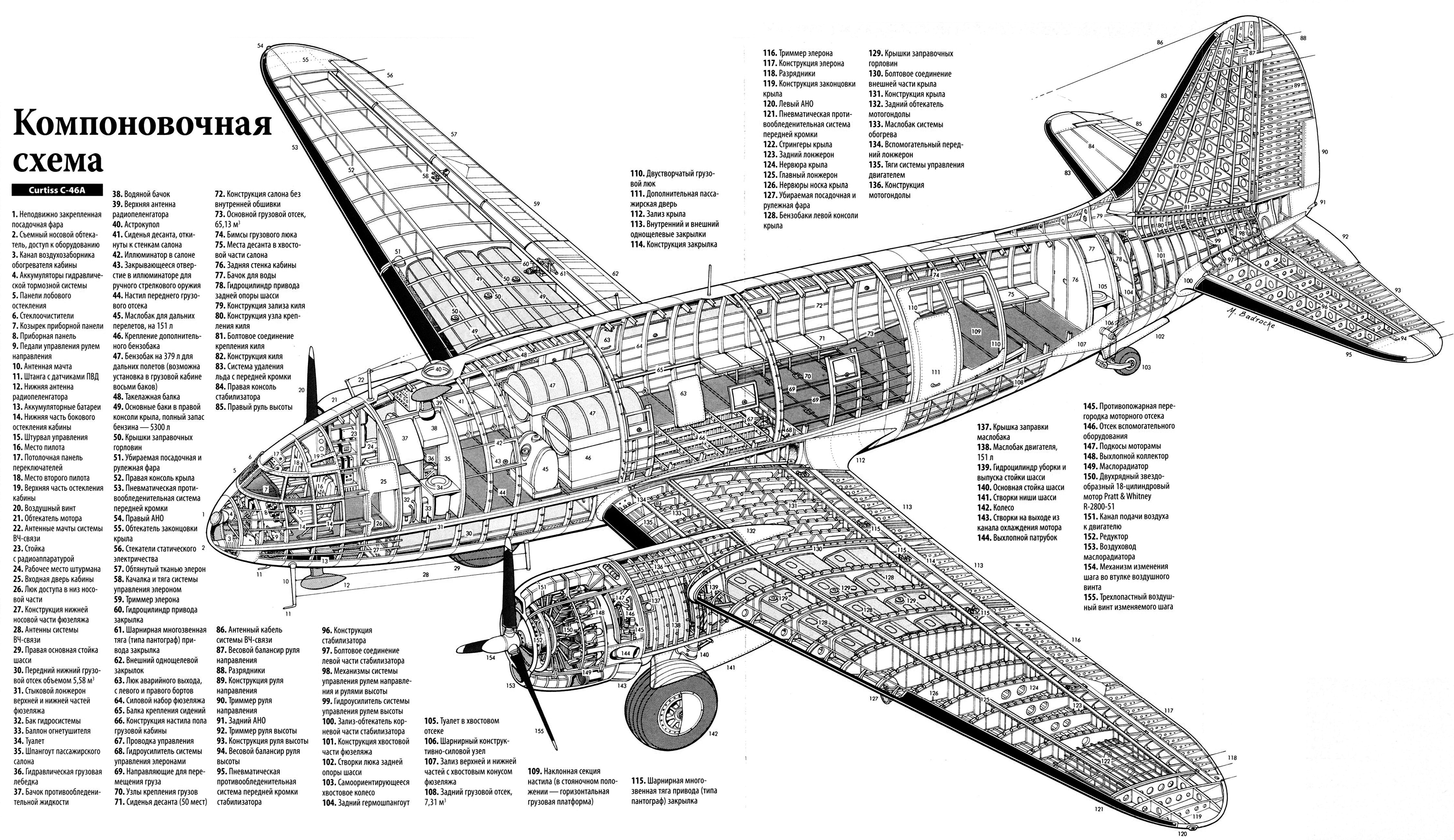 C-46 Commando |
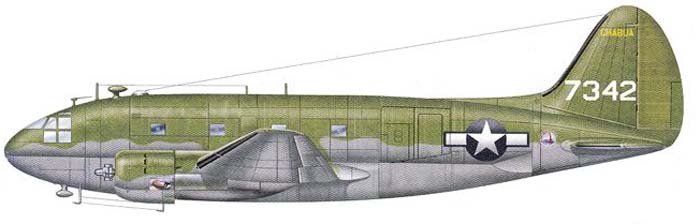 C-46 Commando |
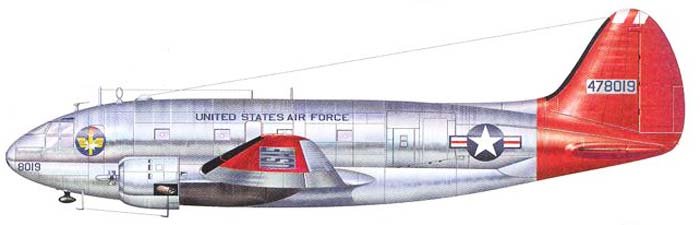 C-46 Commando |