
The Be-12P is a firefighting aircraft developed at TANTK G.M. Beriev, based on the Be-12 anti-submarine amphibious aircraft. During its design for extinguishing forest fires, its ability to quickly fill special tanks with water was utilized. This was achieved using a scooping device, hydroplaning on the surface of suitable bodies of water.
The firefighting aircraft was created under the leadership of Deputy General Designer V.F. Ponomarev of TANK, based on a Be-12 obtained from naval aviation. Bombing armament and other equipment were removed from the aircraft. A 4500-liter tank was installed in the cargo compartment, and two tanks with a total capacity of 1500 liters were placed in the nose section. A system for scooping water from a reservoir, its discharge, and equipment for water refueling at an airfield were also installed.
When hydroplaning on the water surface at a speed of 120 km/h, a full water refill took up to 50 seconds. Once loaded, the water could be dropped on fire sites located up to 100 km away from the water source.
The first demonstration of the Be-12P took place at the MosAeroShow in Zhukovsky in September 1993. It performed quite well in extinguishing forest fires in various regions of the country. This performance demonstrated its advantages over other types of aircraft.
Innovations in the Be-12P-200
During the creation of the new multi-purpose amphibious aircraft Be-200, whose basic variant was intended for forest fire extinguishing, TANTK G.M. Beriev tackled a complex set of design problems. It was essential to create a fire equipment system that would experience minimal loads in the pipelines during water scooping while hydroplaning. Furthermore, it needed to ensure tanks were filled at aircraft speeds that created minimal loads on the aircraft’s underside. This resulted in reduced fuel consumption and preserved engine and structural lifespan, shortening water intake time to 12-20 seconds. To test this system, the Be-12P-200 flying laboratory was created.
A production Be-12 aircraft (factory number 8601301) was taken for the conversion. Y.G. Duritsyn was appointed as the lead designer for the Be-12P-200. The work was carried out at TANTK from August 1994 to June 1996.
Two 6 m³ tanks were installed in the fuselage of the Be-12P-200. Each is divided into two equal parts and has flaps for water discharge and drainage channels leading to the right and left sides of the aircraft’s hull. Onboard the aircraft, control and measuring equipment, targeting equipment for water discharge, and instruments for assessing the environment in the fire zone and the presence of floating objects in the landing area were also installed.
The first flight of the Be-12P-200 was performed on August 9, 1996, by lead test pilot K.V. Babich. Tests continued until October 1996. During these trials, 37 water scooping and discharge modes were performed.
Capabilities and Operation
The Be-12P-200 amphibious aircraft is capable of scooping 4.5 to 6 tons of water while hydroplaning in 15-20 seconds, with a maximum wave height of 0.8 meters. The amphibious aircraft can refill its firefighting system tanks from seas, lakes, and rivers at hydroplaning speeds close to takeoff speeds. The possibility of refueling firefighting equipment tanks from ground sources, under airfield basing conditions, is also provided. In a single refill, the aircraft can deliver and drop up to 140 tons of water into a forest fire zone. The aircraft has proven to be an effective tool for both spot and widespread fires and can also create a barrier against fire spread in windy conditions.
The aircraft is equipped with a complex of flight-navigation and communication equipment ensuring navigation and flight control at all stages, in any weather conditions, at any time of the year, and day or night.
The Be-12P-200 amphibious aircraft’s powerplant, based on AI-20D turboprop engines, allows for its operation in hot climatic conditions (with air temperatures up to +45°C).
At the customer’s request, additional foreign radio-navigation equipment can be installed on the aircraft. This equipment is designed for flights on international air routes and in lower airspace, day and night, in simple and complex weather conditions, performing visual approaches, via OSP, VOR/DME, or ILS. The crew cabin is not pressurized, so for en-route flights, altitudes up to 4000-4500 meters are used. However, all aircraft systems allow for flight at altitudes up to 8000 meters, provided all crew members are supplied with oxygen.
The Be-12P-200 amphibious aircraft holds an “Experimental Aircraft Airworthiness Certificate.” In case of sale to a foreign customer, permission from the official authorities of the customer’s country is required for aircraft operation.
The installation of additional firefighting, flight-navigation, and communication equipment is possible, enabling international flights.
Between 1996 and 2000, the aircraft was successfully operated in extinguishing forest fires in the Krasnodar, Khabarovsk, and Stavropol Krais, as well as in the Irkutsk, Ivanovo, and Rostov Oblasts, and along the Black Sea coast of the Krasnodar Krai.
Technical Specifications
| Modification | Be-12P-200 |
| Wingspan, m | 29.84 |
| Aircraft length, m | 30.11 |
| Aircraft height, m | 7. 40 |
| Wing area, m2 | 99.00 |
| Empty weight | 24000 |
| Normal takeoff weight | 34500 |
| Maximum takeoff weight | 36000 |
| Fuel | 9000 |
| Engine type | 2 Turboprop Progress AI-20D |
| Power, hp | 2 x 5180 |
| Maximum speed, km/h | 540 |
| Cruising speed, km/h | 460 |
| Practical range, km | 3570 |
| Combat radius, km | 500 |
| Practical ceiling, m | 8400 |
| Crew | 4 |
Image and diagram gallery of the Be-12P Chaika
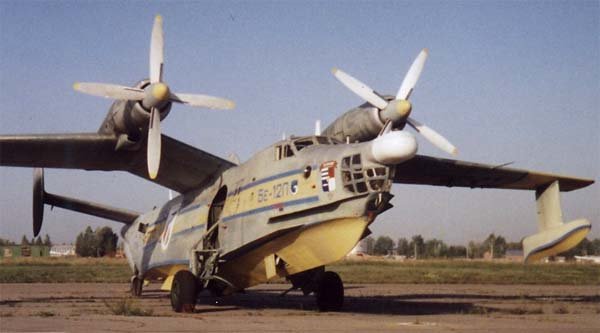 Be-12P Chaika |
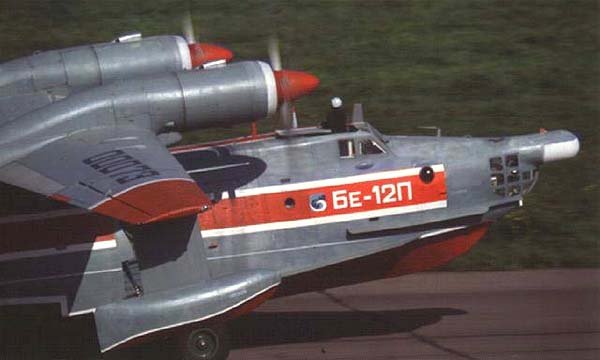 Be-12P Chaika |
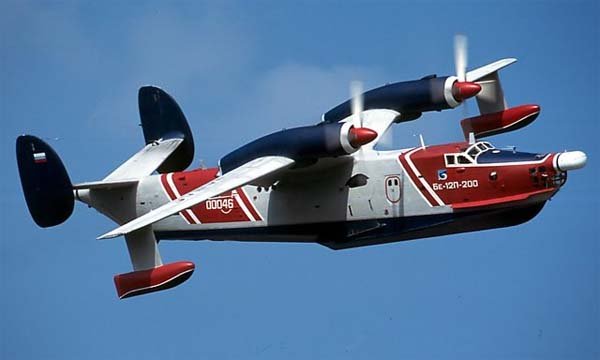 Be-12P Chaika |
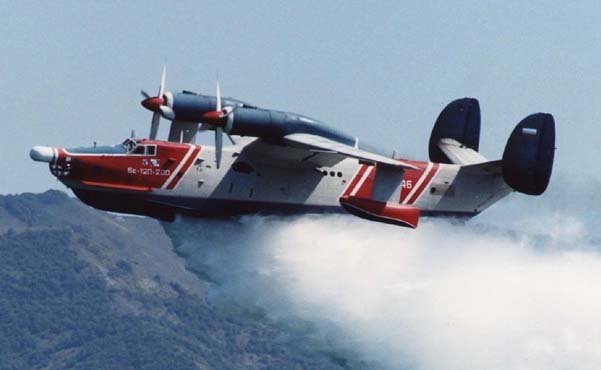 Be-12P Chaika |
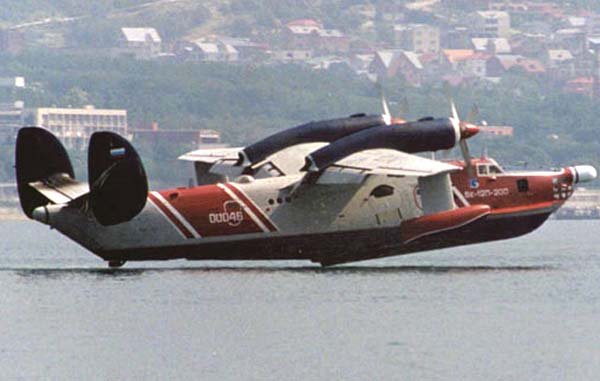 Be-12P Chaika |
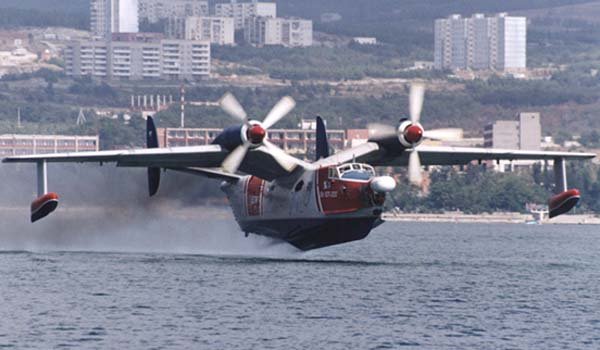 Be-12P Chaika |
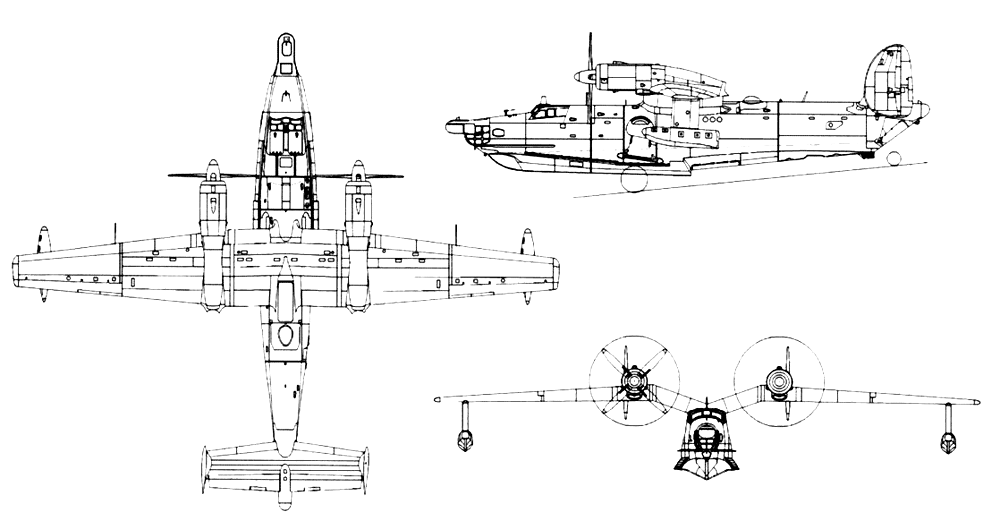 Be-12P Chaika |
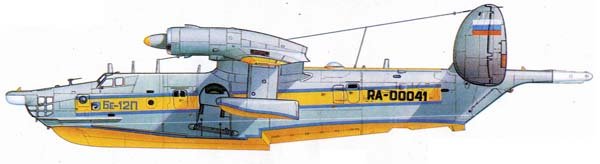 Be-12P Chaika |