
Since the Wright A and Voisin-Farman I carried the first passengers in 1908, many designers and businessmen attempted to organize regular commercial air transport. However, the imperfect design of early airplanes and the lack of ground infrastructure delayed the realization of this idea for several more years.
These years were not wasted. Aircraft and engine durability and reliability significantly improved, and equipped airfields emerged. An aviation industry developed, and serial production of airplanes began. Experience in mail and cargo transport was gained (e.g., Bleriot XI, Humber-Sommer, Wright B). By 1914, aviation was well-prepared to open passenger lines, needing only the right route.
Choosing a route was challenging. Aviation developed most in countries with dense land and water communication networks. Aircraft couldn’t compete in comfort, despite emerging closed-cabin models like the Avro Type G, Bleriot XXIV, Rumpler Taube limousine, Russian Knight, and Igor Sikorsky’s Ilya Muromets. Airplanes also lacked significant speed advantages but could shorten distances between points A and B by overcoming obstacles inaccessible to other transport types.
The first to find a suitable route was Floridian entrepreneur Percival Elliott Fansler. In November 1913, he proposed an air link between St. Petersburg and Tampa. A straight line covers 29 kilometers, but Tampa Bay separates them. A 12-hour train journey around the winding bay, a 2-hour sea trip, or an over-day car ride due to poor roads contrasted with a promised half-hour flight. This led to the St. Petersburg-Tampa Airboat Line’s creation on December 4, 1913, with aircraft provided by designer Thomas Wesley Benoist (1874-1917).
St. Louis engineer and businessman Thomas Benoist began serious aviation work in 1908, previously in the automotive business. In summer 1912, Benoist started building seaplanes, beginning with the float-equipped Benoist XII. Simultaneously, Benoist’s first flying boat, the Benoist XIII, was constructed in St. Louis, with Hugh Robinson, formerly of Glenn Curtiss, involved in its design. The Benoist XIII made its first flight in December 1912.
Its design differed significantly from popular flying boats by Curtiss, Burgess, and Donnet-Leveque. The Roberts engine was installed within the hull, not between the wings, driving a pusher propeller via a chain. Its low center of gravity ensured stability and good maneuverability on water. The two-seat cockpit, though open, was well-protected from sea spray and wind by the hull’s shape, making it one of the most successful flying boats of its time.
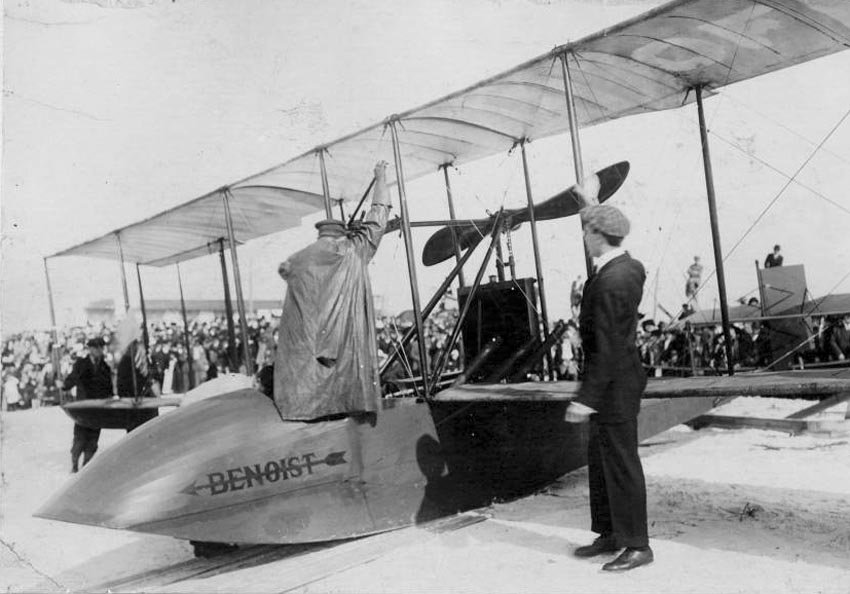
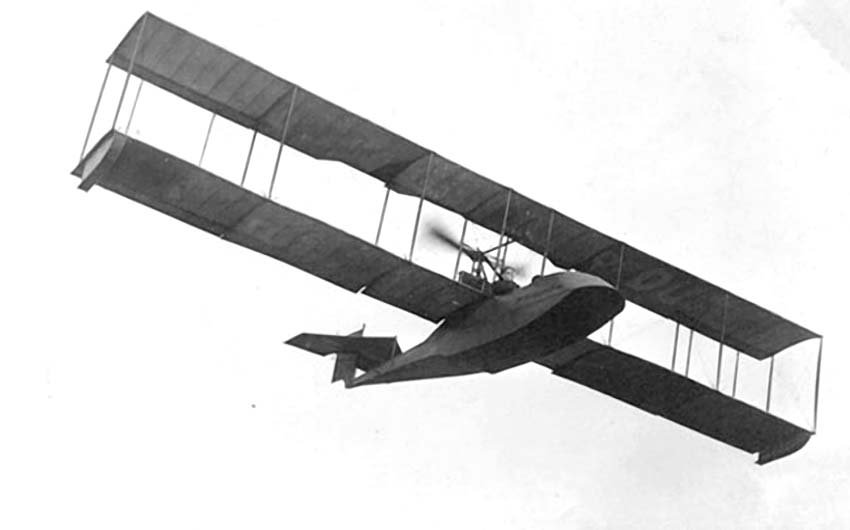
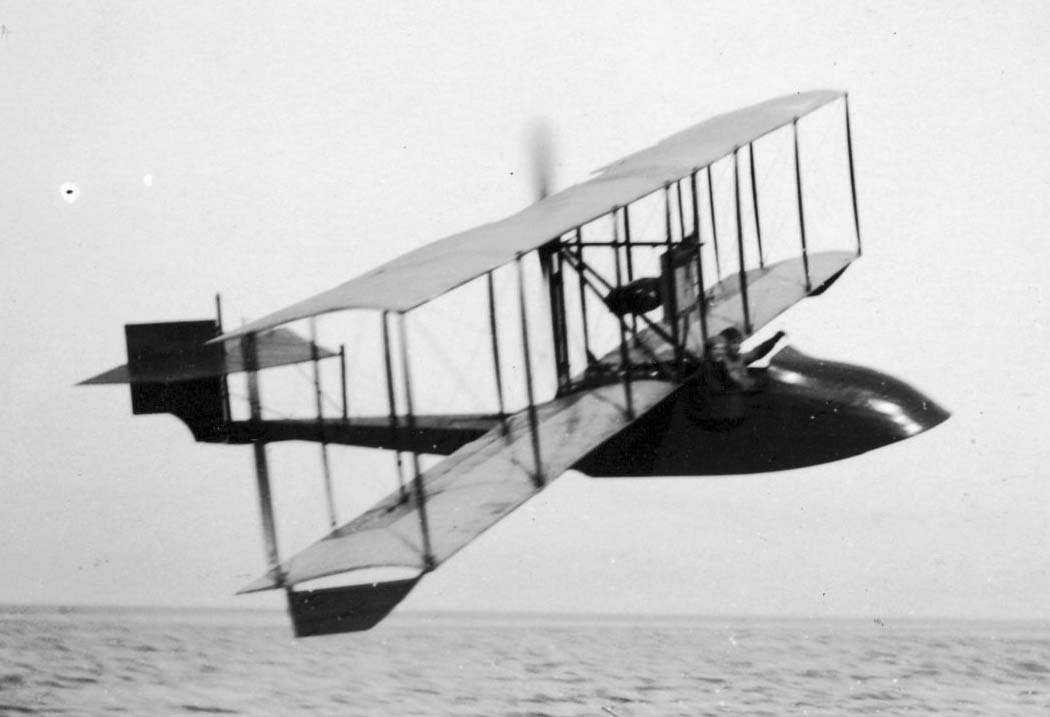
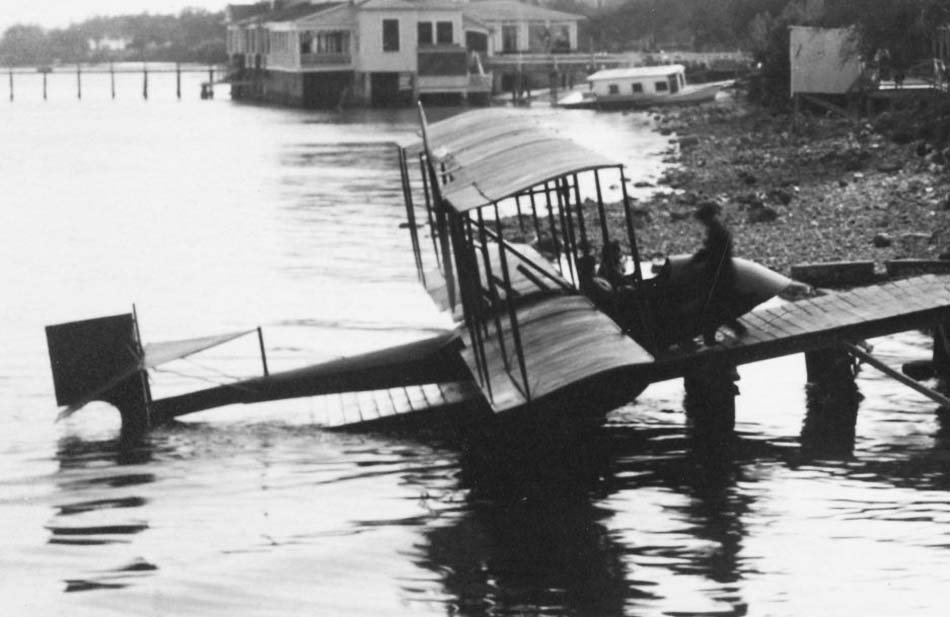
In summer 1913, a larger flying boat, the Benoist XIV, was created. The machine, serial number 43, first flew on June 25, 1913, later named “Lark of Duluth.” This aircraft caught Fansler’s eye for his St. Petersburg-Tampa line. On December 17, 1913, Fansler, on behalf of St. Petersburg’s municipality, contracted Benoist for two Benoist XIVs for the line and one Benoist XIII for pilot training. Benoist’s firm also supplied pilots and mechanics, with the municipality funding operations. The aircraft arrived in St. Petersburg in late 1913, housed in an “Aero School Benoist” hangar, ready for service.
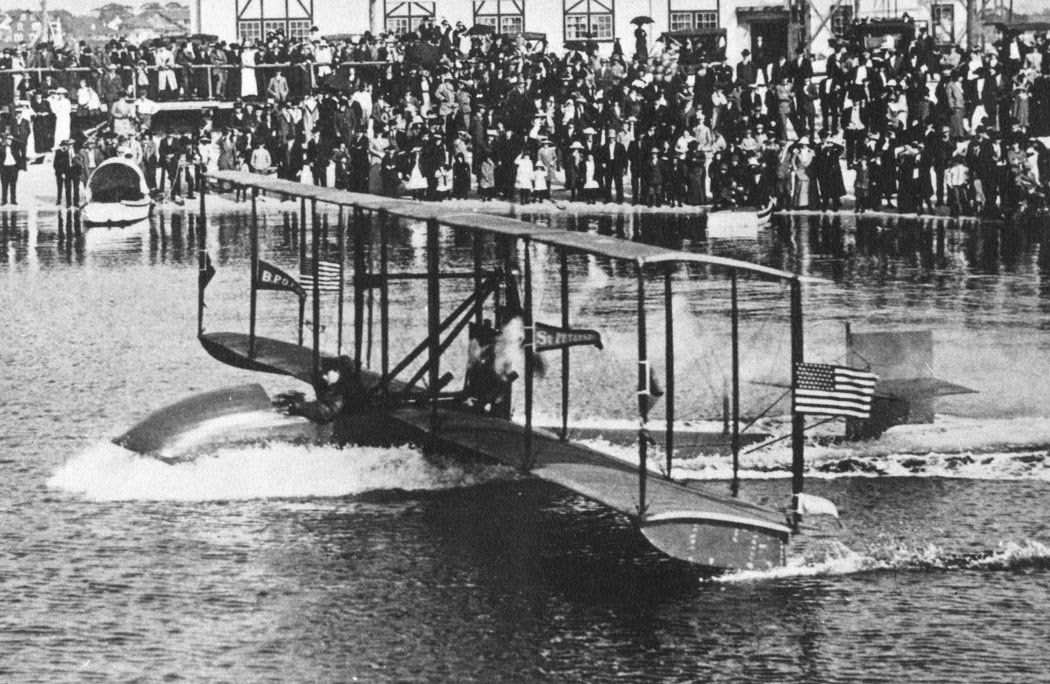
The line opened on January 1, 1914. The first ticket was auctioned for a then-fantastic sum of $400 to former St. Petersburg mayor A.C. Pheil. The aircraft departed St. Petersburg at 10:00 local time, arriving in Tampa 23 minutes later.
Pioneering Scheduled Flights
Regular flights ran daily, twice in both directions. The first flight from St. Petersburg departed at 10:00, with the return from Tampa at 11:00. Second flights started at 14:00 and 15:00, respectively. All flights were piloted by Benoist’s chief pilot, Anthony Jannus.
Tickets cost $5, including transport of small luggage. Passengers exceeding 200 pounds (91 kg) with luggage paid 5 cents for each additional pound (450 g). For $5, one could send cargo up to 200 pounds instead of traveling. While the direct distance was 29 kilometers, the actual route was 37 kilometers, as the aircraft had to skirt a peninsula in Tampa Bay.
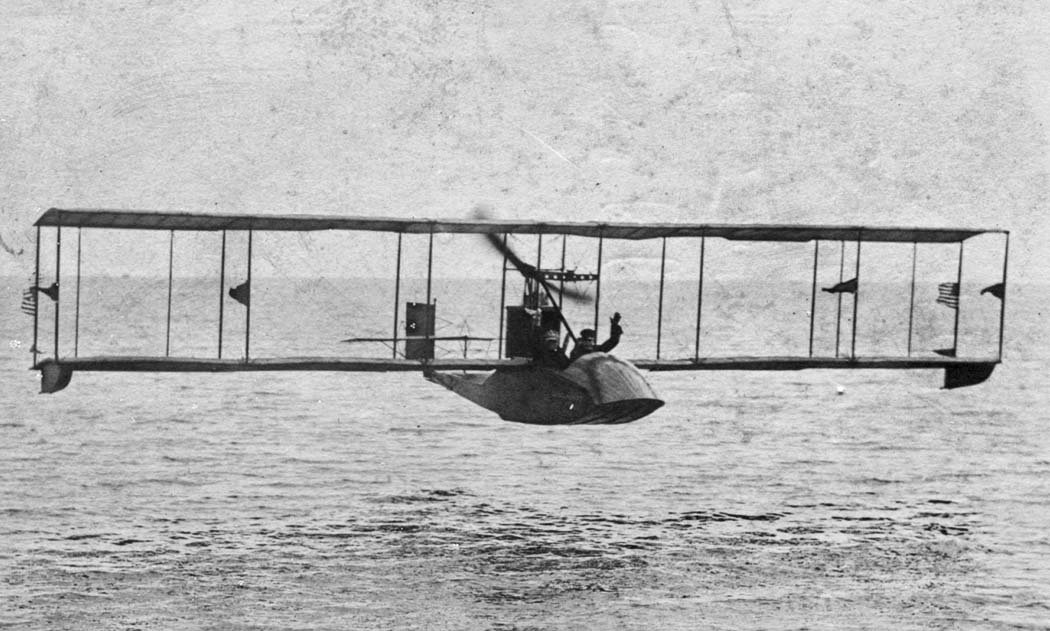
Travel time ranged from 18 to 26 minutes, four times faster than maritime vessels on the same route. Flights were conducted at a low altitude of about 200 meters.
Legally, the initial flights were unlicensed, as neither the aircraft nor its pilot possessed passenger transport licenses. Marine inspection officials, then responsible for such permits, only took notice on January 7. However, they did not impede operations, and after a thorough inspection, issued a temporary license.
In its first month, the airline repaid a $5,360 debt to the city and turned a profit in February and March. Primary clients were tourists from northern states seeking Florida’s warmth to escape winter. The stable demand for air travel was not just about saving time; many purchased tickets for the sheer experience of flight.
In February, a second aircraft, “Florida” (serial number 45), joined the line. This model featured a larger wingspan of 13.72 meters, a more comfortable cabin, and increased baggage space.
This aircraft was piloted by Roger Jannus, Anthony Jannus’s brother. Besides operating the regular line, both Jannus brothers also worked at the Benoist Flying School in St. Petersburg.
The line’s contract, set for three months, expired on March 31, 1914. During this period, 1,204 passengers were transported across 172 regular flights. Only 4 (or 8, by another account) days were missed due to inclement weather or technical malfunctions, primarily related to the engine and propeller chain drive.
In April, the airline continued carrying passengers independently, without city subsidies. However, a decrease in tourism, growing losses, and rumors of a potential war with Mexico led to the cessation of further operations. The last flight took place on May 5, 1914. During its existence, the aircraft covered 17,700 km without serious flight incidents.
Benoist XIV’s Legacy and Design
The Benoist XIV operated on the line for only four months. Nevertheless, it demonstrated to the world that regular air transport was not only feasible but could also be profitable. Benoist’s example stimulated the work of other aviators. In the summer of 1914, two more passenger lines opened. One in California, using the Christofferson Model D, performed charter flights between Oakland and San Francisco, transporting around 7,000 people. On July 22, 1914, the first regular line in the United Kingdom opened with the Blackburn Type I, organized by Robert Blackburn between Leeds and Bradford. How events would have progressed is unknown if World War I hadn’t begun at the end of that same month.
Regarding the Benoist XIV model, both aircraft were sold to private individuals for demonstration flights across the U.S. “Lark of Duluth” crashed two months later on Lake Conneaut in Pennsylvania, while “Florida” reportedly operated until 1915.
The designer, Thomas Benoist, shifted to other projects. In early 1914, he began developing an aircraft for a transatlantic flight to win the Daily Mail prize. The Benoist 16 flying boat appeared in 1916, followed by the wheeled Benoist 17. His career was tragically cut short on June 14, 1917, when he was killed crossing a streetcar track in Sandusky, Ohio. Had it not been for this untimely death, new Benoist aircraft might still be produced today. Benoist Aircraft outlived its founder by only a few months, closing in early 1918 after building 106 aircraft.
The lives of the Jannus brothers were also tragically short. Anthony worked for Curtiss for some time before joining the Sevastopol Flying School. On October 12, 1916, his Curtiss K engine failed, and the machine spiraled into the Black Sea; his body was never recovered. Roger survived his brother by only two years, as the de Havilland D.H.4 he was piloting exploded in mid-air in September 1918.
The original airliners have not survived to this day. However, in 1984, to celebrate the 70th anniversary of this significant event, members of the Florida Aviation Historical Society built an exact replica of the Benoist XIV. The machine made a flight and was subsequently exhibited in the St. Petersburg History Museum. A new flight of the Benoist XIV was planned for 2014, the centenary of the first airline’s opening.
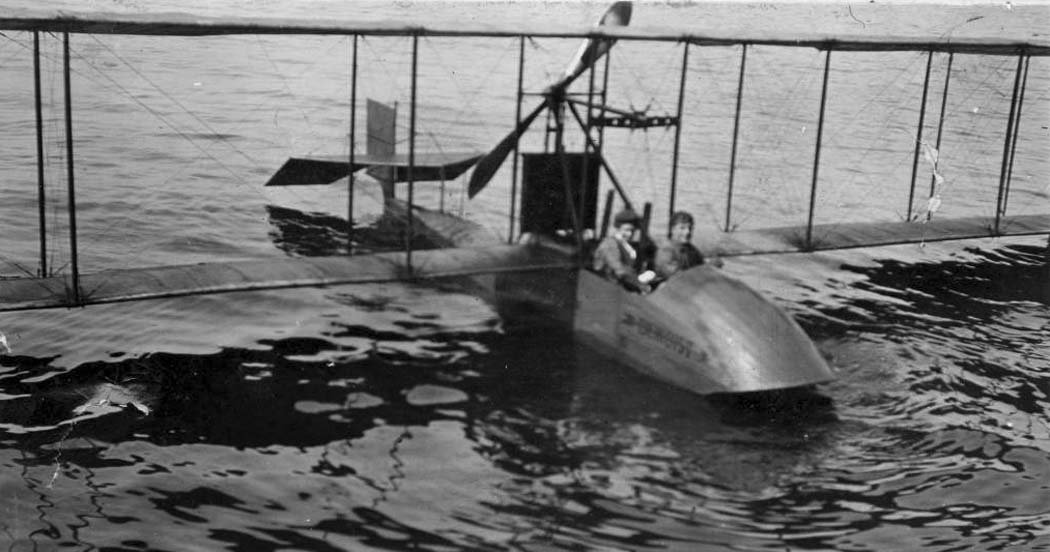
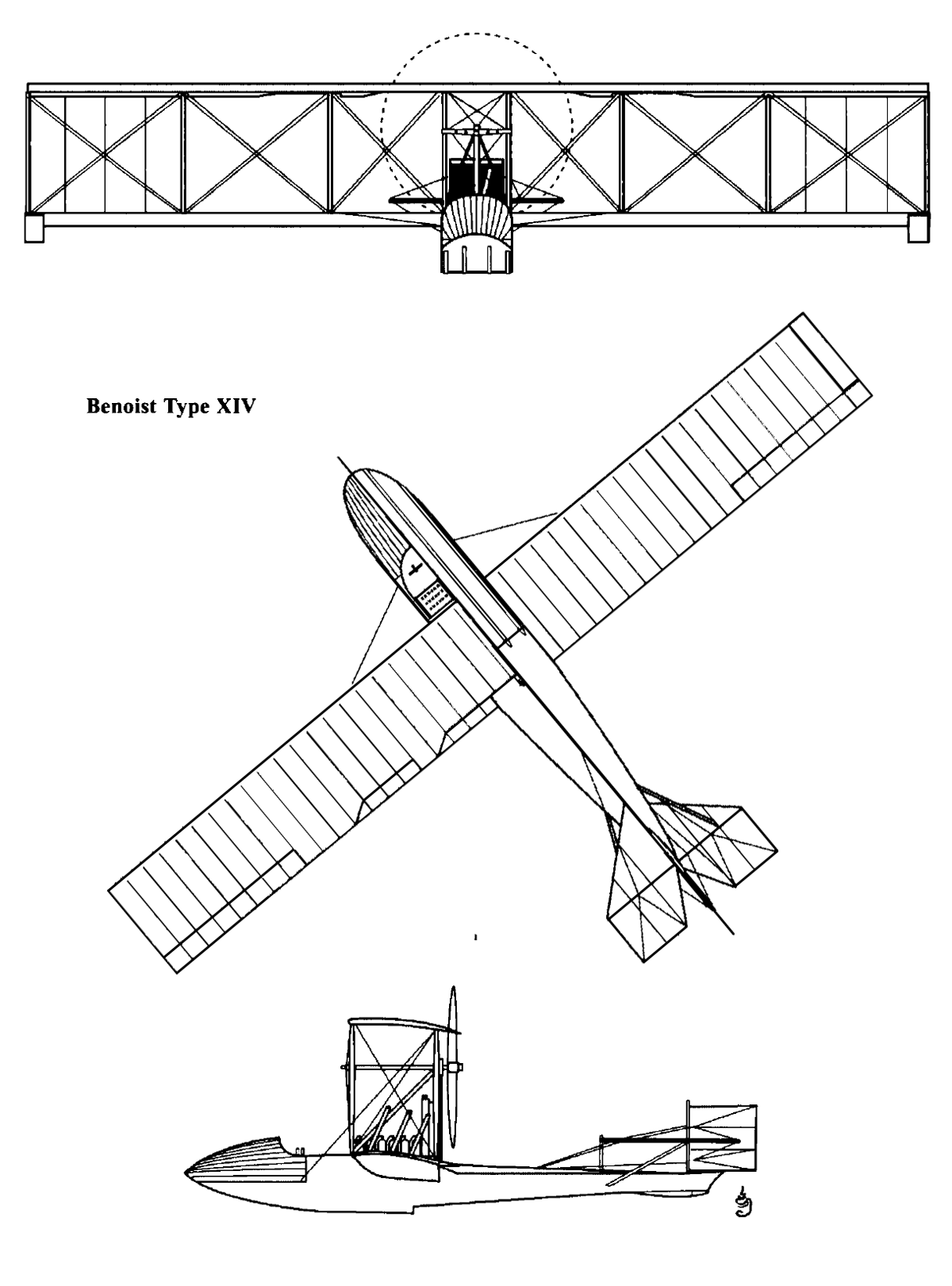
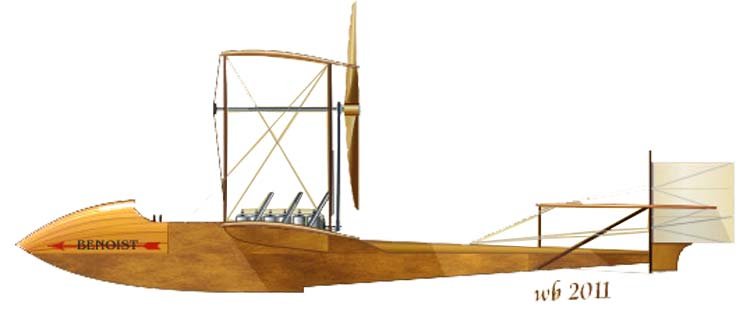
The Benoist XIV was a single-engine biplane flying boat of wooden construction with a conventional tail. The aircraft’s hull was rectangular, tapering towards the tail, and designed as a single-step boat with a flat bottom, measuring 7.01 meters in length. Its framework was spruce, covered with three-layer spruce plywood, with fabric between each layer. The front of the hull was enclosed by a cowling with a spruce stringer framework covered in canvas. Behind this was an open cockpit with two side-by-side seats, the pilot occupying the left. The engine was installed within the hull behind the cockpit.
It featured two rectangular wings of equal span, constructed with a wooden frame and covered in canvas. The ailerons were 2.43 meters long and 0.508 meters wide.
The aircraft’s powerplant consisted of a Roberts six-cylinder inline, two-stroke, liquid-cooled engine, producing 75 hp (55 kW), which drove a two-bladed wooden propeller.
The engine was secured to two parallel spruce beams in the hull’s bottom using bolts and tie rods. The 1.82-meter diameter two-bladed pusher propeller was mounted on a steel shaft, positioned between the upper and lower wings, 45.7 cm below the trailing edge of the upper wing. This shaft was affixed via radial and thrust bearings to bronze retainers. Power was transmitted from the engine to the propeller via a Diamond Chain with a 1:1 gear ratio; the chain length was adjustable. Fuel tanks were installed in the hull adjacent to the engine.
The horizontal empennage, comprising a stabilizer and elevators, was mounted above the tail section of the fuselage. The rudder was hinged to the fuselage. The empennage framework was wooden, covered in fabric. A portion of the rudder extended below the fuselage, serving as a water rudder during takeoff, landing, and taxiing.
The aircraft’s control system was cable-operated, with deflections managed by control sticks. The right stick controlled longitudinal and lateral stability, while the left stick managed the rudders.
Technical Specifications
| Modification | Benoist XIV |
| Wingspan, m | 13.72 |
| Length, m | 7.92 |
| Wing area, m2 | 38.65 |
| Empty weight | 540 |
| Maximum takeoff weight | 637 |
| Engine type | 1 Piston engine Roberts |
| Power, hp | 1 x 75 |
| Maximum speed, km/h | 129 |
| Cruising speed, km/h | 103 |
| Practical range, km | 80 |
| Service ceiling, m | 600 |
| Crew, crew members | 1 |
| Payload | 1 passenger or up to 91 kg of cargo |
Image and diagram gallery of the Benoist XIV
 Benoist XIV |
 Benoist XIV |
 Benoist XIV |
 Benoist XIV |
 Benoist XIV |
 Benoist XIV |
 Benoist XIV |
 Benoist XIV |
 Benoist XIV |