
Boris Ivanovich Cheranovsky began studying the potential of the “flying wing” scheme in 1921. In 1924, he built and flew his first research model, the BICh-1 glider. The BICh-1 wing had a parabolic shape, with a straight trailing edge occupied by elevons and flaps.
The pilot sat in a small gondola immediately behind the wing’s leading edge. There were no vertical control surfaces. It featured a single-wheel landing gear, with small stabilizing skids at the wingtips. The controllability of the BICh-1 glider proved unsatisfactory.
In 1924, a modified version, the BICh-2, was built with a vertical fin. This model successfully completed 27 flights.
Early Aircraft and Prototypes
Building on the experience gained from the BICh-1 and BICh-2 gliders, Cheranovsky then constructed a small aircraft with a parabolic wing, named BICh-3. This aircraft was fitted with a two-stroke engine, and the pilot sat further towards the tail in an open cockpit.
The cockpit featured a fairing that smoothly transitioned into the fin. Tests showed that the BICh-3 was not very stable but demonstrated good controllability.
Between 1927 and 1929, Cheranovsky continued developing aircraft based on the parabolic wing configuration. The most interesting of these was the military BICh-5 aircraft, powered by BMW VI engines.
A less “aggressive” design was the BICh-7, a tandem two-seater airplane from 1929, developed from the BICh-3 project. This model featured a 100 hp (75 kW) Bristol Lucifer engine, small rudders at the wingtips without fins, and a single-wheel landing gear with two outrigger struts.
Unfortunately, the BICh-7’s landing gear proved unsuccessful; the aircraft struggled to accelerate and was unable to take off.
The BICh-11: A Design Leap
Despite his long-standing interest in the parabolic wing shape, for the BICh-11 aircraft completed in 1932, Cheranovsky introduced a trapezoidal wing. This “tailless” BICh-11 initially flew as a glider at the 9th Glider Competitions in 1933.
In fact, the BICh-11 was developed for in-flight testing of F.A. Tsander’s OR-2 liquid rocket engine, which weighed 18 kg and had a thrust of 0.62 kN. This engine was intended to be installed behind the pilot’s cockpit.
The fuel and oxidizer tanks were planned to be integrated into fairings on the wing, on either side of the fuselage gondola.
The Rocket Engine and BICh-11’s Legacy
The OR-2 liquid rocket engine was test-fired on a stand on March 18, 1933, but ten days later, F.A. Tsander passed away. With him, the idea of installing the rocket engine on the BICh-11, which would have been named RP-1 (Rocket Glider-1), also vanished.
Subsequently, the BICh-11 was fitted with a Scorpion piston engine for further flight tests.
Technical Specifications
| Modification | BICH- 11 |
| Wingspan, m | 12.10 |
| Aircraft length, m | 3.25 |
| Wing area, m2 | 20.00 |
| Empty weight | 200 |
| Engine type | 1 Piston engine ABC Scorpion |
| Power, hp | 1 x 27 |
| Crew, crew members | 1 |
Image and diagram gallery of the BICh-11
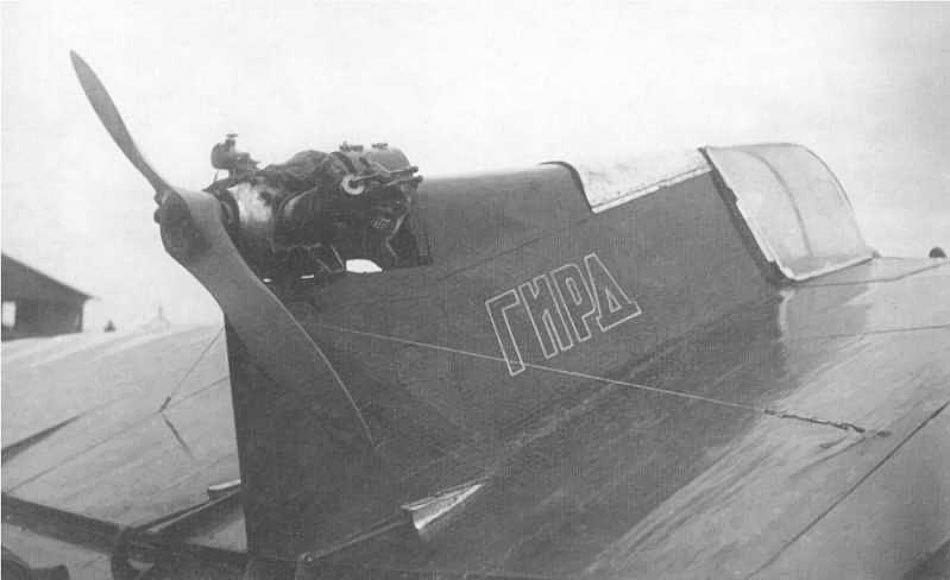 BICH-11 |
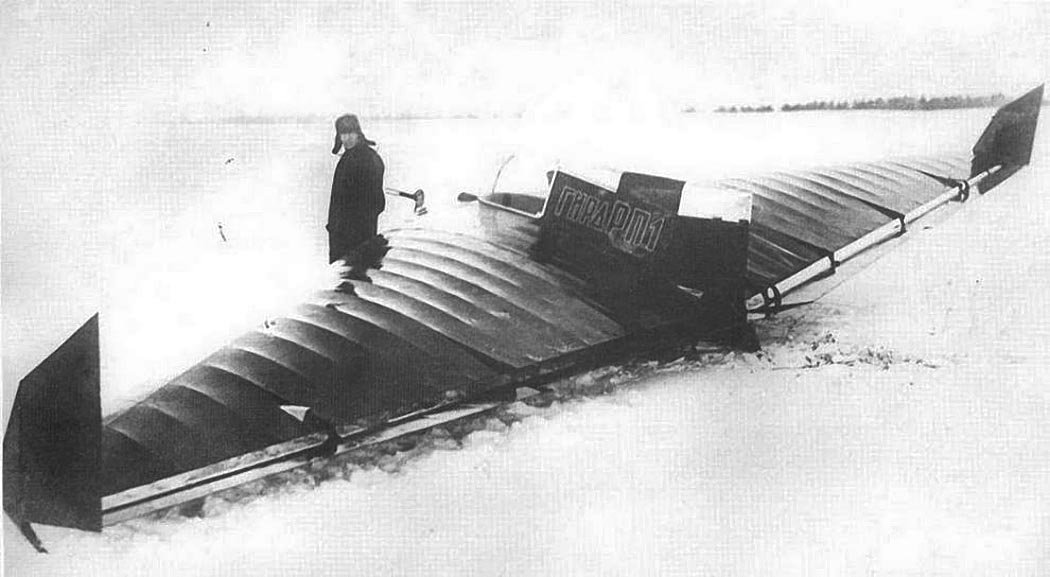 BICH-11 |
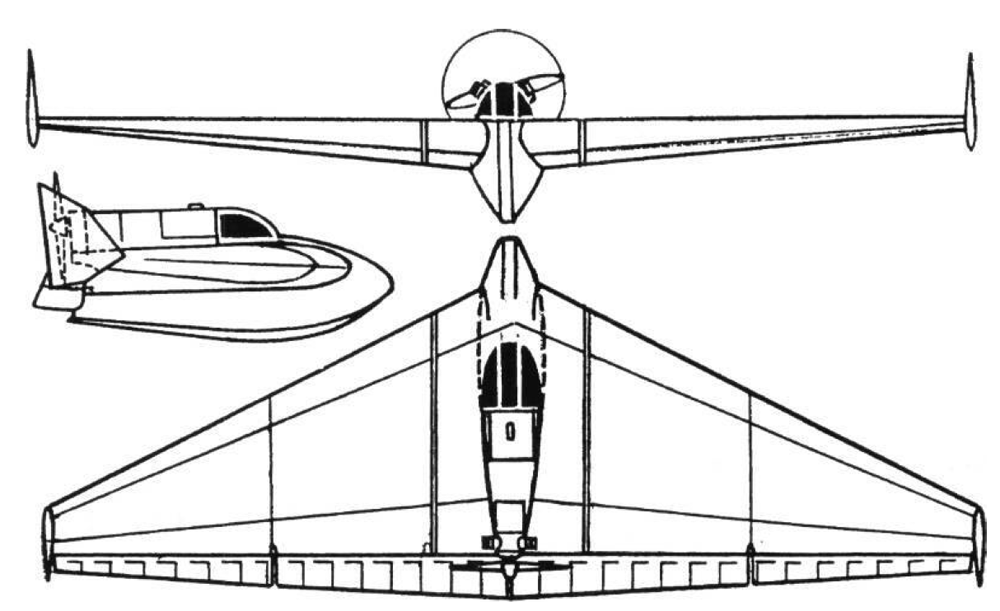 BICH-11 |
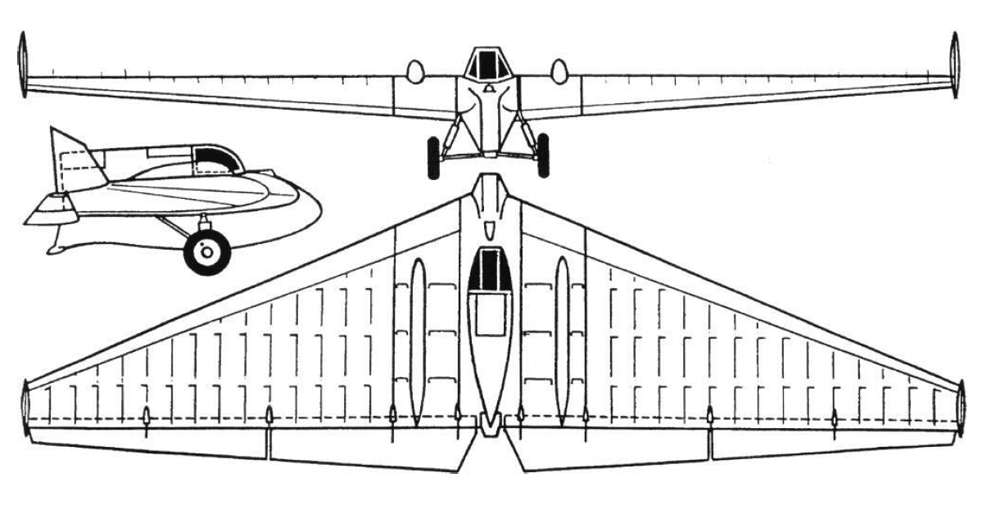 BICH-11 |