
Early Flights and Stability
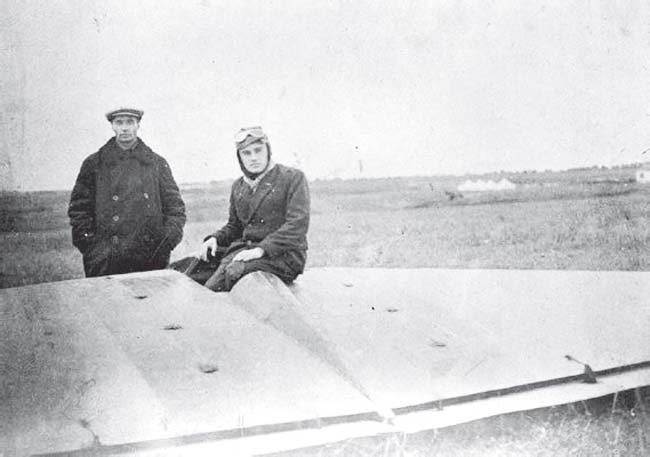
On the BiCh-8 “Triangle” glider, designed by B.I. Cheranovsky, I completed seven taxi runs and 12 flights, the last four of which were from the upper launch of the Moscow Glider Station. During the initial flights, the aircraft showed a tendency to nose down, but this issue was resolved after a small weight was placed on the tail. The most intriguing aspect of the testing was the machine’s overall stability, particularly its longitudinal stability.
The BiCh-8 glider demonstrated full stability in both longitudinal and lateral directions, as well as path stability. It was very responsive to the elevator and did not tolerate sudden movements. At small angles, it exhibited a high sink rate, while normally flying at an angle of about 3°. However, in all possible flight regimes, it showed no tendency to lose stability, spontaneously decrease, or increase its angle; instead, it willingly followed the stick, returning to its original position.
Design and Operational Challenges
The flight and sink speeds for such a machine (compared to a conventional glider type) were quite high, approximately 22-25 m/s, according to chronometer data and observations made on September 29th of that year. It seemed that the aircraft operated at very low lift coefficients, or at least not at the calculated ones obtained by conventional methods. This explains the high speeds and relatively low practical glide ratio (12).
Undoubtedly, the extremely poor external aerodynamics of this glider, which had been left unattended for about a year and suffered significant damage as a result, also played a crucial role. The cutout at the pilot’s seat should have been closed. The pilot’s cockpit was very uncomfortable, mainly due to its cramped nature. The controls had very little stick travel and limited control surface deflection (especially the ailerons). Although in straight flight, one hardly had to work the controls (and the machine responded well), it would still have been better to have some reserve in stick deflection and the control surfaces themselves. The landing angle was too small. Overall, the aircraft was quite unforgiving on landing.
During the testing period, there were no unpleasant incidents in the air or breakdowns. Only during the last flight did slight oscillations of the machine appear, resembling vibrations. It is probable that the cause of this phenomenon lay simply in the machine’s decrepitude and, it must be said, its rather poor condition. This last circumstance forced a halt to further flights on this very interesting glider.
It is regrettable that our glider sub-section treated experimental machines (in general), and especially Cheranovsky’s tailless designs—who has long worked in this field with a number of successes—with such indifference and mismanagement. The experience from abroad, particularly Germany, which is only now achieving some positive results, should, in fact, serve as a good lesson and example of how new problems in aviation can and should be solved.
Construction and Features
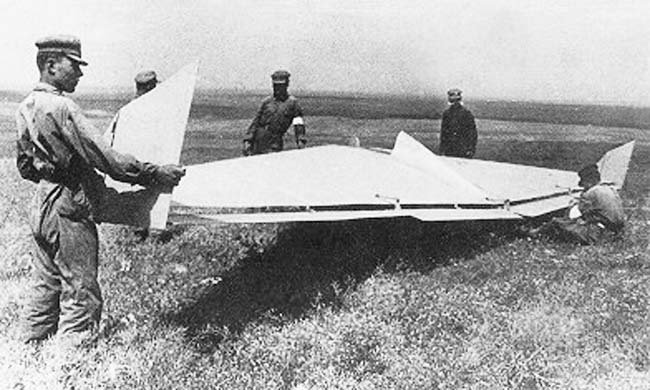
The BiCh-8 glider was built simultaneously with the BiCh-7 aircraft in the VVA workshops in 1929. It was prepared for the All-Union Glider Meet, but having missed the event, it lay unattended in appalling conditions for a whole year and was not tested until very recently. The first thing that stands out is the simplicity and low weight of the glider’s structure. This latter quality is likely inherent to any tailless machine, as the distribution of all loads and the absence of all parts separate from the wing are highly advantageous.
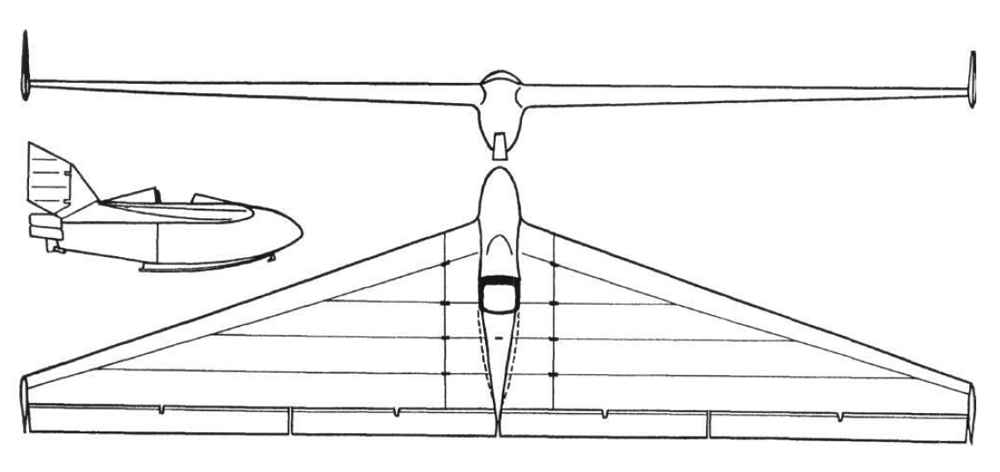
The glider features a cantilever wing, composed of three sections. The central part of the wing forms a single unit with the fuselage. The aircraft is entirely constructed of wood and covered with fabric. The leading edge of the wing is protected by 1 mm thick plywood. The wing’s skeleton is a spatial truss frame, formed by three truss-type spars, ribs, and braces.
The outer wing sections are attached to the center section with steel hinges. The fuselage is covered with plywood. The skid is attached directly to its underside. Damping is pneumatic, achieved via a bicycle inner tube. The elevators (which also function as ailerons) are located at the wingtips, suspended. The stabilizer, adjustable on the ground, is suspended in the middle. The rudders are located at the wingtip ends and are controlled individually, deflecting outwards and returning to a neutral position by the force of a shock cord.
Technical Specifications
| Modification | BICH-8 |
| Wingspan, m | 10.80 |
| Aspect ratio | 2.2 |
| Wing area, m2 | 14.00 |
| Empty weight | 60 |
| Flight weight | 130 |
| Max. glide ratio | 18 |
| Crew, crew members | 1 |
Image and diagram gallery of the BiCh-8 'Triangle' Glider
 BICH-8 Triangle |
 BICH-8 Triangle |
 BICH-8 Triangle |