
In 1950, the Royal Australian Air Force (RAAF) decided to replace its outdated Meteor fighters, which had been thoroughly outmatched in air combat in Korea by Soviet MiG-15s, with more modern jet fighters. The option of organizing the production of Hawker P.1081 fighters in Australia was explored; however, for various reasons, the choice was made in favor of a seriously modified version of the North American F-86F aircraft.
The licensed variant for Australia was equipped with a more powerful British engine, which was also produced in Australia under license. The capacity of the internal fuel tanks was increased, and the armament consisted of two British-designed cannons. The cockpit instrumentation was also modernized. The result was a fighter/fighter-bomber known as the “Avon-Sabre.”
Australian Development and Adaptation
Thanks to its powerful cannon armament and high flight performance, the “Avon-Sabre” was considered the best in the Sabre family. In terms of its characteristics, the “Avon-Sabre” surpassed all other Sabre modifications, with the exception of the Canadair Sabre.
The Avon RA.7 engine had significantly greater thrust than the General Electric J47, which was the base engine for American-built fighters. The Avon’s airflow was about 25% greater, but the engine’s dimensions were roughly equivalent to the American one, although the British engine was 181 kg lighter. The need to ensure greater airflow to the engine and maintain the aircraft’s center of gravity led to a redesign of the fuselage, of which only 40% remained common with the F-86F fuselage.
The fuselage became taller, its nose section was lengthened, and the tail section was shortened, modified to accommodate the new engine. Approximately 100 assembly kits were received from the USA from “North American,” but due to the structural changes, most of these kits were not used. The CA-26 prototype made its first flight on August 3, 1953, with an engine imported from the United Kingdom.
Design and Production Innovations
During testing, the aircraft confirmed its calculated characteristics. Since CAC’s engine division was not yet ready for series production of engines, the aircraft entered production as the CA-27 with imported Avon Mk 30 turbojet engines and an F-86F wing, which had only two hardpoints. Subsequently, the CA-27 was produced, comparable to early F-86F models (with an all-moving tailplane), aside from the engine and fuselage. The first Sabre Mk 30 took to the air on July 13, 1954; a total of 22 aircraft were built and delivered to the RAAF from August 1954 to March 1956.
Aircraft of the next production series were equipped with Australian-built Avon Mk 20 turbojets and a “6-3” type wing without leading-edge slats but with increased chord (Sabre Mk 30s were re-equipped with this wing). The chord of the “6-3” wing’s leading edges was increased by 0.15 m closer to the wing root and by 0.076 m at the tip. The new wing contributed to increasing maximum speed at high altitudes without detriment to maneuverability.
The increased wing chord allowed for greater capacity in the wing fuel tanks. Two additional tanks could be suspended, if necessary, on pylons under the wing; instead of tanks, the suspension of bombs or 127mm HVAR rockets was provided. A total of 20 aircraft of this series were built, and surviving Sabre Mk 30s were upgraded to the Sabre Mk 31 variant.
The Sabre Mk 32 was the final Australian-built variant in the Sabre family. It differed from its predecessors by having an Avon Mk 26 turbojet (such engines were later installed on earlier built aircraft) and four underwing hardpoints, allowing it to carry not two, but four fuel tanks or a heavier combat load. In addition to the first batch of 28 aircraft, contracts for 20 and 21 aircraft, respectively, were signed in July 1957 and 1959 as an “intermediate variant.”
Operational Service and International Legacy
However, in 1957, the RAAF declined to purchase F-104 Starfighter fighters, opting instead for Dassault Mirage III aircraft, the production of which was established under license in Australia. Sabres were withdrawn from RAAF service in July 1971, but even earlier, sales of “surplus” aircraft began to two of Australia’s regional allies.
Malaysia received 18 fighters in October 1969, and another 18 aircraft were supplied to Indonesia in February 1973. The Sabre aircraft were withdrawn from Malaysian Air Force service in the mid-1970s, and in July 1976, six Malaysian aircraft were transferred to Indonesia, which operated the Sabres until the first half of the 1980s.
Technical Specifications
| Modification | CA-27 Mk.30 |
| Wingspan, m | 11.30 |
| Length, m | 11.43 |
| Height, m | 4.34 |
| Wing area, m2 | 26.75 |
| Empty weight | 5445 |
| Maximum takeoff weight | 7850 |
| Engine type | 1 Rolls Royce RA 7 Avon Turbojet |
| Thrust, kgf | 1 x 2572 |
| At sea level | 1127 |
| At altitude | 998 |
| Ferry range, km | 2400 |
| Practical range, km | 1120 |
| Maximum rate of climb, m/min | 3655 |
| Service ceiling, m | 16800 |
| Crew | 1 |
| Armament | two 30-mm Aden cannons |
Image and diagram gallery of the CAC CA-27 Avon-Sabre
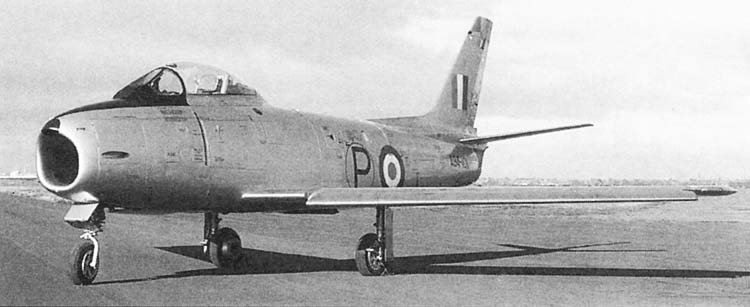 CA-27 Sabre |
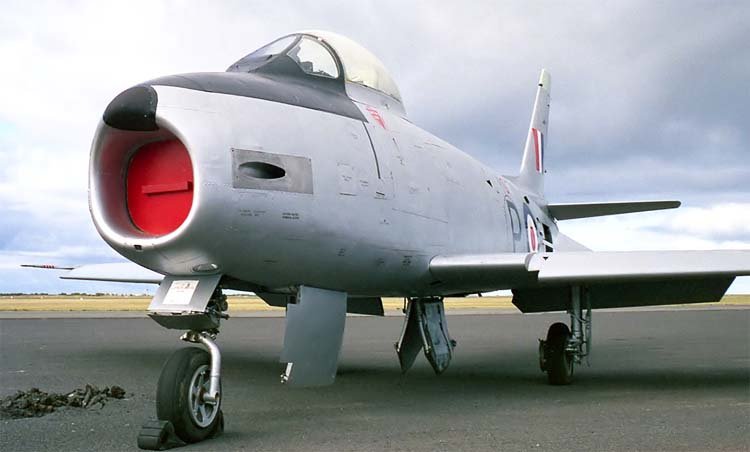 CA-27 Sabre |
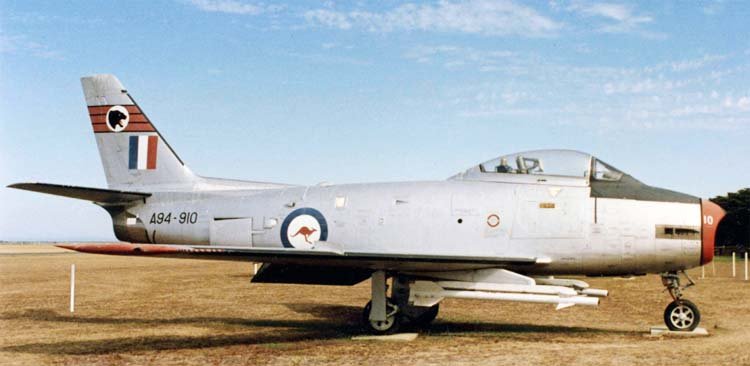 CA-27 Sabre |
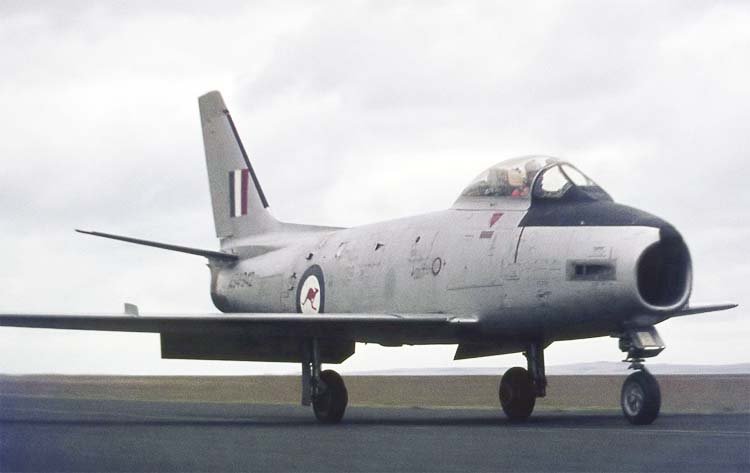 CA-27 Sabre |
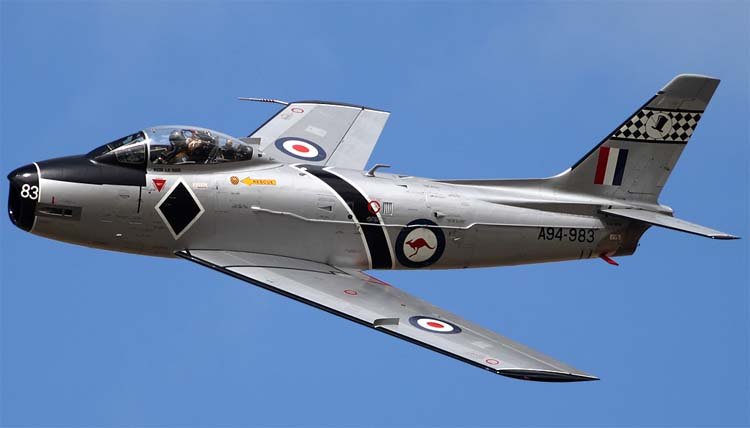 CA-27 Sabre |
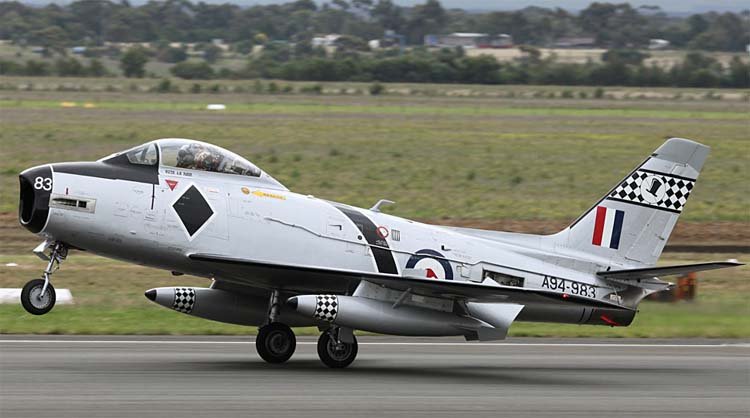 CA-27 Sabre |
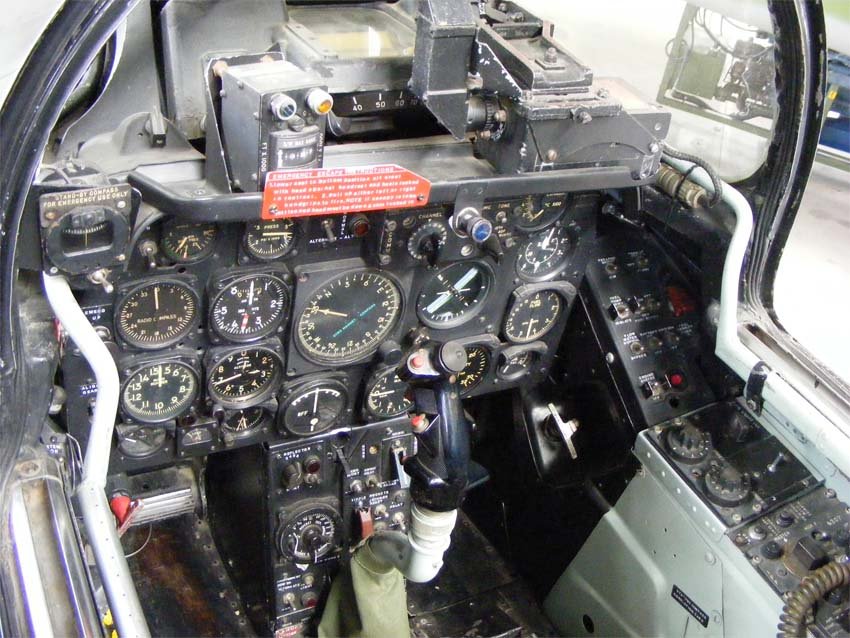 CA-27 Sabre |
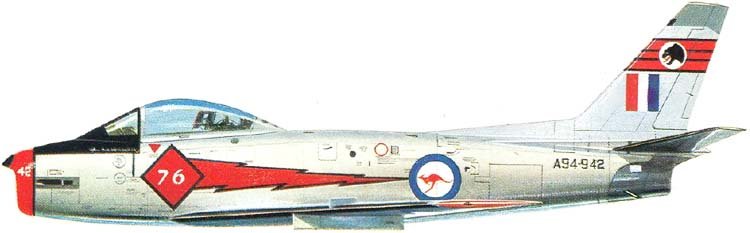 CA-27 Sabre |
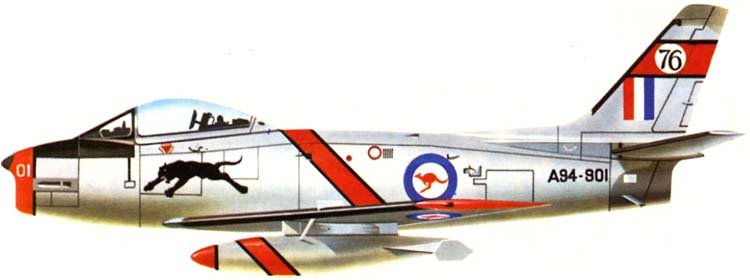 CA-27 Sabre |