
The renowned Soviet aircraft designer B.I. Cheranovsky designed and built aircraft of the most unusual configurations, being the pioneer of domestic tailless aircraft and gliders, and the creator of the world’s first “flying wing” aircraft with a thick aerodynamic profile.
In 1947-1948, at B.I. Cheranovsky’s experimental design bureau (OKB-MAI), work was carried out on the creation of gliders built to the “flying wing” scheme, featuring a parabolic wing planform.
Innovative Design and Features
The first glider designed by B.I. Cheranovsky at MAI was the single-seat experimental glider Che-22 (BiCh-22), built according to the “flying wing” scheme. Its wing was composite, formed by a low-aspect-ratio parabolic center section, to which trapezoidal outer panels of greater aspect ratio were attached. Vertical fins, or endplates, were installed at the tips of the outer panels, though a variant of the Che-22 without these endplates (without vertical empennage) also existed.
The trailing edges of the outer panels and the center section coincided. Ailerons (on the outer panels) and the elevator (on the center section) were located along the wing’s trailing edge. The outer panels had straight sweep. The control surfaces on them extended beyond the trailing edge of the center section. The wing profile itself was developed by the glider’s designer. The pilot’s cockpit was situated in the central part of the center section, enclosed in front by a monolithic oval canopy and at the rear by a conical fairing.
The glider’s structural mass was 60 kg, with a wingspan of 7.5 m and a wing area of 14 sq. m. Its aerodynamic quality was 18. The glider’s construction was entirely wooden, covered with plywood and percale. Aerodynamic studies of the glider models were carried out in the MAI wind tunnel. The results of the experimental research showed good stability and controllability of the proposed aerodynamic scheme.
Testing and Further Development
In 1948, an experimental prototype of the Che-22 was built, and its test results confirmed the calculated flight performance characteristics. On July 17, 1949, during an air parade in Tushino, test pilot I.A. Petrov successfully performed complex aerobatic figures in the Che-22.
Concurrently, at OKB-MAI, work was underway on the design and creation of a two-seat “flying wing” type glider – the Che-23 – with smaller dimensions and greater sweep of the outer panels. The Che-23 glider represented a prototype for a supersonic aircraft. Its wingspan was 6.7 m, wing aspect ratio 3, and maximum aerodynamic quality 12.3. The Che-23 glider was flown by I.A. Petrov in 1948.
Tragedy and Legacy
After the successful flight tests of gliders with the new aerodynamic scheme, the Central Committee of DOSAV ordered a series of ten Che-22 gliders from Cheranovsky’s design bureau. However, in late 1949, a catastrophe occurred with a Che-22 glider at the DOSAV repair workshops in the village of Chornoye, Moscow region, where test pilot I.A. Petrov tragically died. Work on the series production was halted.
At this time, the designer was already developing projects for supersonic “flying wing” aircraft like the BiCh-24 and BiCh-26, equipped with turbojet engines. In 1950-1951, several wind tunnel models of “flying wing” aircraft and gliders were manufactured according to Cheranovsky’s drawings in the model workshop of the MAI aerodynamic laboratory, for experimental aerodynamic research.
In 1951, by order of the Central Committee of DOSAAF, a model of a “flying wing” type glider – the TLK – was manufactured according to Cheranovsky’s drawings, intended for research in the T-1 wind tunnel. The testing of the TLK model was preceded by tests of special profile sections developed by Cheranovsky (this profile was used in the glider’s wing layout). These works were carried out at MAI in 1952. The TLK glider became the prototype for the supersonic BiCh-26 aircraft, one of B.I. Cheranovsky’s last works.
Technical Specifications
| Modification | BICH-22 |
| Wingspan, m | 7.50 |
| Length, m | 5.04 |
| Wing area, m2 | 14.03 |
| Empty weight | 60 |
| Crew, crew | 1 |
Image and diagram gallery of the Cheranovsky BiCh-22 (Che-22) Glider
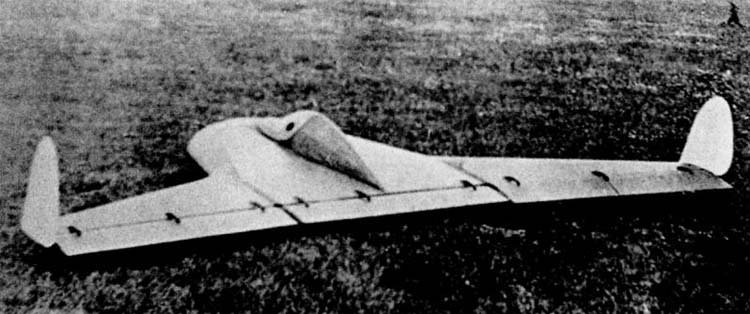 BICH-22 (Che-22) |
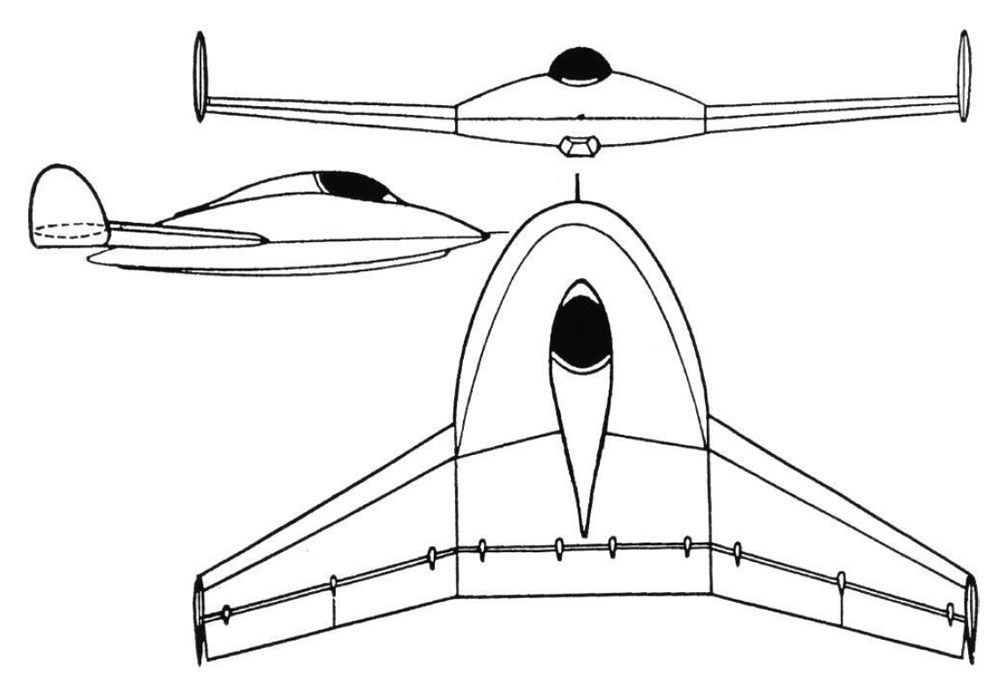 BICH-22 (Che-22) |