
In 1957, the workshops of the Kaunas Glider Station completed the construction of another training glider-soarer designed by B. Karvelis. The BK-4 “Kaunas” glider features a cantilever high-wing configuration.
In terms of strength, it belongs to the first-class, group II of gliders. It is designed for launch using either a motor winch or aero-towing behind an aircraft. The primary construction is wooden, with bonding achieved using K-17 resin glue. Joints are made from grade 20 sheet steel, while turned parts utilize grade 45 steel.
Fuselage Features
The fuselage has an elliptical, almost circular cross-section, with a canopy integrated into its contours. The framework is assembled from six stringers and twenty-six frames. The skin is plywood, doubled in the forward section.
A unique design feature is the canopy, made from a single sheet of plexiglass. The canopy opens by sliding forward; the rear part lifts, rotating on the arms of levers fixed to the fuselage sides, while the front part slides forward along a guide rail located on the canopy’s axis of symmetry. An emergency jettison handle, placed on the right side, simultaneously releases all three canopy attachments. The pilot’s seating position is semi-reclined. The center-wing spars, with their joint nodes, are integrated into frames No. 9 and 11. The fuselage tail smoothly transitions into the fin and carries a non-removable stabilizer. The fuselage is equipped with a ski featuring rubber damping, a fixed wheel, a spring-type tail skid, and two towing hooks.
Wing Design and Controls
The wing consists of two “consoles” or sections. The wing profile used is “Göttingen 549” across its entire span. The wing structure is single-spar, with an auxiliary spar and a strut at the root.
Profiled slots, acting as leading-edge slats, are present in the leading-edge plywood skin at the wingtips. Each console attaches to the fuselage at three points using conical bolts. The ailerons consist of two parts and extend across the entire span. There is a mechanism to change the average aileron position in flight (up and down). The control handle for aileron droop/hang is located on the control shaft bracket.
Spoilers are situated on the wing, behind the main spar, on both the upper and lower surfaces.
Flight Performance
Flight tests of the BK-4 demonstrated normal stability and good glider maneuverability. All controls proved to be sufficiently effective, especially the spoilers. The most advantageous speed in a spiral turn with a 45° bank is 60-65 km/h, increasing to 70 km/h with a bank up to 60°. Winch launches are performed at a speed of 80-90 km/h, with the ailerons set to the lower position before takeoff.
Technical Specifications
| Modification | BK-4 |
| Wingspan, m | 14.00 |
| Length, m | 6.75 |
| Aspect ratio | 14.80 |
| Height, m | 1.37 |
| Wing area, m | 13.20 |
| Empty weight | 205 |
| Maximum weight | 295 |
| Cruising speed, km/h | 75 |
| Max. glide ratio | 25 |
| Minimum sink rate, m/s | 0.80 |
| Landing speed, km/h | 50 |
| Crew | 1 |
Image and diagram gallery of the BK-4 "Kaunas"
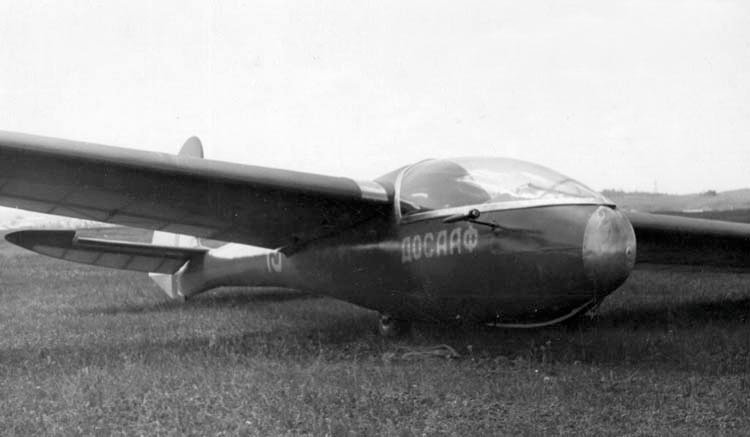 BK-4 "Kaunas" |
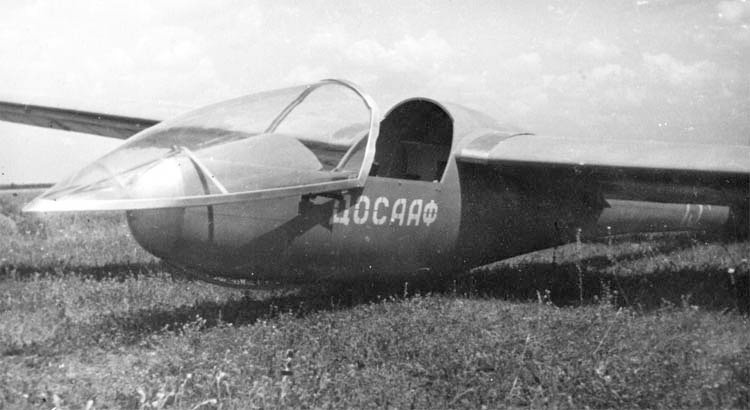 BK-4 "Kaunas" |
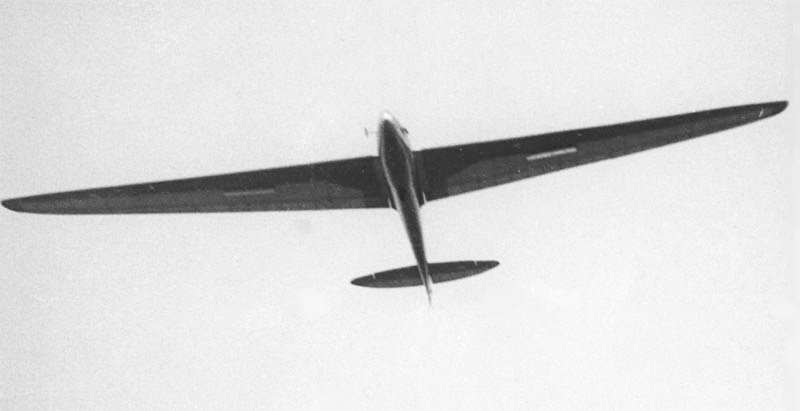 BK-4 "Kaunas" |
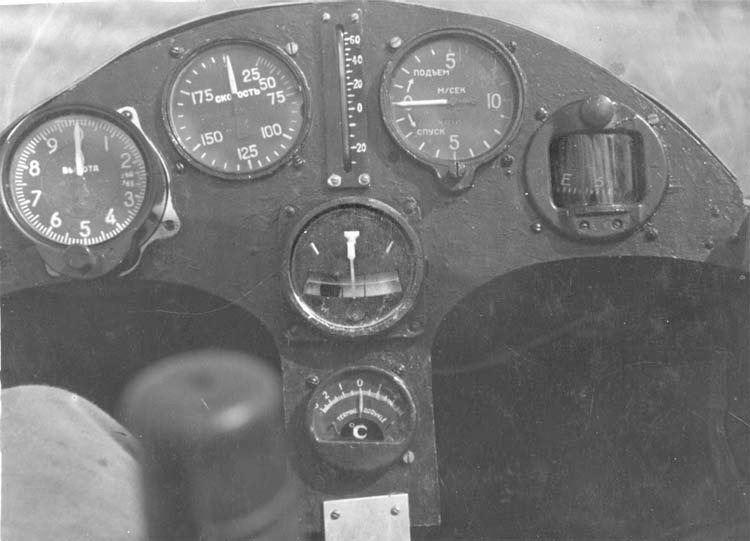 BK-4 "Kaunas" |
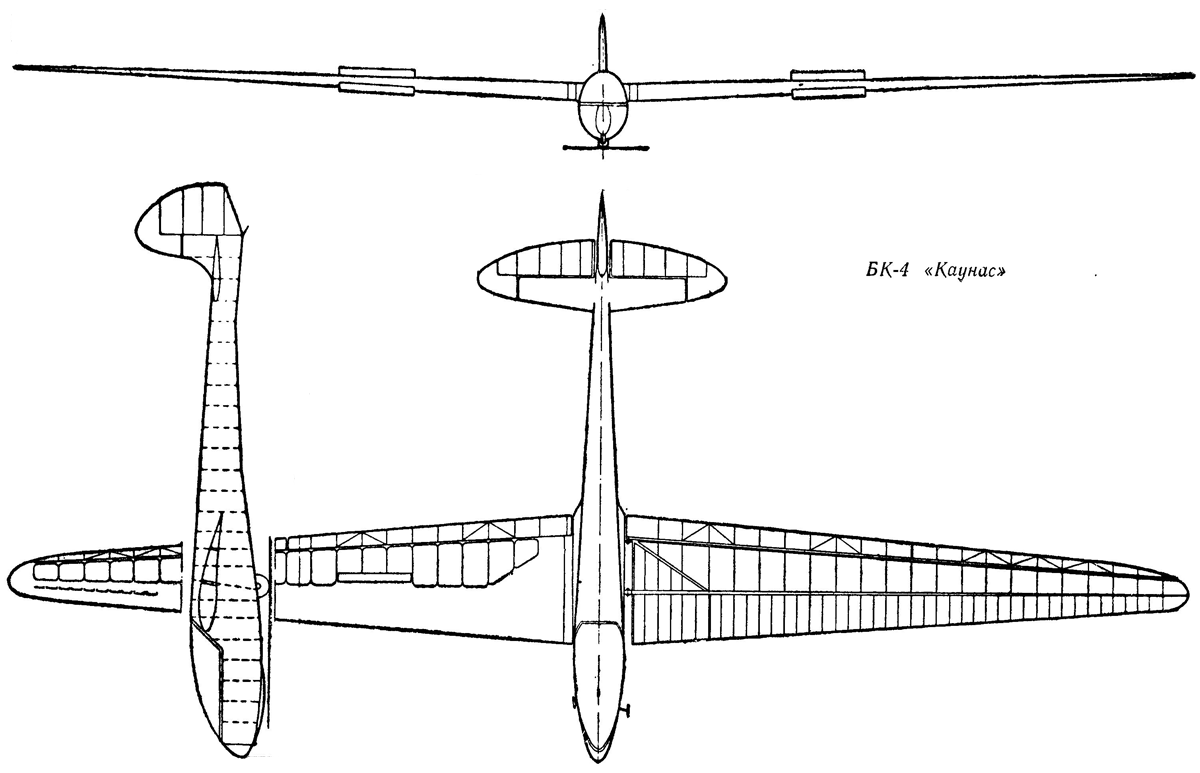 BK-4 "Kaunas" |