
In the late 1920s, the prestige and status of a country’s aviation industry were determined by the number of records set by its aircraft. Those years were characterized by a frantic race for performance, in which France played a leading role. Initially, results were modest, as they were achieved with modified combat aircraft. These machines were poorly adapted to the requirements needed to achieve the expected characteristics.
Thus, the first range records—mainly non-stop flight distance records—represented a sequence of steps taken in line with the capabilities of these aircraft. However, very quickly, aircraft designed exclusively for high operational performance emerged. In France, aircraft intended for extended routes were designated “grand raid”—for long-distance flights.
The goal was to fly as far as possible without intermediate landings. The most successful of these aircraft was a variant of the latest Breguet XIX light bomber, featuring a fuselage that served as a massive fuel tank; these aircraft earned the nickname “flying jerrycan.”
The Pursuit of World Records
Records for flight duration, straight-line distance, or closed-circuit distance were among the most desired, as, in addition to crew skill, they demonstrated the quality of airframes and engines. This is why, in early 1929 in France, Albert Caquot—the new head of the main technical department of the Ministry of Aviation—consulted on the development of aircraft specifically designed for record-setting. This required a flight range of over 10,000 kilometers against a headwind blowing at 35 km/h.
This meant that, in the absence of wind, the maximum range had to be 13,000 kilometers! With these characteristics, a flight west across the Atlantic with strong headwinds required masterful skill. In addition to global fame, a prize of one million francs was promised to the crew that completed this flight, which naturally attracted aircraft manufacturers.
In March, three sets of design documentation were submitted to the Commission for the Examination of Prototypes and New Aircraft (CEPANA). Three projects were selected in a surprisingly short time—less than 15 days—and Blériot Aéronautique, Avions Bernard, and Dewoitine received orders to build prototypes.
The ambition of these projects cannot be overstated, developed at a time when heavy aircraft had a maximum range and speed of only 1,000 kilometers and 180 km/h. The program demanded the creation of aircraft at the very limit of the technical and technological capabilities of the time. With this program, Albert Caquot aimed to stimulate the search for innovations in aviation.
Design and Early Flights of the Blériot 110
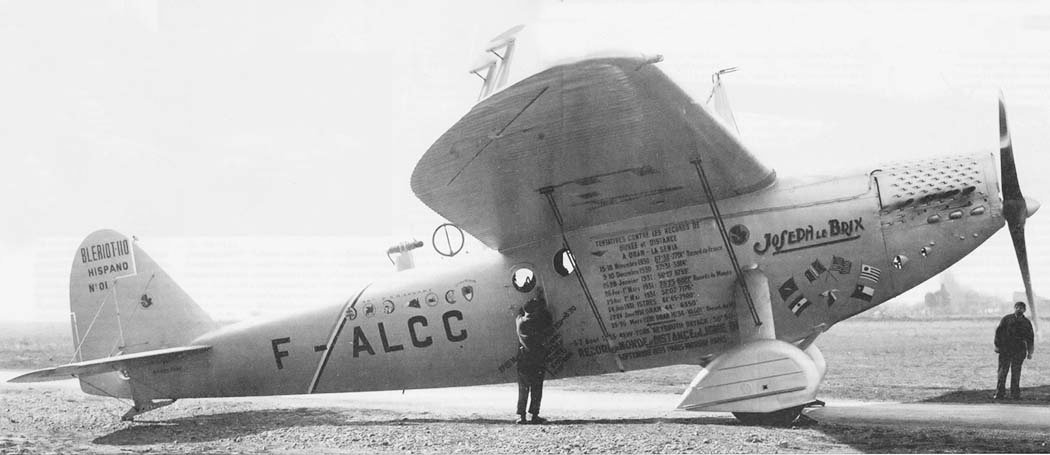
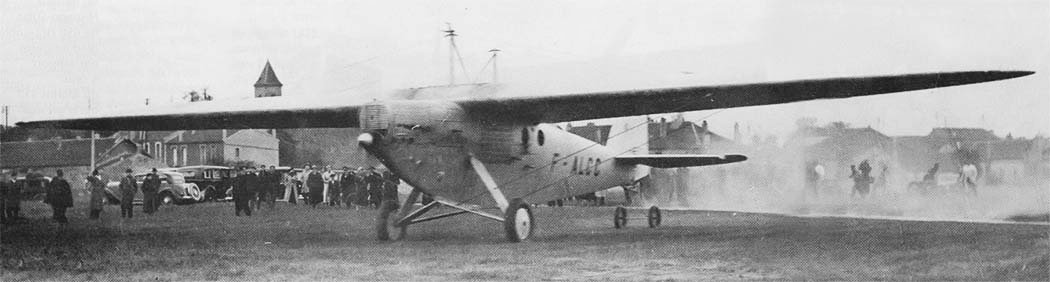
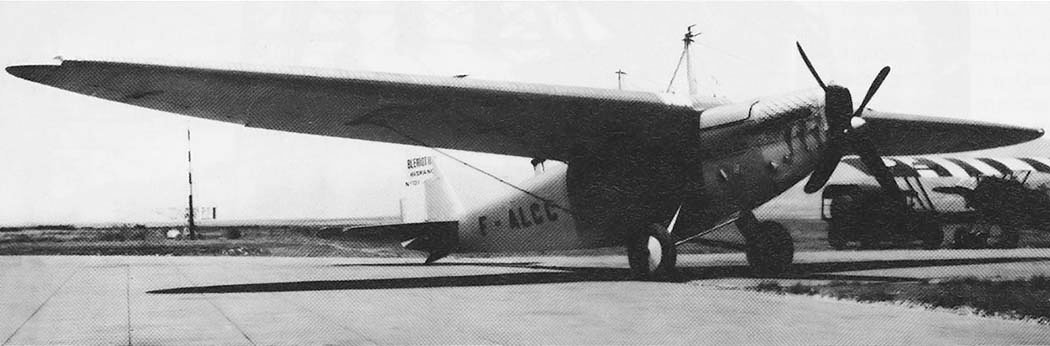
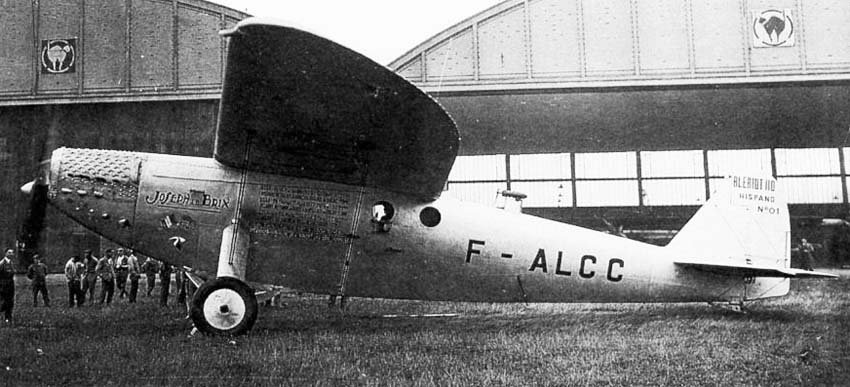
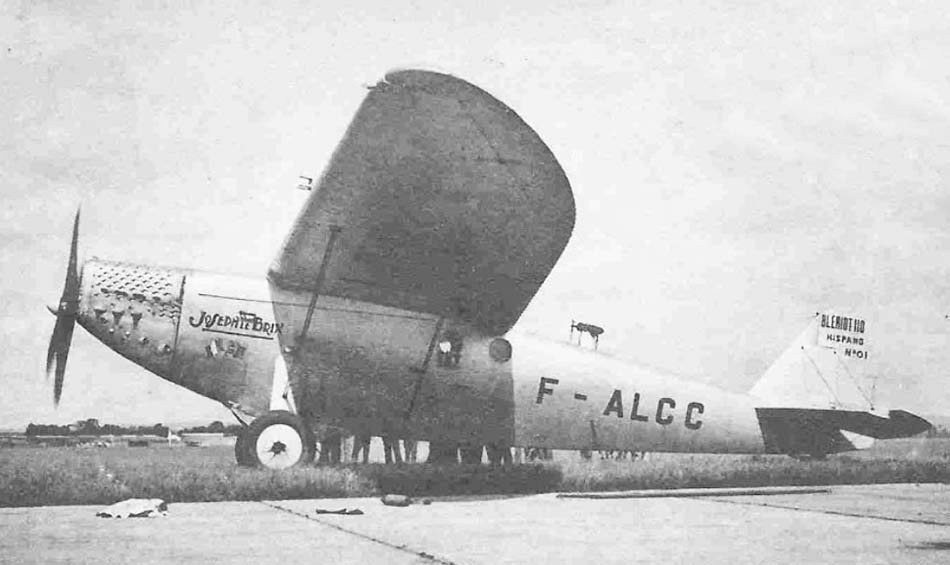
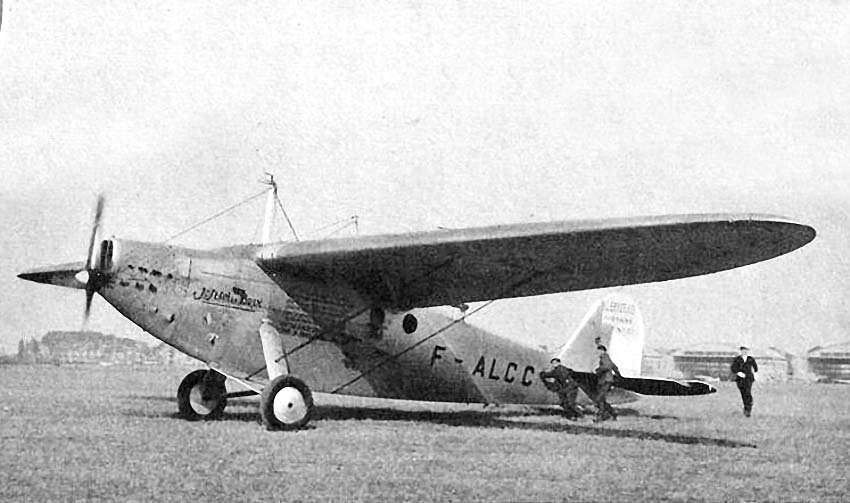
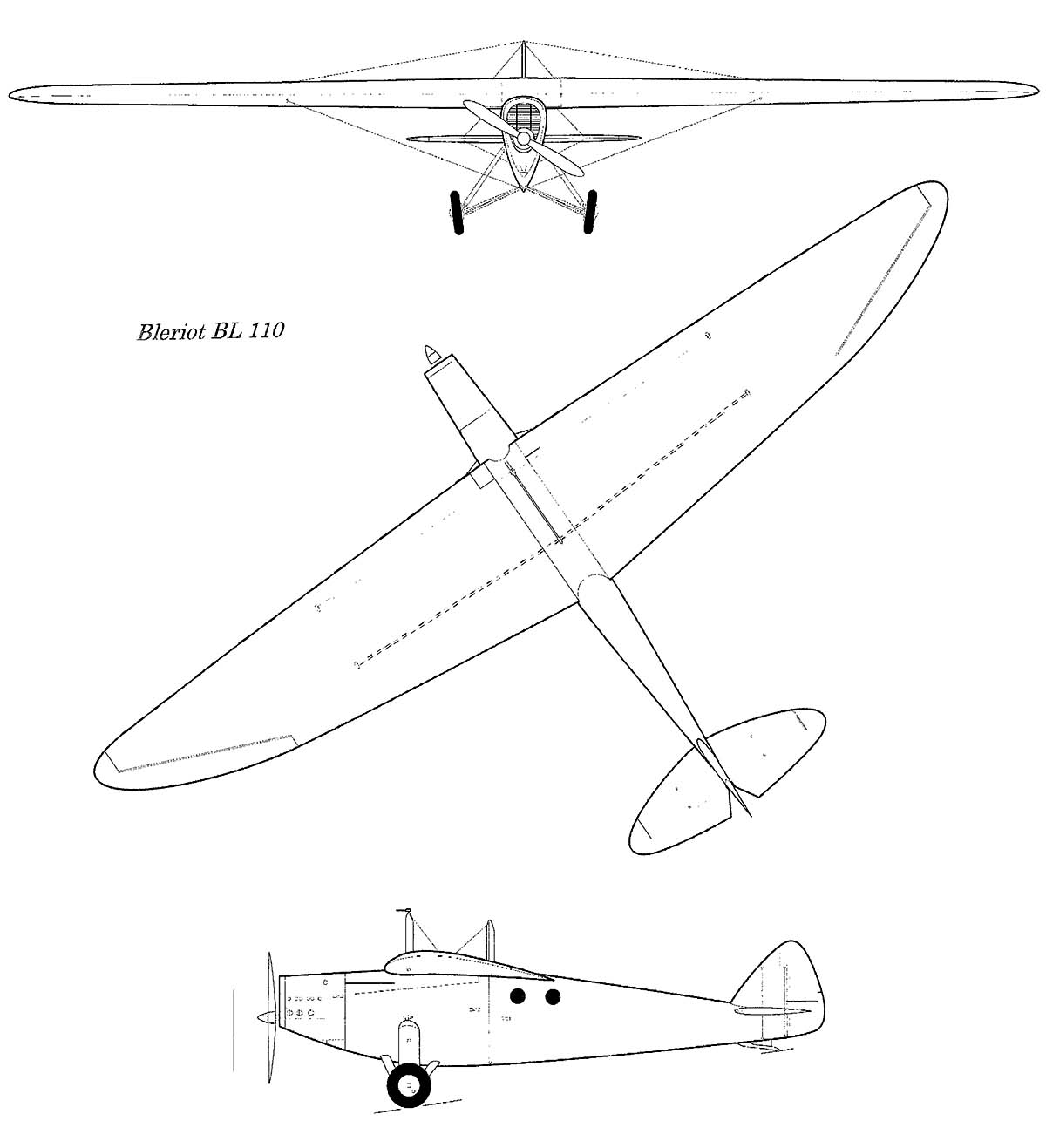
Louis Blériot approached the Italian engineer Filippo Zappata and, without waiting for the official contract endorsement, began detailed design and construction of the Blériot 110 at his Suresnes factory in April 1929. It was a large high-wing monoplane with a pear-shaped fuselage cross-section. The only feature breaking the aircraft’s refined lines was the non-retractable main landing gear struts with single, large-diameter wheels and low-pressure tires.
The enormous wing, with a span of 26.5 meters and consisting of three parts (center section and two outer panels), was additionally reinforced with bracing wires, which, though not as elegant as struts, were much lighter. In the center section area, the straight leading edge of the wing was formed by an oil tank, the skin of which was intended for cooling the oil after it exited the engine.
The wing structure consisted of ribs and two main spars. To increase torsional stiffness at the wingtips, the spars were reinforced with stringers. Ailerons were attached to an auxiliary spar, and the wing covering was entirely fabric. The fuselage frame included the vertical stabilizer. Two longerons located in the upper part of the fuselage and one lower longeron formed the basis of the structural framework, to which conventional frames and two reinforced ones were attached.
The wing spars and the rubber-damped main landing gear supports were fastened to these reinforced frames. The fuselage skin was formed from three layers of 5 cm wide veneer, glued together at a 45° angle to the normal. The veneer was then covered with fabric, which was then painted. As a result, this skin possessed both lightness and strength. It should be noted that such a technology was not new in aviation: since 1912, it had been used by Louis Béchereau on Deperdussin monoplanes.
In the front part of the fuselage was the engine mount, formed by three metallic longerons connected to the lower and two upper fuselage longerons. A Hispano-Suiza 12Lb liquid-cooled, twelve-cylinder inline engine, developing 600 hp and driving a four-bladed wooden propeller, was installed on the engine mount. The engine was cooled by a frontal water radiator (“automotive” type) located between the engine and the propeller. The fuel system consisted of ten tanks with a total capacity of 7,000 liters. These tanks were placed in the wing (three in each outer panel) and in the fuselage (four tanks) under the wing near the center of gravity.
The crew cabin was two-seater with the crew members arranged in tandem and dual controls, allowing pilots to relieve each other during 70-hour flights and rest in a small cabin located behind and above the fuselage fuel tanks. The crew members had no forward view, but their seats were equipped with four round portholes. An upper window, intended for astronomical observations, illuminated this “monastic” interior. Limited forward vision was provided by a complex system of reflecting mirrors placed in the front portholes. Initially, the Blériot 110 was not equipped with a radio, and its flight-navigation equipment was limited to only the most basic instruments.
As a result, the empty weight of the aircraft was impressively low—only 2,500 kg, while the takeoff weight with 5,700 kg of fuel was 8,610 kg! It goes without saying that with such a takeoff weight, the 600 hp engine power was clearly insufficient.
The first flight of the Blériot 110 was conducted on May 16, 1930, piloted by Blériot Aéronautique test pilot Lucien Bossoutrot and accompanied by engineer Filippo Zappata. The flight took place in Buc, near Versailles, from the company’s airfield, which had become traditional for the first flights of prototypes. This flight ended in a forced landing in the countryside due to engine power loss, though without any serious damage.
In early July, the prototype was transferred to Villacoublay for evaluation by pilots of the Aeronautical Technical Service (STAé), who rendered their verdict on August 30. STAé pilots deemed the aircraft safe and easy to control, with the exception of speed limitations at maximum values related to wing vibrations, and a spin from which recovery was complicated by unbalanced ailerons whose inclined axes did not help in this situation. The aircraft’s lifting surfaces were found to be too soft (its predecessor, the Br XIX, had the same defect). Nevertheless, the aircraft received approval and was registered as F-ALCC.
Naturally, with a low-powered engine and, consequently, insufficient thrust-to-weight ratio, the aircraft’s flight characteristics could not be called outstanding: maximum speed at ground level was 220 km/h, the time to climb 5,000 meters with a load of 5,300 kg was 1 hour, with maximum load the practical ceiling was 2,000 meters, and the takeoff run length was 1,200 meters. However, despite all this, the Blériot 110 was expected to achieve unsurpassed flight duration and range. Let us give the floor to Lucien Bossoutrot:
“By the time the aircraft had accumulated 150 hours, test pilot Maurice Rossi ferried the Blériot 110 to Oran, where climatic conditions for loaded takeoffs were more favorable than in metropolitan France. Before proceeding with the narrative of successive record-setting, it is necessary to describe the conditions of closed-circuit flights, which were particularly difficult and exhausting for pilots. To achieve the goal, it was necessary to complete a sufficient number of laps on a strictly established and marked route. The length of the daytime route was 164 kilometers, and the nighttime route was 91 kilometers, meaning the average length of the daily distance was 126 kilometers. Thus, the Blériot 110’s first achievement (7,700 km) corresponded to sixty laps, which gives an idea of the monotony of the race.”
An Odyssey of Records and Challenges
On November 15, 1930, Bossoutrot and Rossi took off from Oran-La Sénia airfield with 5,900 liters of fuel. After flying 7,701 kilometers in 67 hours and 32 minutes, the aircraft broke the French record for duration and distance in a closed circuit. However, on November 18, the pilots were forced to land prematurely due to excessive oil consumption. To break the world record (67 hours and 30 minutes), according to FAI rules, the aircraft had to fly one hour more, meaning the Blériot 110 needed to surpass its own result by 58 minutes!
The next two attempts in Oran—on December 9 and 27—were interrupted by storms after 27 hours 31 minutes and 56 hours 27 minutes of flight, respectively. The large wing was quite fragile and could not withstand flight in bad weather. A new attempt to set a record had to wait until February 1931: on the 26th, the Blériot 110 took to the sky with a takeoff weight of 7,825 kg and a fuel supply of 6,250 liters. Bossoutrot and Rossi spent 78 hours and 23 minutes in the air, covering 8,822 kilometers at an average speed of less than 100 km/h. Such a low average speed is explained by strong headwinds during several laps. World records for duration and closed-circuit distance were broken.
The valiant crew believed that under more favorable weather conditions they could set a new record with much higher figures. However, their competitors—two other French aviators—surpassed them: on April 14, 1931, the Bernard 80, piloted by Antoine Paillard and Jean Mermoz, set a new record of 8,960 kilometers, and a few days later, Doret and Le Brix, in the Dewoitine 33, flew 10,342 kilometers! Bossoutrot and Rossi decided to take revenge, and on April 24, they took their aircraft (again from Oran-La Sénia airfield) to the sky, but a strong sandstorm forced them to abort the attempt after 57 hours of flight and covering 7,176 kilometers.
Returning to metropolitan France, Bossoutrot and Rossi attempted to set a new closed-circuit record on June 26, 1931 (choosing the Istres – Bordeaux – Étampes – Istres route). And again, failure met them: a fuel leak and a severe storm forced them to abandon this frantic race after 61 hours 45 minutes of flight and 7,900 kilometers covered.
After this setback, the Blériot 110 was returned to Buc for an engine replacement, the installation of two additional wing tanks, bringing the total capacity to 7,250 liters, the adaptation of a new propeller, and finally, the installation of a radio. In November 1931, the aircraft’s refit was completed, and on January 22, 1932, the Blériot 110, piloted by Bossoutrot and Rossi, took off from Oran-La Sénia airfield with the goal of reclaiming the record. However, due to a magneto failure, the pilots were forced to make an emergency landing after 44 hours of flight and covering 6,005 kilometers.
A new record attempt was made two months later. This time, everything went successfully: despite unfavorable weather conditions, two world records (distance and duration of closed-circuit flight) were set—10,601 kilometers and 76 hours 34 minutes.
Once the goal was achieved, Louis Blériot withdrew from the record race: government aid did not cover the expenses, and the difference placed a heavy burden on Blériot Aéronautique, whose funds were almost depleted. By this time, Louis Blériot’s interests were shifting towards transatlantic cargo and passenger seaplanes, while in official circles, increasing attention was drawn to high flight speeds.
The continued career of the Blériot 110, which received the name Joseph Le Brix (in memory of the pilot who died in the Dewoitine D.33 crash), seemed compromised. However, the press was engaged, and the Ministry of Aviation paid once again. Paul Codos successfully replaced Lucien Bossoutrot, who was busy testing the Blériot 5190 Santos Dumont seaplane, and Maurice Rossi, who knew the Blériot 110 well, remained as part of the crew.
A new task was set for the aircraft and its crew: to break the world record for straight-line distance flight of 8,796 kilometers, set by the Britons Gayford and Nicholetss. To maximize their chances, it was decided to take off in the USA and land in the Middle East, taking advantage of the favorable winds blowing over the North Atlantic. In June 1933, the Joseph Le Brix was delivered to Le Havre and loaded aboard the ship “Champlain” bound for New York.
In the United States, customs demanded a bond of 500,000 francs as a guarantee that the aircraft would successfully leave US territory! This was quite unpleasant, but the pilots’ reception by the Americans was friendly, despite some skepticism about the modest power of this huge aircraft.
At Floyd Bennett airfield, where a team of mechanics prepared the Blériot 110, the two pilots left nothing to chance. Technicians worked on the aircraft day and night. Hoping to avoid icing—anti-icing systems had not yet been invented—some aircraft surfaces were coated with a mixture of lard and paraffin. Since the runway was short (only 1,250 meters), a mark was painted with lime 50 meters from its end, indicating the takeoff limit. This was an illusory precaution, although Codos and Rossi had time to prepare for the start: they waited 41 days for good takeoff weather.
Finally, at dawn on August 5, 1932, the Blériot 110 F-ALCC, with 6,300 liters of fuel on board, left American soil. With its nose raised, the aircraft slowly crawled along the ground at approximately second gear speed, and Codos incrementally lifted the machine to an altitude sufficient for the flight across the Atlantic Ocean. After crossing the coastline, the aircraft encountered a severe storm. The bad weather lasted five hours, during which the pilots alternated every 15 minutes. Then came hail and carburetor icing! Engine power decreased, and the Blériot 110 was only two hundred meters from the raging ocean.
Nevertheless, after 30 hours of flight through thick fog, Cherbourg appeared, and during the flyover of Le Bourget, the aircraft descended to a low altitude to drop a bottle with a note prepared by Codos for journalists. This was the first time the press could publish the story of a record flight in progress. Originally, the final destination of the flight was Baghdad, but night was approaching, and the crew decided to land at Rayak airbase, located in Lebanon, which was under French mandate. The reception given by French Air Force personnel was very enthusiastic, as 55 hours 29 minutes of flight and 9,104 kilometers covered meant that the Blériot 110 had broken a world record. On August 15, Codos and Rossi returned to Le Bourget, where the pilots were greeted as heroes. In the autumn, Joseph Le Brix, accompanied by several prototypes of passenger aircraft, participated in a propaganda tour of the USSR.
“We can do much better…” Codos and Rossi believed, being very confident in their machine. They decided to connect Paris and San Francisco in a non-stop flight. At dawn on May 27, 1934, the 9.8-ton aircraft lifted off from the 1,800-meter runway of Le Bourget airfield. The takeoff was very difficult, and Codos could only jettison the auxiliary dolly attached to the tail skid midway down the runway. The Joseph Le Brix cleared the treetops beyond a small river, Morée, that ran through the airfield and had been planked over to extend the runway.
Over Normandy, the Blériot 110 flew at an altitude of only 100 meters, but gradually the machine became lighter, and its flight altitude increased. Thirty hours after takeoff, flying over Newfoundland, the crew had to be vigilant. In the midst of a severe storm, the instrument panel dials began to vibrate, although the engine itself was running normally and should not have caused any concern. However, the situation worsened, and taking this into account, Codos and Rossi decided to dump 2,500 liters of fuel into the sea and land in New York.
Ironically, the Joseph Le Brix landed at Floyd Bennett airfield, from which the Blériot 110 had taken off several months earlier. After landing, Codos and Rossi discovered that during takeoff at Le Bourget and passing over the treetops, their lines had damaged the copper shielding of the propeller blades. The damaged shielding was gradually tearing off, causing dangerous vibrations. In the best traditions of New York, Americans reserved a house for the French crew: although the record was not set, the pilots and their aircraft were the first to cross the North Atlantic by air in both directions.
After a reception at the White House, hosted for the pilots by President Roosevelt, and after the Sperry company—in homage to their flights—kindly provided and installed a gyrocompass on the Joseph Le Brix, Codos and Rossi conducted a successful tour of the United States and Canada. Until then, French pilots had accomplished nothing similar! For transport back to France, the ship “Champlain” was used again; the Blériot 110 was transported to Le Havre, and from there it made its own way to Le Bourget. There, during a solemn formation, Paul Codos received the neck badge and became a Commander of the Legion of Honor, and Maurice Rossi received the rank of captain.
Convinced that the Blériot 110’s capabilities were not being fully utilized, Codos and Rossi planned a spectacular 11,500-kilometer non-stop France-Chile flight in early 1935. This was a very ambitious task, but after three months of workshop work, the Joseph Le Brix was significantly improved: aileron compensation devices were finally installed, which were intended to significantly reduce torsional forces on the wing and make piloting the aircraft more pleasant. In addition, fuel odors were removed from the cockpit, the wheels received impressive fairings, and a new engine was installed.
As a result, the speed increased by 15 km/h, and the calculated maximum flight range became 12,000 kilometers. This time, it was decided to start from the Istres airfield, whose runway was several kilometers long and had no obstacles at the starting line. The takeoff in the early morning hours went smoothly, and the F-ALCC headed southwest. However, 1,500 kilometers from Natal (a city on the coast of Brazil; the easternmost point of the country), the oil pressure suddenly dropped. Through the side periscope, Codos could see that the engine cowl was covered in oil.
While Rossi reported the accident by radio, Codos turned around and headed for the nearest landmass—Porto Praia island (Cape Verde Islands, 800 kilometers off the coast of Senegal). Four hours of torment with an engine that could have stalled at any moment but nevertheless held out until the end. Three weeks later, mechanics and a spare pump were delivered by motorboat.
Considering that the fuel reserve loaded before takeoff was sufficient to return to France without refueling, Codos and Rossi left Porto Praia on March 14, 1935, and 24 hours 45 minutes later, the Blériot 110 landed in Buc. Since its takeoff from Istres, the Joseph Le Brix had flown almost 11,000 kilometers, and there was still fuel in its tanks for another thousand kilometers. The non-stop France-Chile flight was not utopian, but it became the Blériot 110’s swan song. The poor financial condition of Blériot Aéronautique and the constant criticism from schemers who insisted on the uselessness of Joseph Le Brix, put an end to this machine.
Technical Specifications
| Modification | Bl.110 |
| Wingspan, m | 26.50 |
| Length, m | 14.57 |
| Height, m | 4.90 |
| Wing area, m2 | 81.00 |
| Empty weight | 2680 |
| Maximum takeoff weight | 8790 |
| Engine type | 1 Piston engine Hispano-Suiza 12Lb |
| Power, hp | 1 x 600 |
| Maximum speed, km/h | 220 |
| Cruising speed, km/h | 189 |
| Practical range, km | 12600 |
| Service ceiling, m | 2000 |
| Crew, crew members | 2 |
Image and diagram gallery of the Blériot 110 'Joseph Le Brix'
 Bl-110 Joseph Le Brix |
 Bl-110 Joseph Le Brix |
 Bl-110 Joseph Le Brix |
 Bl-110 Joseph Le Brix |
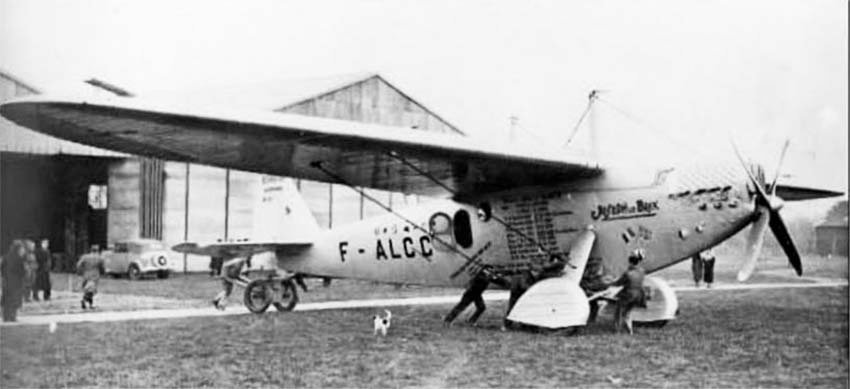 Bl-110 Joseph Le Brix |
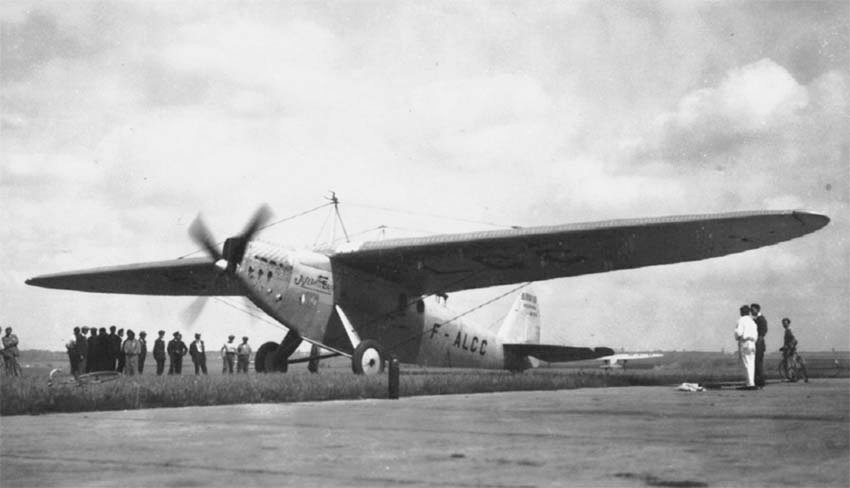 Bl-110 Joseph Le Brix |
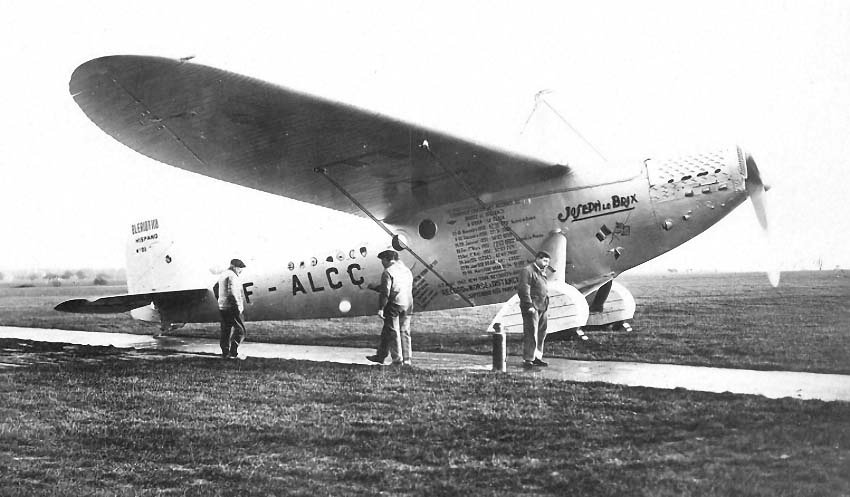 Bl-110 Joseph Le Brix |
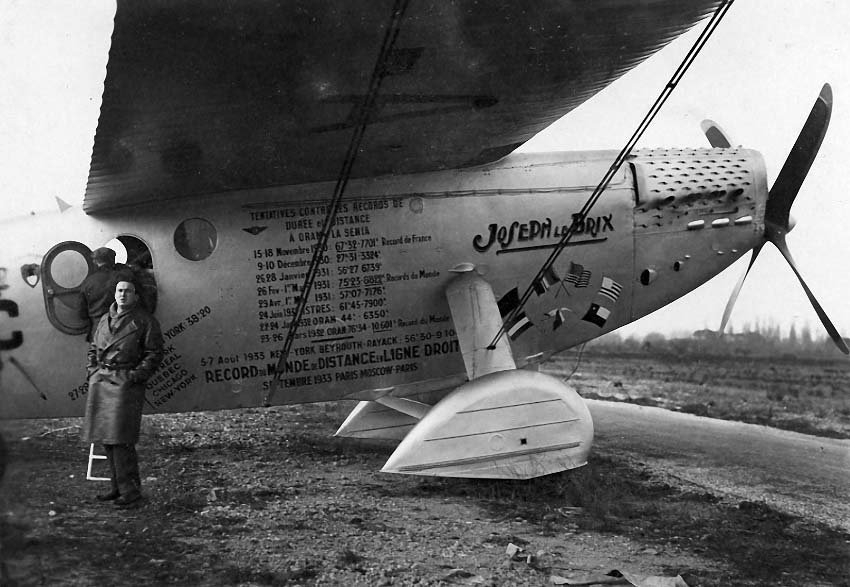 Bl-110 Joseph Le Brix |
 Bl-110 Joseph Le Brix |
 Bl-110 Joseph Le Brix |
 Bl-110 Joseph Le Brix |