
The Bell 214ST Super Transport is a multipurpose helicopter developed by the American company Bell Helicopter Textron. The Bell 214ST helicopter is an evolution of the Bell 214A, which began development as a military transport variant in 1972 for the Iranian army. Iran ordered 283 helicopters, optimized for operation in mountainous terrain and high-temperature conditions.
The first flight of the experimental Bell 214ST helicopter took place in February 1977. Production of three pre-series helicopters began in 1978, and in 1979, the production of the first serial batch of 107 214ST helicopters commenced. Deliveries started in 1982 and concluded in 1989.
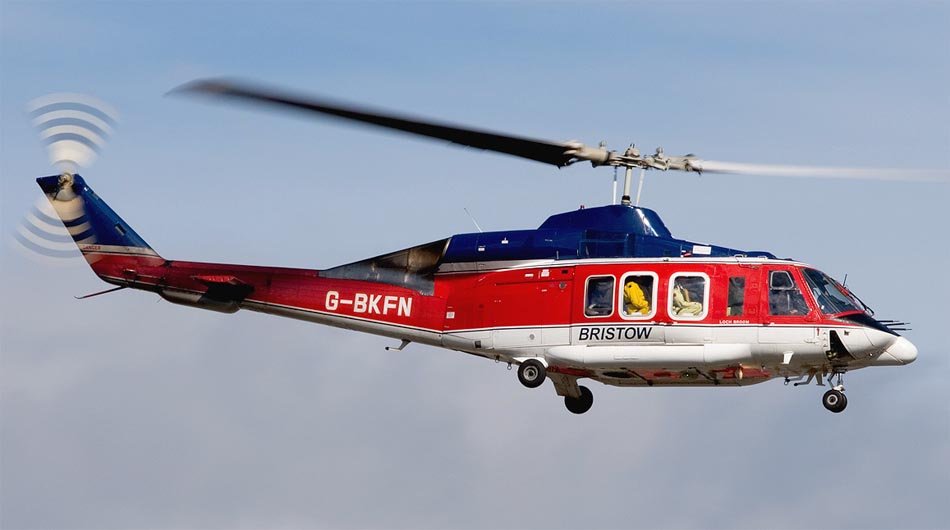
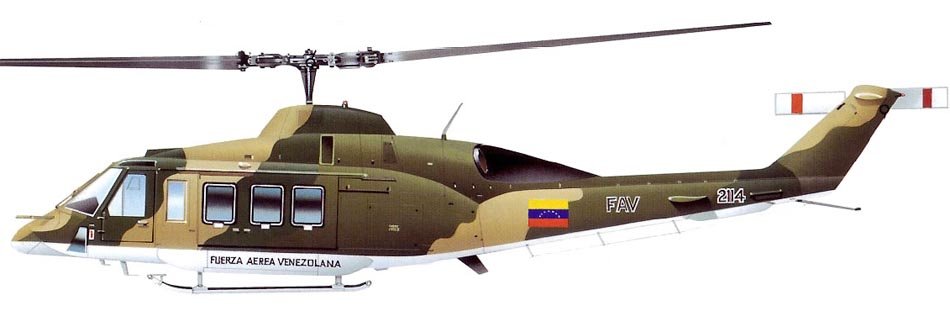
In 1982, the 214ST helicopter was certified in the USA as a civil transport variant with multi-purpose capabilities. The helicopter also underwent transport category certification in Canada, Japan, England, and the USA, where it is used for servicing offshore drilling platforms. Additionally, 45 helicopters were ordered for Iraq, 11 for Peru, 9 for Thailand, and 4 for Venezuela in the military transport variant.
The Bell 214ST helicopter continues the development direction of Bell 205, 212, and 214 helicopters and can be considered a new, next-generation helicopter. Its payload characteristics approach those of multi-purpose and transport helicopters like the Sikorsky S-70. The possibility of using a four-bladed main rotor with a “type 600” hub was also considered for the helicopter.
The Bell 214ST helicopter was developed with Bell’s own funds, with the company spending over $100 million on its development and certification. The price of a production Bell 214ST helicopter in 1988 was $6.5 million.
Design and Structure
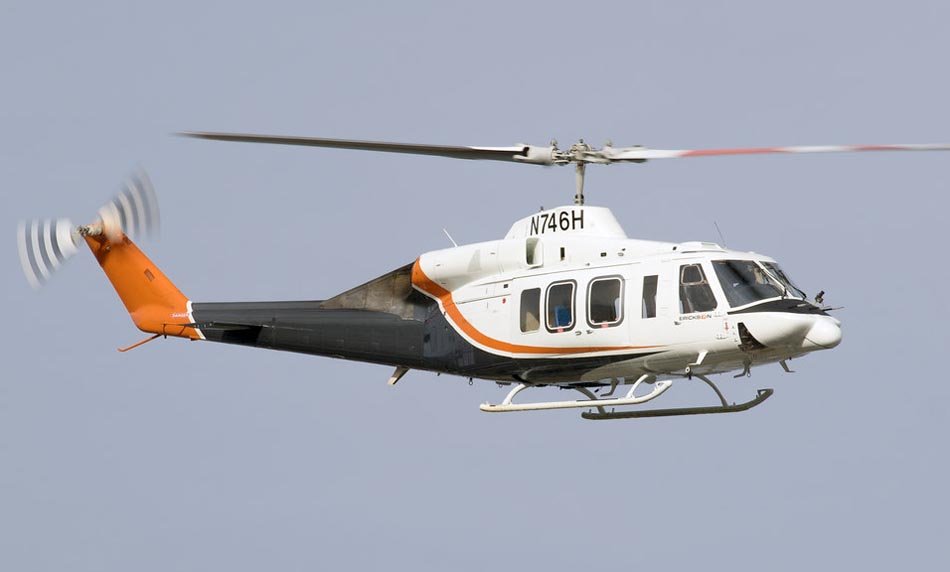
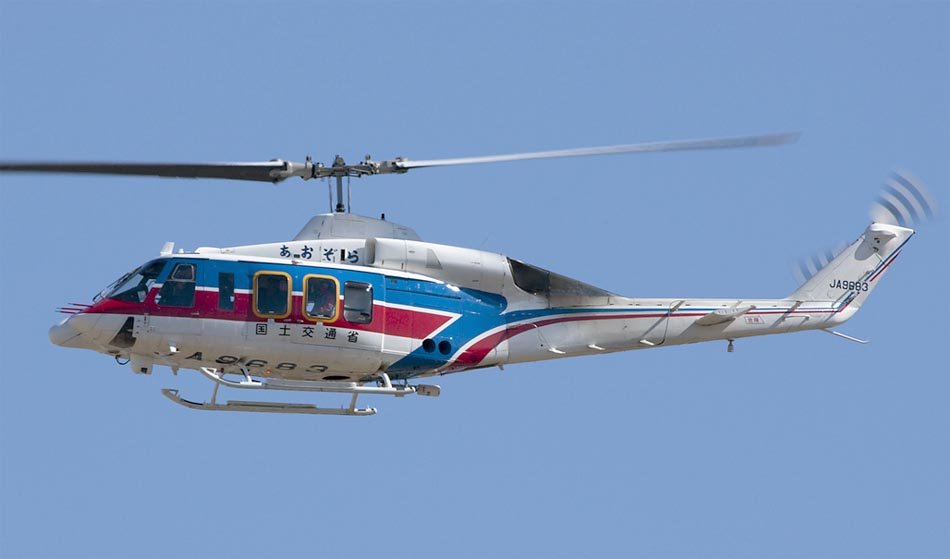
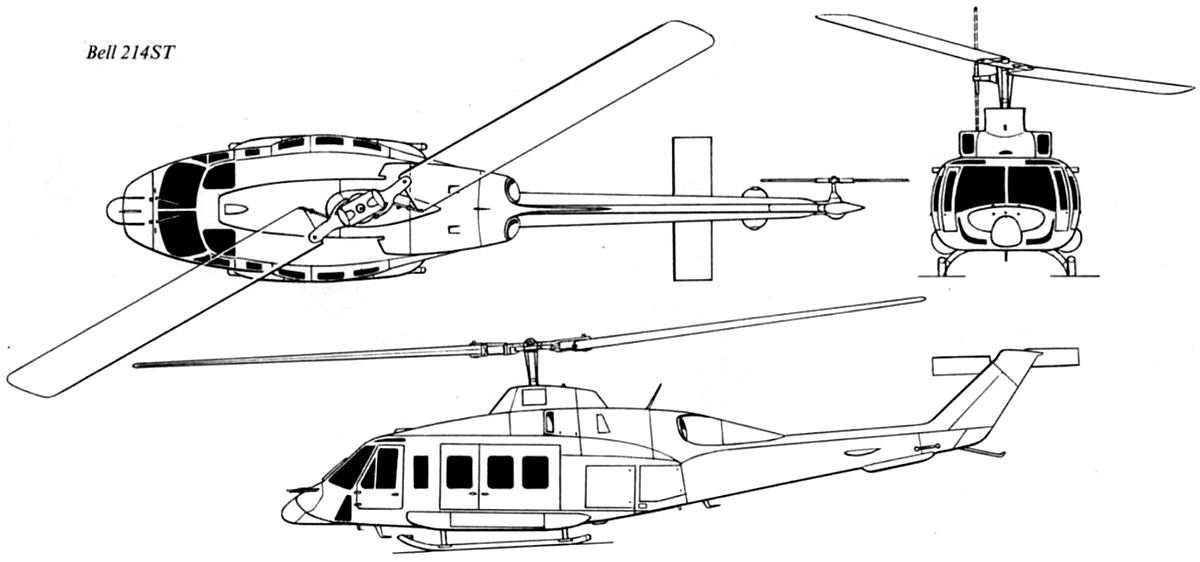
The helicopter is designed with a single-rotor configuration, featuring a tail rotor, two turboshaft engines (GTEs), and skid landing gear.
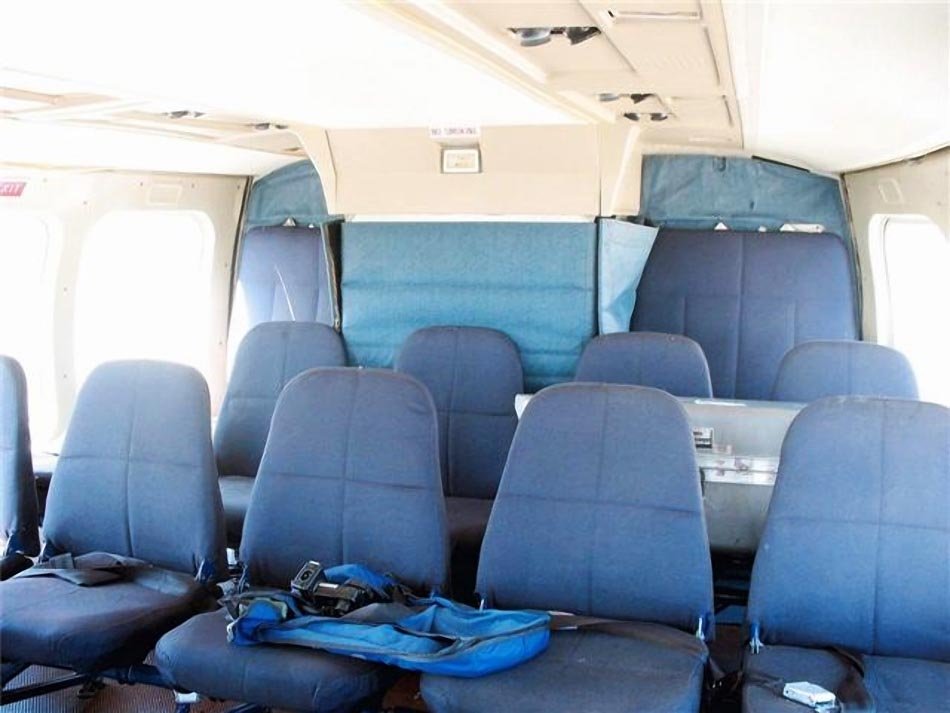
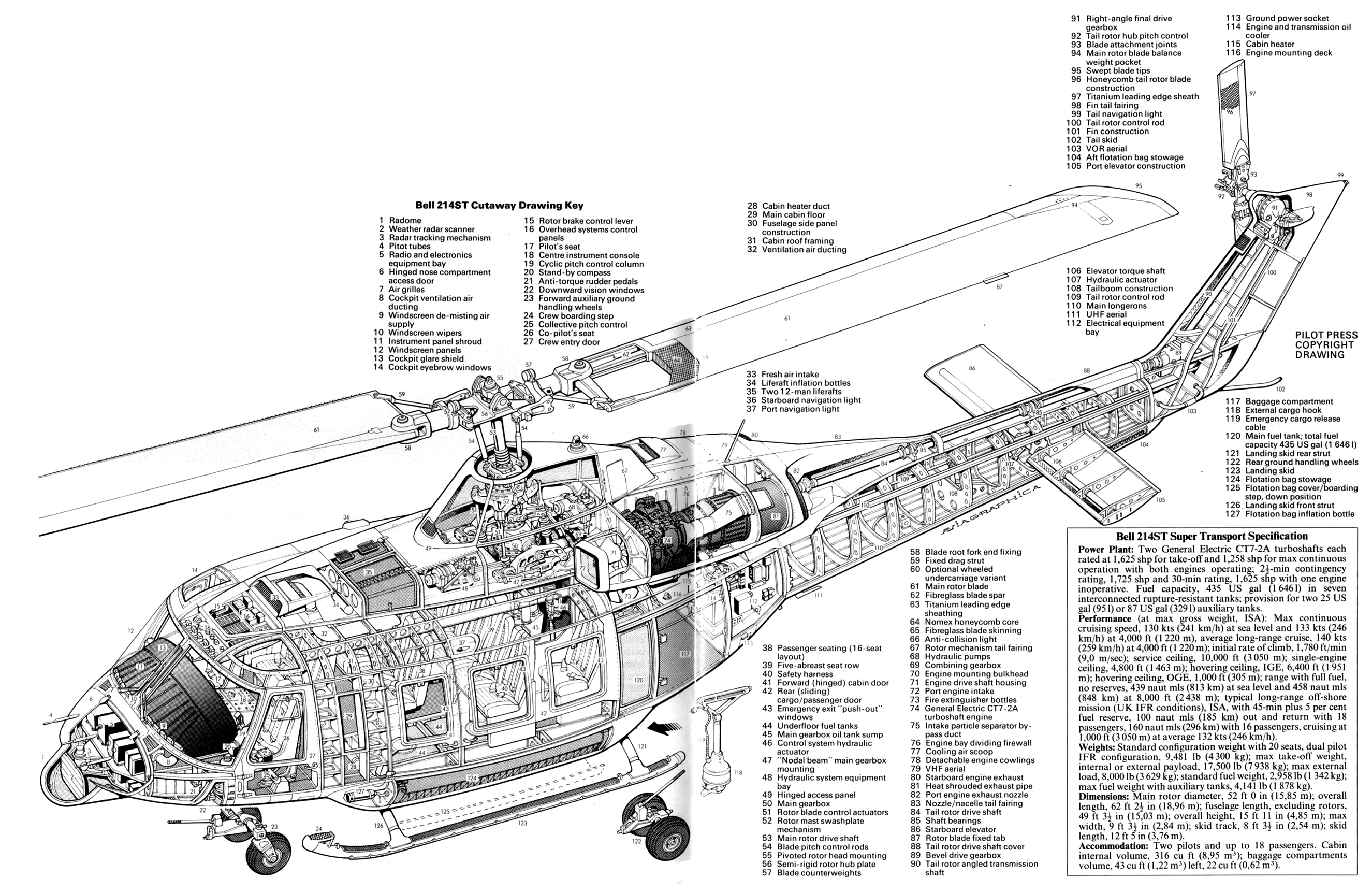
The fuselage is an all-metal semi-monocoque type with a reinforced structure; large cargo doors, sliding on guides, and crew doors are located on both sides of the fuselage. The cabin, with a maximum length of 4.13 m, a width of 2.41 m, and a volume of 8.95 m³, accommodates 15 seats in the passenger variant, arranged in three rows, plus two additional seats at the base of the main rotor shaft.
In the cargo variant, the seats are removable. A luggage compartment with a volume of 1.84 m³ is located behind the cargo cabin. A standard heating and ventilation system is provided.
The stabilator is all-moving, controllable, rectangular in plan, with a span of 2.85 m and an area of 2.22 m². The tail boom, designed as a fin, has a height of 1.5 m and an area of 1.65 m².
The main rotor is two-bladed, with rectangular-plan blades of improved design using composite materials. The spar and stringer along the blade’s trailing edge are made of fiberglass with unidirectional fibers, while the skin is made of fiberglass with fibers oriented at a +45° angle. The compartments between the spar and the stringer along the trailing edge have a honeycomb structure with Nomex material as filler. The blade’s leading edge is covered with a protective titanium strip, and the blade tip, made of stainless steel, is removable, with a chord of 0.84 m. The hub, with a common horizontal hinge, features elastomeric bearings.
The helicopter uses Bell’s developed “Noda-Matic” main rotor pylon suspension system, which reduces vibrations and includes elastomeric dampers that do not require lubrication for 1500 hours of operation. The main rotor brake is standard.
The tail rotor has a diameter of 2.95 m, is two-bladed, and its blades are interchangeable. The spar forms the blade’s leading edge and is made of stainless steel. The middle part of the blade is made of aluminum alloy with a honeycomb filler, and the stringer along the blade’s trailing edge is made of fiberglass. The blade chord is 0.36 m.
The landing gear is non-retractable skid type, with a track of 2.64 m. A variant with standard three-point wheeled landing gear with a track of 2.83 m is possible.
Power Plant
The power plant consists of two coupled General Electric CT7-2A turboshaft engines with a free turbine, housed in a fairing behind the main rotor shaft. The engine’s takeoff power is 1210 kW.
In case of one engine failure, the second can operate in emergency mode, developing 1270 kW. Engine dimensions are: length 1.168 m, diameter 0.635 m. The engines are equipped with an anti-icing system.
The fuel system includes seven protected, interconnected tanks with a capacity of 1674 liters. Provision is made for installing two additional tanks of 2 x 329 liters in the rear part of the cabin and an auxiliary tank of 95 liters under the passenger seat.
The transmission consists of a main gearbox, an intermediate gearbox, a combined gearbox, a tail rotor gearbox, and connecting shafts. The main rotor drive transmission is designed to transmit a maximum power of 1730 kW, 1420 kW in maximum continuous mode, and 1270 kW when one engine is operating. The combined, intermediate, and tail rotor gearboxes can operate without lubrication for one hour.
The main and tail rotor control system is hydraulic, boosted, and duplicated. There is a system to improve stability in pitch, roll, and yaw. The hydraulic system ensures the functioning of the control system and brake actuation; there is an oil cooling system in the transmission and combined gearbox.
Pressure in the hydraulic system is 21.3 MPa, provided by two pumps driven by the main gearbox. The working fluid flow rate in the hydraulic system is 25.4 l/min and 19 l/min (in the general-purpose hydraulic system).
The electrical system is duplicated and includes two generators driven by the main gearbox.
Systems and Avionics
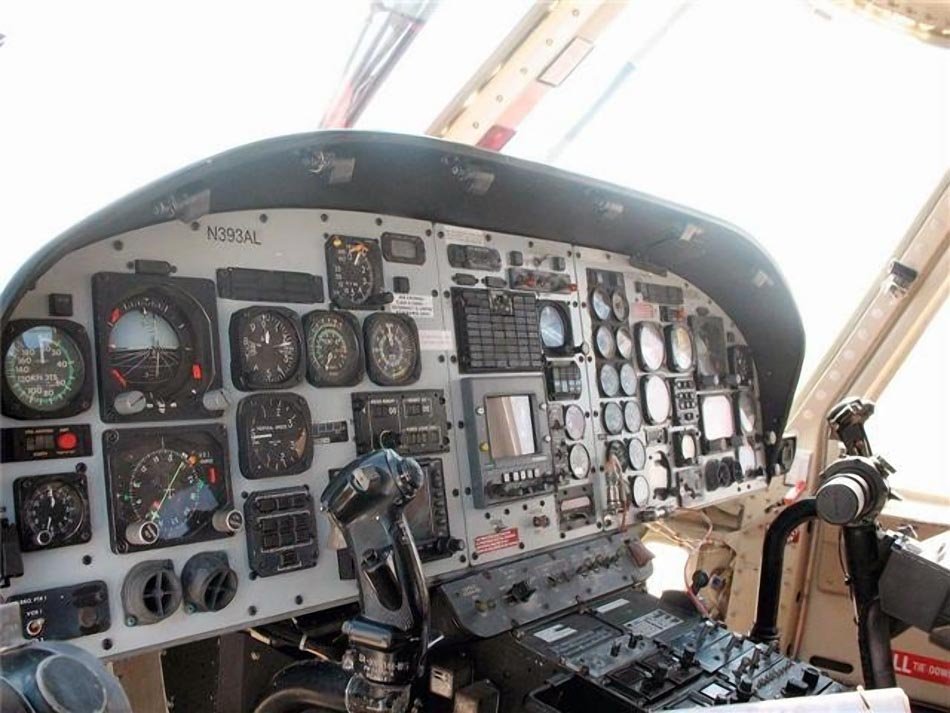
The helicopter is equipped with stability and control augmentation systems (SCAS), attitude and altitude retention systems (AARS), and an automatic (computer-controlled) fly-by-wire stabilator control system.
Electronic equipment includes a standard navigation and communication system with dual redundancy, radio navigation equipment, a radio compass, a transponder, distance measuring equipment, and an air data computer. Provision is made for installing radar and a low-frequency navigation system.
At the customer’s request, an anti-icing system, emergency float landing gear, external cargo suspension points, a winch, and two inflatable life rafts for 10-12 people can be installed.
Technical Specifications
| Modification | Bell 214ST |
| Main rotor diameter, m | 15.85 |
| Tail rotor diameter, m | 2.95 |
| Length, m | 18.95 |
| Height, m | 4.84 |
| Empty weight | 4284 |
| Maximum takeoff weight | 7938 |
| Internal fuel, l | 1647 + optionally 659 |
| Engine type | 2 General Electric CT7-2A turboshaft engines |
| Power, kW | 2 x 1212 |
| Cruising speed, km/h | 259 |
| Practical range, km | 1020 |
| Combat radius, km | 858 |
| Rate of climb, m/min | 543 |
| Service ceiling, m | 1950 |
| Static ceiling, m | 1460 |
| Crew | 1 – 2 crew |
| Payload | 18 passengers or 3493 kg of cargo |
Image and diagram gallery of the Bell 214ST Super Transport
 Bell 214ST Super Transport |
 Bell 214ST Super Transport |
 Bell 214ST Super Transport |
 Bell 214ST Super Transport |
 Bell 214ST Super Transport |
 Bell 214ST Super Transport |
 Bell 214ST Super Transport |
 Bell 214ST Super Transport |