
Origins and Initial Concept
The light multi-purpose Boomerang aircraft was developed by Australian designer C. William Whitney in the early 2000s. This three-seater, cantilever low-wing monoplane was equipped with a 116 hp Lycoming O-235-N2C four-cylinder engine. The Boomerang was primarily intended for civil pilot training, as well as for tourism and sport flights, showcasing its versatility.
Development and Market Ambitions
The prototype’s maiden flight took place on July 6, 2006. Production of the Boomerang DW-200 was managed by Dean-Wilson Aviation Ltd. Designed to meet FAR23 requirements, the aircraft was envisioned as a direct replacement for popular models like the Piper PA-38 Tomahawk and Cessna 150/152. Furthermore, the company leadership harbored strong hopes of securing a significant contract from the Royal Australian Air Force (RAAF).
Production Challenges and Company Demise
Serial production of the Boomerang commenced in September 2007. Initially, aircraft were fitted with the Lycoming O-235 engine and an analog (VFR) cockpit. A later decision was made to upgrade subsequent models with a more powerful Lycoming O-320 engine and a modern “glass” (IFR) cockpit. Unfortunately, after producing only six examples, Dean-Wilson Aviation Ltd. ceased its operations, and its remaining assets were ultimately sold off in 2011.
Technical Specifications
| Modification | Boomerang DW-200 |
| Wingspan, m | 9.80 |
| Aircraft length, m | 6.46 |
| Wing area, m2 | 13.72 |
| Empty weight | 600 |
| Maximum takeoff weight | 825 |
| Engine type | 1 Piston engine Lycoming O-235-N2C |
| Power, hp | 1 x 116 |
| Maximum speed, km/h | 282 |
| Cruising speed, km/h | 172 |
| Practical range, km | 805 |
| Practical ceiling, m | 3048 |
| Crew | 1 |
| Payload | 2 passengers |
Image and diagram gallery of the Boomerang
 Boomerang |
 Boomerang |
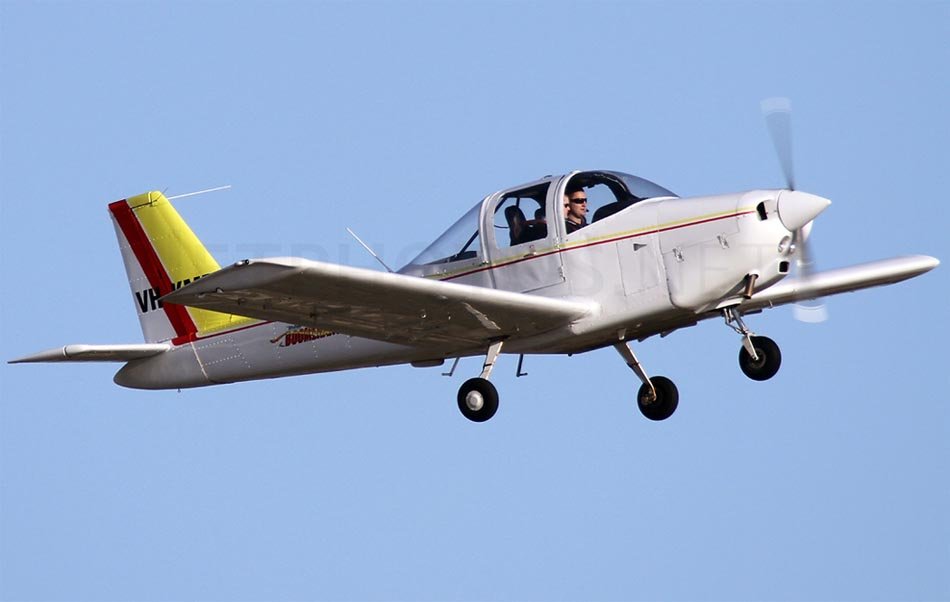 Boomerang. Photo: Brenden |
 Boomerang. Photo: aviationwa.org.au |
 Boomerang |