
Origins and Initial Design
In the final days of World War I, British pilots encountered localized armor protection on German aircraft, prompting calls for increased effectiveness of airborne armament. An early attempt involved upsizing the .303-inch Vickers machine gun, though its 11mm variant wasn’t evaluated in combat. In January 1924, Adams Willmot, chief designer at Birmingham Small Arms (BSA), a major producer of Lewis machine guns during WWI, presented his own heavy machine gun design for defensive installations.
The weapon’s resemblance to the Lewis led many to believe it was merely an enlarged version, but the 12.7mm BSA was, in fact, an entirely independent design, with similarities limited to external appearance. The machine gun featured a remarkably simple design, allowing for manual disassembly and assembly without tools. Unlike the gas-operated Lewis, its automatic mechanism functioned via bolt recoil.
It offered both air and water cooling options for the barrel and supported both automatic and single-shot firing modes. Ammunition was fed from a unique 37-round disk magazine, which visually resembled an enlarged Lewis magazine. The need for a heavy machine gun in defensive installations was evident, complementing the heavy offensive armament that garnered interest in England during the late 1920s.
Trials, Unique Features, and Mechanics
In 1928, the 12.7mm BSA machine gun underwent trials by both the RAF and the Royal Navy. Two versions were tested: an air-cooled aviation variant with aluminum radiator fins and a perforated shroud for enhanced air circulation, and a water-cooled “ground” version featuring a sealed jacket around the barrel with flexible hoses and a simple water pump.
The ammunition feeding system, while visually similar to the Lewis machine gun’s disk magazine, was entirely original and never replicated in other firearms before or since. Developers used a single-row, 37-round disk magazine to achieve a lower aiming line. Recognizing this capacity was insufficient for aviation, designers allowed for in-situ reloading of the disk without removing it from the gun. This feature enabled a gunner to continuously add rounds during combat lulls, avoiding time-consuming magazine changes. Additionally, spent brass casings ejected straight down from beneath the receiver onto the cockpit floor, a combat advantage preventing them from hitting other friendly aircraft.
The machine gun could be equipped with either a wooden stock or Maxim-style handles.
To fire the .50 caliber BSA machine gun, a loaded magazine is inserted with the first round positioned in the central feed slot. The charging handle is pulled back until the bolt engages the sear, holding the entire recoil mechanism cocked. The fire selector can be set for single-shot or automatic firing.
Upon pressing the trigger, the recoil mechanism moves forward under the stored energy of the return spring, picking up a round from the magazine and chambering it. The spring-loaded firing pin is unlocked by the rotation of the bolt sleeve, which presses it against the barrel, allowing it to move forward and strike the primer in the chamber.
Recoil energy, generated by powder gases acting on the barrel, breech extension, bolt, bolt sleeve, and two extended guides (all locked together), provides a recoil stroke of 85.7 mm. At the end of this stroke, an unlocking lug engages bayonet slots, rotating the bolt sleeve to unlock the bolt from the breech extension and barrel.
The barrel’s rearward movement stops when the front end of the breech extension contacts a buffer. The barrel then returns to its forward, normal position under the action of the return spring. The bolt, bolt sleeve, and firing pin continue moving backward. The slow unlocking action facilitates casing ejection.
As the bolt approaches the end of its rearward travel, the front face of a slot in its upper part strikes the protruding end of the ejector tooth. This tooth, located in an inclined window, deflects the casing downwards through an opening in the receiver’s bottom.
To keep the bolt sleeve, bolt, and firing pin cocked until the barrel and breech extension reached the firing-ready position, the weapon featured a lever safety within the trigger guard frame. One lever pivoted towards the sear’s fulcrum, its rear designed to engage the bolt sleeve’s bent ends under spring pressure. Its front end attached to the trigger pivot.
A second lever in this intricate system contacted a cam on the underside of the breech extension, and upon returning to the firing-ready position, pressed against the trigger transfer bar, enabling firing only when all working parts were securely locked.
The internal construction of this weapon was highly unusual. Bayonet slots on the sides of the breech extension accommodated lugs located on the head of the bolt sleeve. The bolt body was hollow, containing the firing pin, which was linked to the bolt sleeve by a rigid rod passing through a helical slot in the bolt body. This design allowed for limited longitudinal movement of the bolt sleeve and firing pin, during which some rotational movement was imparted to the bolt for engaging and disengaging the bayonet slots in the breech extension and the lugs on the bolt sleeve head.
Performance Assessment and Verdict
Only two prototypes of the 0.5-inch BSA machine gun were produced; one was sent for testing to the RAF, the other to naval aviation. The machine gun utilized the same 12.7×81 ammunition as the Vickers heavy machine gun, manufactured by Kynoch in Birmingham, a close collaborator with BSA. Trials conducted in Hythe, Kent, yielded disappointing results, including a low rate of fire of only 400 rounds/min and a muzzle velocity of 782.5 m/s for a 53-gram bullet.
The most significant criticism, however, concerned the magazine’s small capacity; it was noted that a minimum capacity of 97 rounds was required. The unusually long recoil stroke of 85.7 mm severely hampered the machine gun’s rate of fire. While theoretically falling under “short-recoil” due to not exceeding cartridge length, this was a record-setting recoil stroke in its class, making the designers’ choice of this mechanism perplexing, given its obvious impact on cyclic rate. Engineers at BSA were aware of the Vickers heavy machine gun, developed concurrently for the same cartridge, and could have observed the advantages of its much shorter recoil stroke of just over 19 mm.
The aforementioned drawbacks ultimately rendered the 0.5-inch BSA machine gun an outsider. Both the Navy and Air Force unequivocally deemed it unsuccessful and unfit for the demands of its era.
Technical Specifications
| Caliber, mm | 12,7 |
| Rate of fire, rpm | 400 |
| Length, m | 1,372 |
| Weight, kg | 20,9 |
| Muzzle velocity, m/s | 792 |
| Cooling | air-cooled |
Image and diagram gallery of the BSA 0.50
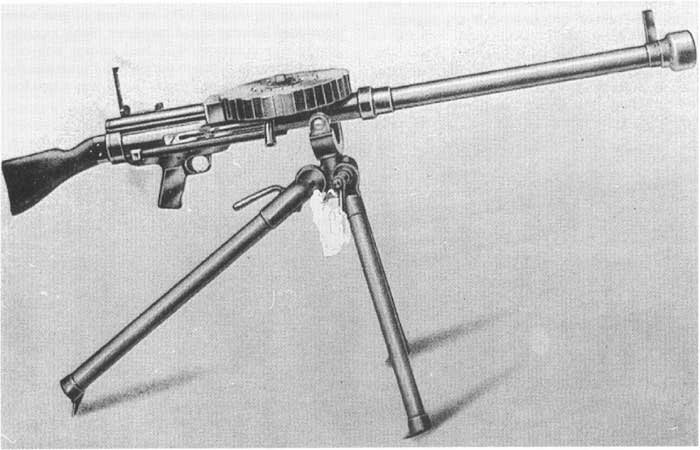 BSA 0.50 |