
The entry of the USA into World War II after the Japanese attack on Pearl Harbor in December 1941 highlighted the unpreparedness of the US Army Air Forces (USAAF) for war. Some preparations made before the “day of infamy” (December 7) proved insufficient and belated. Manufacturers struggled to quickly establish aircraft production in the necessary quantities to meet the demands of the national armed forces, with the need for training aircraft being particularly great.
The Urgent Need for Trainers
This urgent demand explains why Fleetwings Inc., a company from Bristol, Pennsylvania, specializing in stainless steel manufacturing and the production of parts from this material for the US aviation industry, undertook to build a primary trainer aircraft for the USAAF under the designation BT-12.
Named Model 23 by the company, the aircraft outwardly appeared as a rather conventional low-wing monoplane with fixed landing gear, a tailwheel, and a power plant consisting of a single Pratt & Whitney R-985 radial piston engine. The instructor and student were housed in separate cockpits with fully duplicated controls, covered by a common transparent canopy.
Innovative Stainless Steel Construction
An unconventional feature of the BT-12 was embedded in its design: the latter was almost entirely made of stainless steel, with the exception of 65% of the wing skin, ailerons, flaps, part of the fuselage skin, elevators, and rudder, which were fabric-covered. Spot and roller welding techniques were extensively used in its construction.
The sole prototype, XBT-12 (serial number 39-719), successfully completed flight tests. A contract for 24 BT-12 aircraft was subsequently signed. All units were produced and delivered to the USAAF between 1942 and 1943.
Technical Specifications
| Modification | BT-12 |
| Wingspan, m | 12.19 |
| Length, m | 8.89 |
| Height, m | 3.50 |
| Wing area, m2 | 22.23 |
| Empty weight | 1 439 |
| Maximum takeoff weight | 20 00 |
| Engine type | 1 Piston engine Pratt Whitney R-985-25 Wasp Junior |
| Power, hp | 1 x 450 |
| Maximum speed, km/h | 314 |
| Cruising speed, km/h | 240 |
| Practical range, km | 885 |
| Service ceiling, m | 7255 |
| Crew, crew | 2 |
Image and diagram gallery of the BT-12
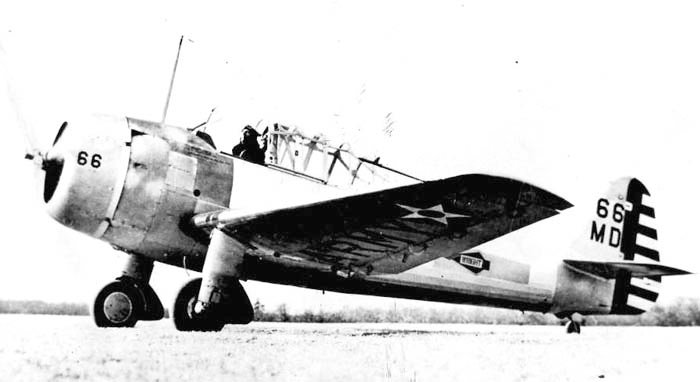 BT-12 |
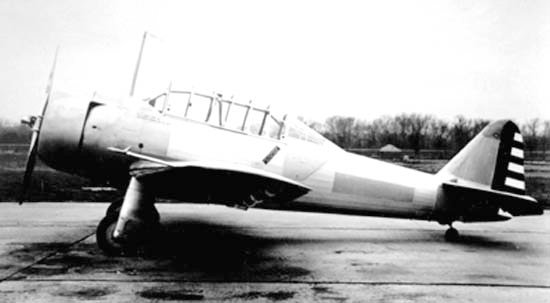 BT-12 |
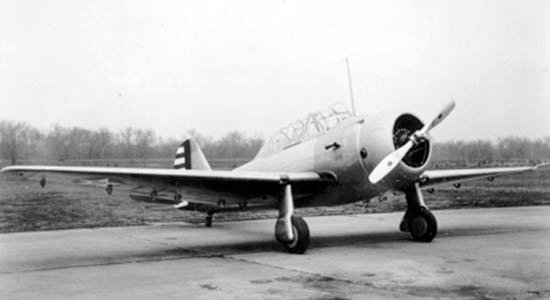 BT-12 |
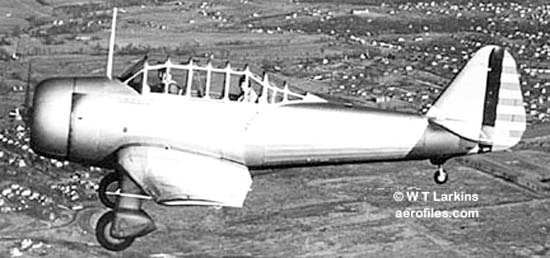 BT-12 |
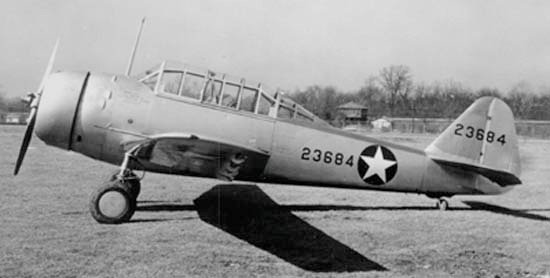 BT-12 |