
The Origin of a Visionary Design
While Rutan Aircraft Factory (RAF) primarily focused on developing homebuilt kits, its successor, Scaled Composites, began fulfilling orders from aircraft manufacturing companies involved in the development and production of certified aircraft. Arguably the largest canard aircraft project was the Starship-1, developed under contract with Beech Aircraft Corporation (now Hawker Beechcraft).
Beechcraft began in 1979 by analyzing the prospects of its twin-engine King Air aircraft line, whose performance characteristics no longer satisfied customers. This led to the conceptualization of a twin-turboprop canard aircraft. In January 1980, the Preliminary Design 330 (PD-330) conceptual project was developed.
On August 25, 1982, a contract was signed between Beechcraft and Scaled Composites, tasking Rutan’s company with verifying the concept using a prototype demonstrator. Burt Rutan was only 39 at the time. Scaled Composites introduced significant changes to the project, notably giving the aircraft a variable sweep wing.
Twenty months later, in August 1983, the prototype took flight. It featured an unpressurized cabin, analog instruments, and differed significantly from the future production design. The demonstrator’s primary role was to validate the concept, so the aircraft was retired once this task was accomplished.
Aeronautical Innovations and Materials
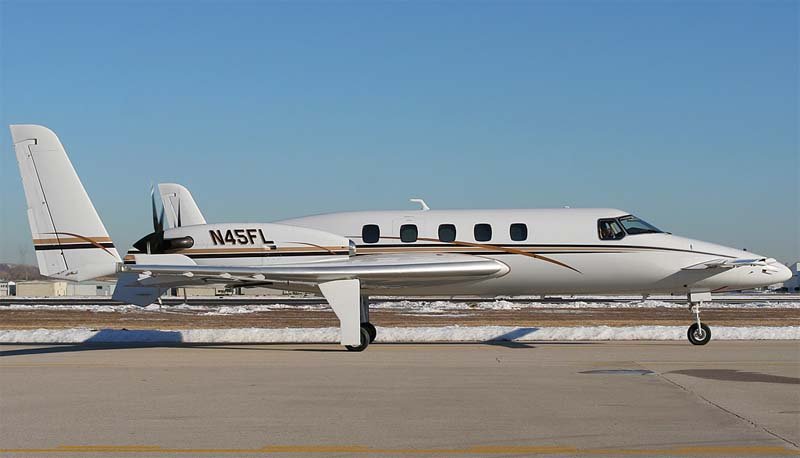
The Starship 1 was in many ways a revolutionary project in business aviation and civil aircraft construction. Primarily, it was the first in this field to develop a “canard” with two turboprop engines and pusher propellers. The engines were positioned behind the passenger cabin, close to the fuselage, to minimize moments from thrust asymmetry in case of an engine failure.
This layout aimed to reduce cabin noise and improve pilot visibility. With its economical turboprop engines, the aircraft acquired qualities akin to a turbofan jet. The aircraft was built using the SCAT 1 automatic speed control system for takeoff and landing.
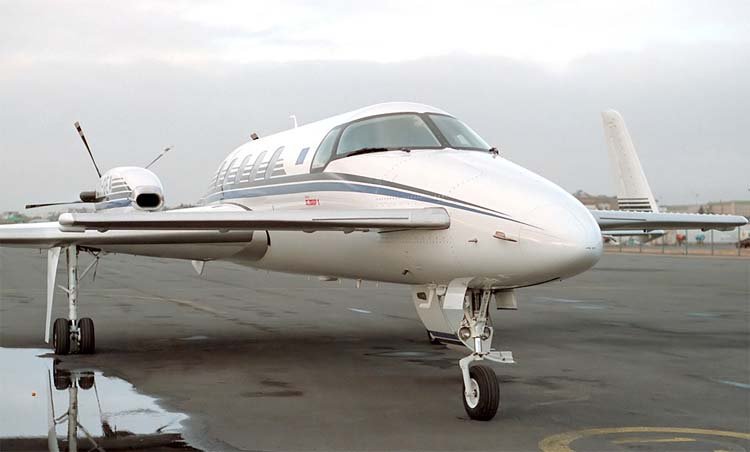
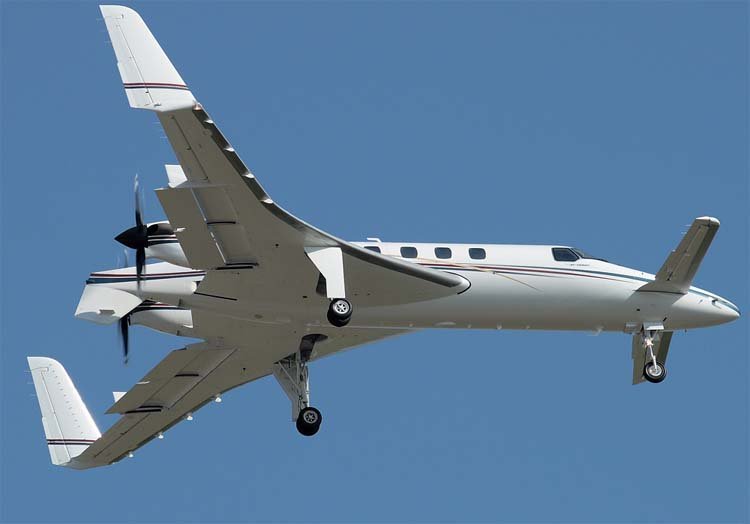
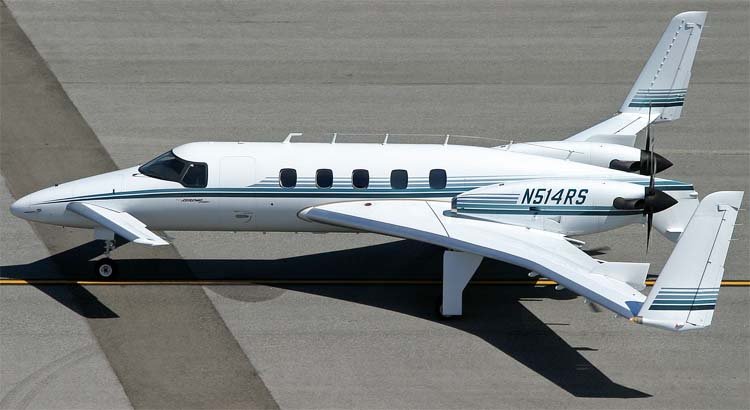
It features a variable taper wing, on which the two pusher engines are mounted. Large wingtip fins, two small rudders on the wing’s trailing edge, and a ventral fin ensure directional stability. The large variable geometry canard surfaces deflect 4 degrees forward during low-speed flight and 30 degrees backward in cruise mode. The internal structural framework of the aircraft is made from Nomex honeycomb graphite-epoxy composite material, with titanium used in areas subjected to high thermal stresses.
The powerplant, consisting of two turboprop engines, is mounted on the wing’s trailing edge, with each engine driving a five-bladed propeller. The engines were installed as close to each other as possible to reduce problems with thrust asymmetry in the event of an engine failure. For the same reason, the lines of thrust force converged somewhat. The main structural element, entirely manufactured from honeycomb panels using composite materials, was the virtually circular cross-section fuselage. To reduce noise, the cabin and cockpit were located forward of the power plant.
The wing was swept, with a high aspect ratio and large leading-edge root extensions (LERX). The aircraft across its entire span presented a monolithic structure, where two swept vertical surfaces were installed (Beech’s definition: “tail sails”). Ahead of the cockpit was the forward horizontal stabilizer (canard), which was set at a 30° sweep in cruise mode. However, during takeoff and landing, the canard surfaces moved to a 4° reverse sweep position, as the aircraft’s center of lift shifted due to the Fowler flaps installed on the wing’s leading edge.
In flight, the Model 2000’s control was achieved: for pitch, by the canard elevators and elevons; for yaw, by the rudders; and for roll, solely by the elevons. For directional control, winglets located on the wingtips and a small fin positioned under the fuselage between the engines were used. The LERX at the wing root not only improved its stall characteristics but also allowed for a thick airfoil, enabling a large fuel capacity onboard.
Combined with minimal aerodynamic drag and the efficiency of the turboprop engines, the aircraft could perform non-stop flights of 2500 km or more. For the first time in civil aircraft construction, carbon composites were extensively used in the design, along with a fully “glass cockpit” – Rockwell Collins Proline 4 AMS-850 displays appeared on the instrument panel. Despite a similar takeoff weight to the King Air 350, the Starship 2000 had a larger cabin.
Production Challenges and Legacy
The Starship aircraft program cost Beechcraft $300 million. During development, the carbon-composite fuselage proved heavier than initially calculated. On the first Starship 2000 aircraft, external noise was also higher than expected, as the pusher propellers operated in the turbulent flow influenced by exhaust gases.
Therefore, after special research, the Starship 2000A received improvements to its exhaust system, the wing surface forward of the engines, noise insulation, and an increased fuel capacity of 117 liters. This not only reduced noise but also lowered the stall speed, allowing the aircraft to take off from shorter runways. However, overall aircraft production was ceased quite quickly.
The first production aircraft flew on April 25, 1989, and in 1995, production of the Starship 2000/2000A ceased. A total of 24 units were built, and by 2010, only 9 machines were in operation. In 2003, Beechcraft considered supporting such a small fleet too expensive, and a year later, the Raytheon Corporation, which then owned Hawker Beechcraft, sold all Starship tooling and components.
Some aircraft were sold by Evergreen Air Center in parts for $50,000 for assembling Epic turboprop kit planes. Some aircraft ended up in museums; at least one was used by an aviation college as a stand for training in aircraft maintenance.
The problems of the Starship 2000 can be attributed to several reasons. Firstly, the aircraft was too unusual, and too many new solutions (new aerodynamic configuration, new materials, technology, and avionics) were being tested during its creation. Consequently, development costs turned out to be much higher than originally planned.
The aircraft’s operational launch coincided with an economic downturn and the introduction of stricter laws. Specifically, due to a luxury tax adopted in the U.S. in the late 90s, the aircraft’s prices were too high for mass demand. The company even offered them for lease for two years. Nevertheless, the Starship truly became a “spacecraft” in business aviation, whose primary clients are always conservative. Perhaps the “starship” was too far ahead for them?
Work on the Starship project found continuation in the development of the Triumph Model 143 turbofan, which Beechcraft also funded in the 80s. However, this aircraft belongs to a different aerodynamic scheme, featuring three lifting surfaces.
Technical Specifications
| Modification | Beech 2000А |
| Wingspan, m | 16.60 |
| Aircraft length, m | 14.05 |
| Aircraft height, m | 3.94 |
| Wing area, m2 | 26.10 |
| Empty weight | 4574 |
| Maximum takeoff weight | 6758 |
| Engine type | 2 Turboprop Pratt Whitney Canada PT6A-67A |
| Power, hp | 2 x 1200 |
| Maximum speed, km/h | 680 |
| Cruising speed, km/h | 621 |
| Economical speed, km/h | 570 |
| Practical range, km | 2920 |
| Rate of climb, m/min | 838 |
| Practical ceiling, m | 12000 |
| Crew, crew | 1-2 |
| Payload | 6 passengers |
Image and diagram gallery of the Beechcraft Starship 2000
 Beech 2000 Starship |
 Beech 2000 Starship |
 Beech 2000 Starship |
 Beech 2000 Starship |
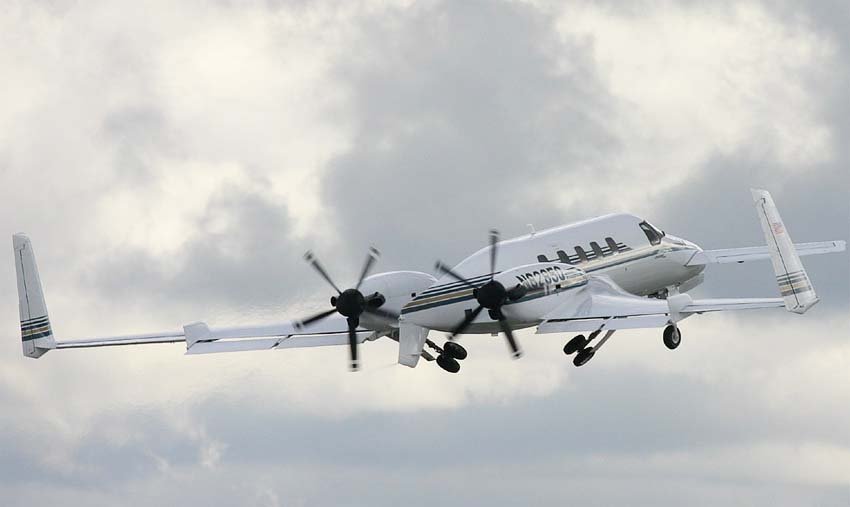 Beech 2000 Starship |
 Beech 2000 Starship |
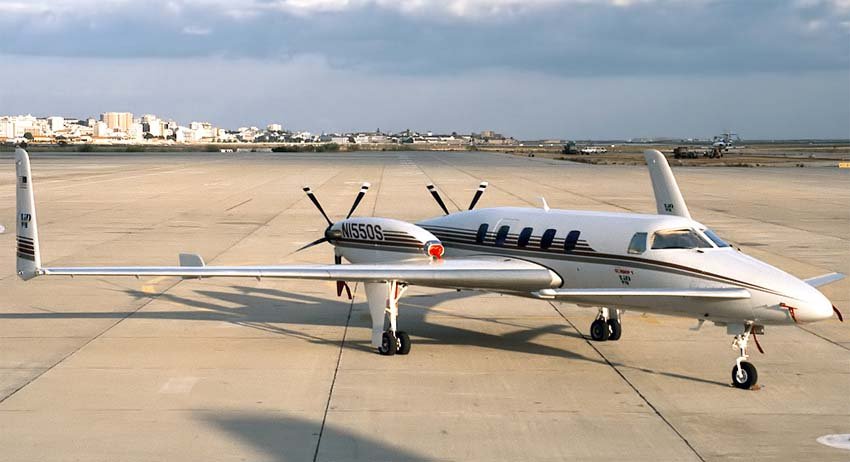 Beech 2000 Starship |
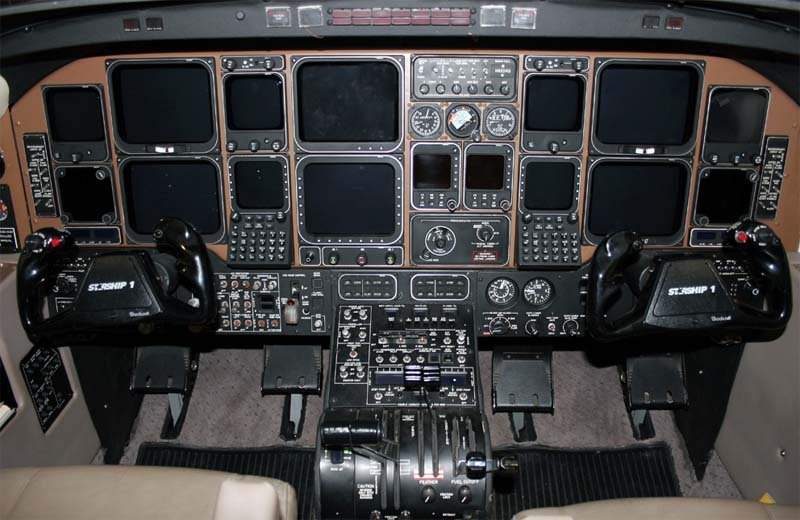 Beech 2000 Starship |
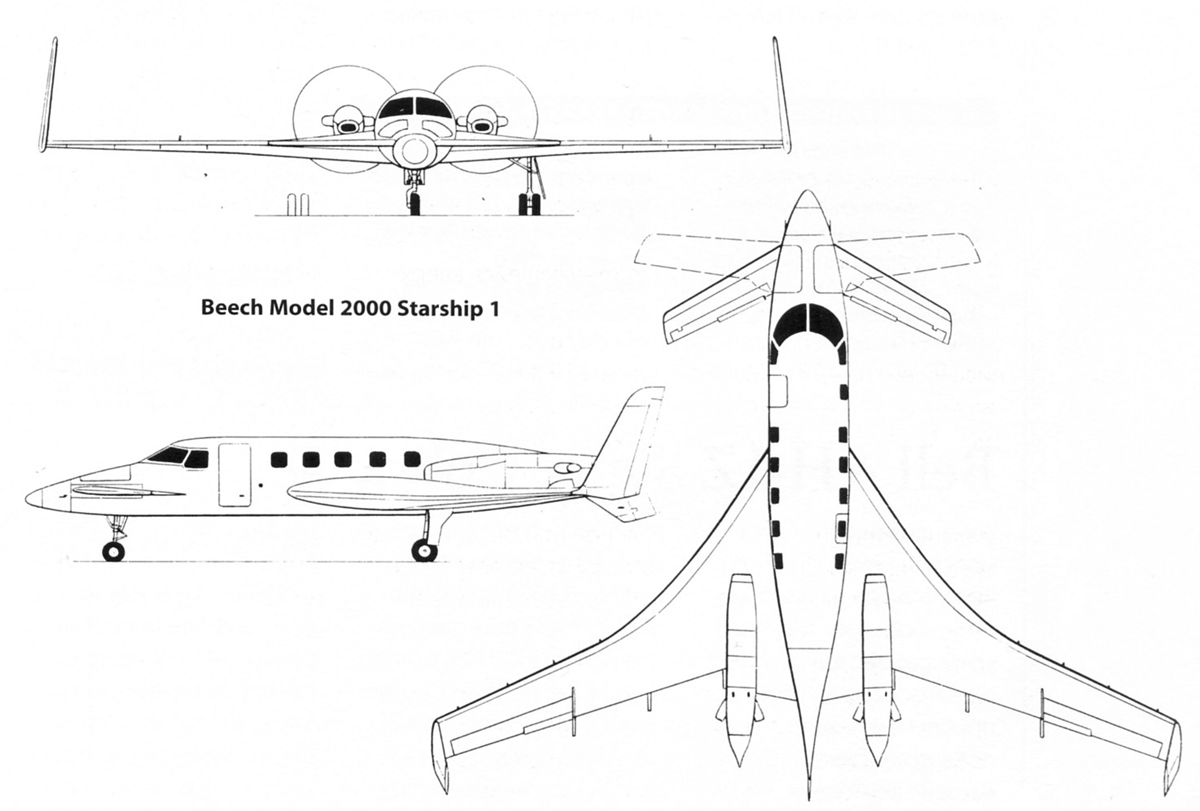 Beech 2000 Starship |
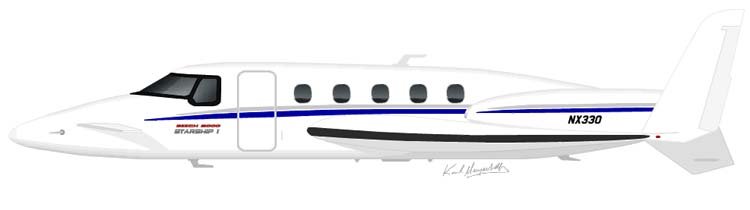 Beech 2000 Starship |