
In the autumn of 1936, testing began on an all-metal aircraft designed by employees of the Bureau of Special Designs (BOK) of TSAGI, under the leadership of engineer V.A. Chizhevsky. In terms of layout, size, and contours, this monoplane resembled the well-known ANT-25. The BOK-1 aircraft was also called “stratospheric” because it was primarily intended for flights at high altitudes, specifically between 12,000 and 13,000 meters.
The aircraft’s wing, with an area of 78.8 square meters, had an aspect ratio of approximately 13, almost identical to that of the ANT-25. The fuselage housed a removable two-seat sealed cabin of the regenerative type, designed for minimal air leakage. This marked the first time such a cabin was installed on a relatively large aircraft in the country. The empty weight of the BOK-1 was 3482 kg, with a normal takeoff weight of 4162 kg.
Early Development and Performance
Flight tests largely confirmed the calculated data. Equipped with an M-34RN engine boasting 725 horsepower, the aircraft achieved a speed of 230 km/h near the ground and 242 km/h at an altitude of 4,000 meters. With a light load, its ceiling reached an impressive 14,000 meters. However, trials also revealed that the cabin required refinement, particularly a significant increase in glazing area. A radiator located beneath the cabin contributed to excessive heat inside.
These shortcomings were predominantly addressed in subsequent aircraft models. The BOK-1 was envisioned for use as a high-altitude reconnaissance aircraft. In the latter half of the 1930s, modified aircraft such as the BOK-7, BOK-8, and BOK-11 were developed based on its design. These variants served as testbeds for sealed cabin structures, turbocharger installations for engine boosting, and advanced hermetic cabins.
Technological Innovations and Variants
Some of these machines featured remotely controlled electrically operated armament systems, similar installations only appearing in the United States several years later. The BOK-8 represented an evolution of the BOK-7. Its preliminary design, developed in 1939, included provisions for a gun system. An electro-autosynchronous targeting system (Rezunova sight) and remote firing control for operating weapons from inside the sealed cabin were developed. The aiming system for machine guns located outside the sealed cabin was also remote-controlled, using a synchronous-tracking scheme with thyratrons and Selsyns. Engineers V.S. Kostyshkin and K.V. Zhbanov authored this innovative system, long before a similar setup was implemented in the US B-29 bomber.
The BOK-11 shared the same airframe design as the BOK-7 but was powered by an A.D. Charomsky ACh-40 diesel aircraft engine to extend its flight range. It featured a three-seat sealed cabin. Two prototypes of the aircraft were built in 1940 and successfully underwent trials. Preparations were underway for a long-range high-altitude flight, but the pre-war situation prevented such flights from taking place. Ultimately, the BOK design bureau was integrated into P.O. Sukhoi’s OKB.
Detailed Technical Specifications
The wing of the BOK-1, equipped with a center section and detachable outer panels, was a three-spar design. Unlike the ANT-25, it lacked powerful fairings at the fuselage junction. The detachable outer wing panels (OCK) comprised 16 ribs, whose upper chords protruded into the airstream. The chords of the first two OCK spars, up to mid-span, were made of heat-treated chrome-molybdenum tubes, transitioning to duralumin tubes towards the wingtips. The third spar, being the least stressed, was entirely constructed from duralumin tubes. The wing skin was corrugated, similar to the ANT-25. During tests, the corrugated upper surface was covered with thin percale, polished, and painted.
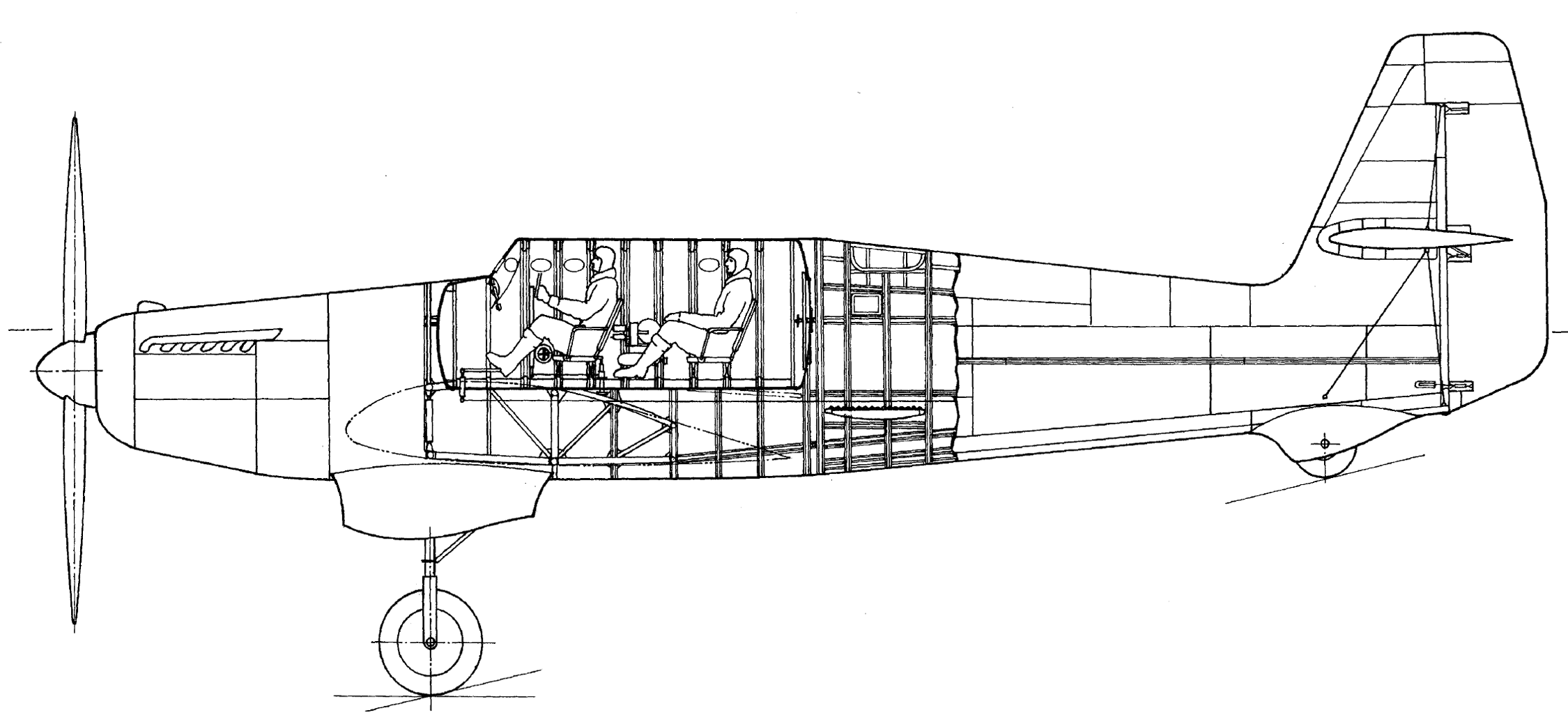
The fuselage was structurally divided into three parts: nose, central (integrated with the center section), and tail. The front section of the fuselage was easily removable to facilitate the installation of various engines. The central part was designed to allow the sealed cabin to be inserted from above.
The two-crew sealed cabin was a separate, self-contained element, not structurally integrated into the aircraft’s airframe. It had an oval cross-section, consisted of 11 frames, and was skinned with 2mm duralumin. To ensure sufficient airtightness, a double riveted seam with pre-applied zinc white was used. The cabin was designed with a 6-fold safety margin, and in practice, it maintained an overpressure of 0.8 atmospheres. Entry into the cabin involved the crew first entering the aircraft via an upper fuselage hatch (a preliminary vestibule), then proceeding through a sealed hatch in the cabin’s rear wall to their workstations, where they sealed themselves in.
The upper exterior of the sealed cabin (but beneath the fuselage skin) was insulated with a layer of felt. This insulation also significantly reduced cabin noise, allowing for conversation without vocal strain. The lower part of the sealed cabin was heated by air flowing from the engine’s cooling radiator. A special flap, controllable from the cabin, was provided for regulating this heating.
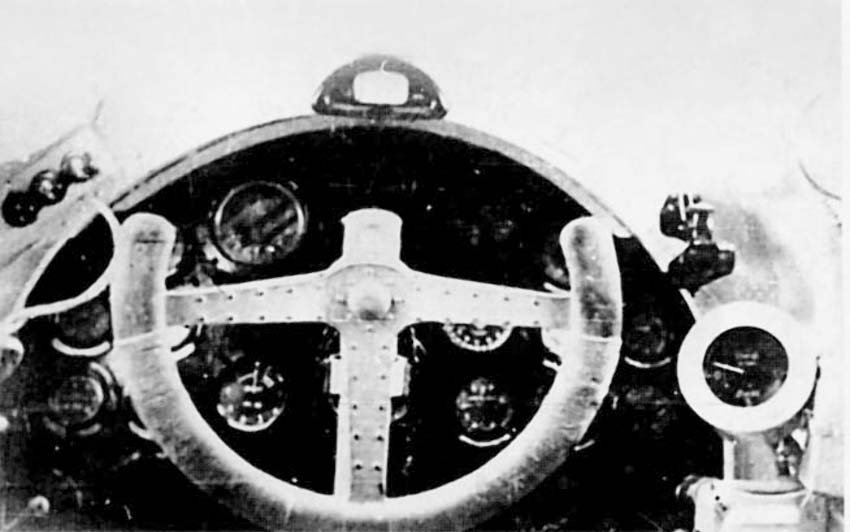
The sealed cabin was equipped with seven portholes: five for the pilot and two for the observer. These portholes utilized special tempered glass, 15-16mm thick. To prevent fogging, inner panes of 3-4mm thickness were installed, constantly warmed by hot air. The space between the panes was dried with moisture absorbents (calcium chloride and silica gel). The crew’s air supply was managed through a regeneration system. Oxygen was supplied at a rate of 120 liters per hour for two people. Expelled carbon dioxide and moisture were absorbed as cabin air was circulated by a centrifugal fan through chemical absorbents.
The BOK-1’s landing gear was non-retractable, featuring oil-pneumatic shock absorption. The main struts were equipped with supporting braces. The 900×200 mm wheels were covered by teardrop-shaped fairings. Power was provided by an AM-34RN engine, delivering 800 horsepower up to 4,000 meters. The liquid coolant radiator was positioned beneath the fuselage, fitted with adjustable flaps. The oil radiator was placed in front of the water radiator, initially a plate-type and later a cellular design. For initial flights, a wooden, four-bladed propeller with a diameter of 4.0 meters was used. This was subsequently replaced by a two-bladed wooden propeller (4.35 m diameter), and later still, a metal propeller with a 4.1-meter diameter was adopted.
The total fuel capacity was 500 kg, stored in four cylindrical tanks located between the first and second spars of the center wing section. The BOK-1 featured a two-tone red and silver paint scheme. A triangle bearing the emblem of the Bureau of Special Designs was depicted on its vertical stabilizer.
Technical Specifications
| Modification | BOK-1 |
| Wingspan, m | 30.00 |
| Length, m | 12.86 |
| Wing area, m2 | 78.80 |
| Empty weight | 3400 |
| Normal takeoff weight | 4880 |
| Engine type | 1 Piston engine M-34RNB |
| Power, hp | 1 x 830 |
| Speed at sea level | 240 |
| Speed at altitude | 260 |
| Rate of climb, m/min | 500 |
| Service ceiling, m | 12000 |
| Crew, crew members | 1 |
Image and diagram gallery of the BOK-1
 BOK-1 |
 BOK-1 |
 BOK-1 |
 BOK-1 |
 BOK-1 |
 BOK-1 |
 BOK-1 |
 BOK-1 |