
Today’s jetliner passengers flying on the edge of the stratosphere rarely consider that just 60 years ago, reaching such altitudes (over 10 kilometers) was considered a heroic feat. Only specially trained pilots were permitted for high-altitude flights, battling oxygen deprivation in the thin air with the help of an oxygen mask.
To protect a person from low atmospheric pressure and cold, and critically, to maintain their performance in the upper atmosphere, a spacesuit or a pressurized cabin was essential. The Bureau of Special Designs (BOK), established in January 1931 at TsAGI (Central Aerohydrodynamic Institute), addressed this problem. It was headed by Vladimir Antonovich Chizhevsky, a graduate of the N. E. Zhukovsky Air Force Academy and a TsAGI design engineer.
The creation of aircraft with pressurized cabins became BOK’s primary focus. All machines developed under V. A. Chizhevsky’s leadership were designated “BOK,” which is perhaps why he is less known than other aircraft designers whose names are borne by planes and helicopters. BOK’s first achievement was the pressurized gondola of the “SSSR” stratostat.
Pioneering Stratospheric Flight
In 1933, the “SSSR” stratostat made a brilliant record-breaking flight into the stratosphere. Leaving far behind the world record of Swiss physicist and balloonist Auguste Piccard (16,370 meters), the Soviet aircraft ascended to an altitude of 19 kilometers. The crew conducted unique experiments and gathered data, refining understanding of the atmosphere’s structure and parameters at high altitudes. The “SSSR” stratostat’s flight, which garnered worldwide admiration, paved the way for the creation of the first domestic aircraft with pressurized cabins.
The concept of a stratospheric aircraft took shape at BOK even during the work on the “SSSR” stratostat gondola. In April 1934, Chizhevsky spoke at the All-Union Conference on Stratosphere Studies. In his report, he formulated the main requirements for a high-altitude aircraft with a pressurized cabin and immediately followed up by proposing the project for the USSR’s first stratospheric aircraft, the BOK-1(SS). This machine was intended for high-altitude aerodynamic research, testing the pressurized cabin and external control outputs, and verifying engine capabilities.
BOK-7: Advancements in Pressurized Cabin Design
The new BOK-7, primarily designed for achieving record altitudes, already featured a ventilated pressurized cabin. The BOK-7 was a repetition of the BOK-1, but its pressurized cabin was integrated, meaning it was inseparable from the fuselage, with its walls forming part of the fuselage structure. Above the cabin were two convex domes with several portholes each, covering the pilot’s and observer-pilot’s seats.
Equipped with an M-34FRN engine and two turbochargers, the BOK-7 was tested in 1938 and showed performance generally similar to the BOK-1. Pilots I.F. Petrov and P.M. Stefanovsky tested it. Interesting ground experiments were conducted with this aircraft and its successor, the BOK-11. Several crews, preparing for long-duration high-altitude flights (Gromov, Yumashev, Danilin, Spirin, Baidukov, Belyakov, etc.), lived for several days in the aircraft’s pressurized cabin, testing the entire life cycle on themselves. This was a training for pilots intended for future prolonged high-altitude flights on the BOK-15 aircraft.
High-Altitude Survival Engineering
All systems worked well. The cabin’s sealing was such that normal oxygen supply to the breathing apparatus compensated for minor air leakage through seams and control and wiring outlets. However, it was anticipated that leakage in a flying aircraft could be significantly greater, so the pressurized cabin was additionally equipped with a supercharging system by installing an engine-driven centrifugal supercharger (PCN). This was the first mixed-type pressurized cabin, featuring gland-sealed control rods and cables.
Technical Specifications
| Modification | BOK-7 |
| Wingspan, m | 32.40 |
| Length, m | 14.85 |
| Wing area, m2 | 87.00 |
| Empty weight | 3400 (3600) |
| Normal takeoff weight | 4814 |
| Engine type | 1 Piston engine M-34FRN (2TK) |
| Power, hp | 1 x 890 |
| Maximum speed, km/h | 350 |
| Service ceiling, m | 15200 |
| Crew | 1 |
Image and diagram gallery of the BOK-7
 BOK-7 |
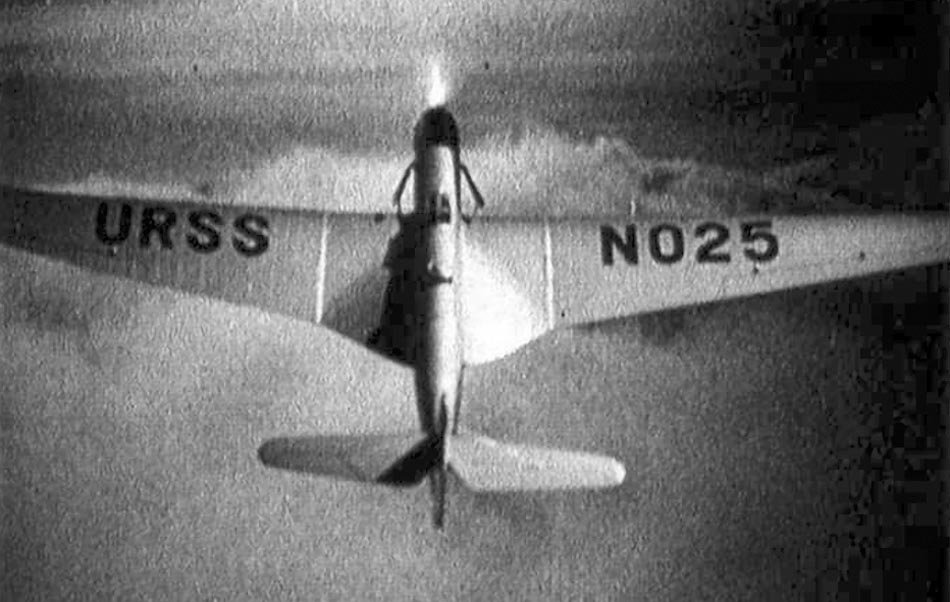 BOK-7 |
 BOK-7 |
 BOK-7 |
 BOK-7 |
 BOK-7 |
 BOK-7 |