
A Revolutionary AEW Concept
Perhaps the most interesting new military aviation development at the recent Le Bourget Air Show was the prototype of a new airborne early warning and control (AEW) system. Proposed by “Airbus Military,” a division of the European aerospace consortium Airbus, and built on the C-295 light military transport aircraft platform manufactured by the Spanish company CASA, part of the consortium, this system represents a significant step forward.
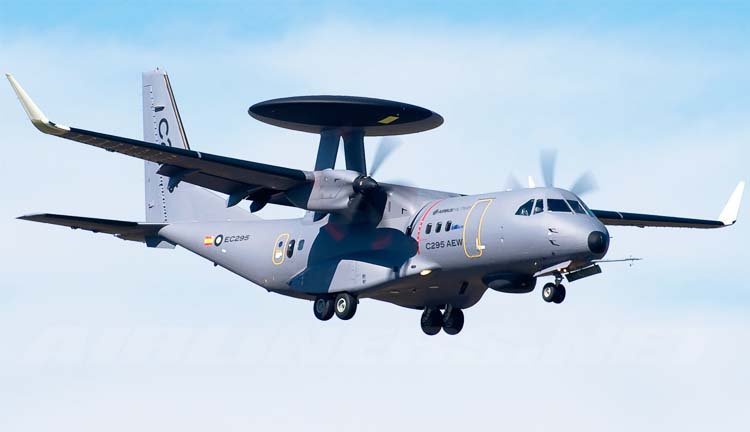
The aircraft’s maiden flight occurred just two weeks before the exhibition opened, yet it arrived at Le Bourget, parked on static display “under the wing” of Airbus Military’s more famous product, the A400M transport. It is important to note that the C-295AEW (sometimes designated EC-295) participating in the airshow is currently a technology demonstrator. The full radio-technical complex (RTK) is not yet on board, and its potential supplier was officially announced only during the exhibition. Nevertheless, the innovation is noteworthy, primarily due to its antenna system placement: an active electronically scanned array (AESA) within a rotating radome—a “dish” above the fuselage—whereas other modern aircraft of similar purpose typically feature fixed AESA panels. Secondly, it marks Airbus’s first proprietary AEW complex, as similar aircraft in Europe have historically been developed and built only in Russia and Sweden.
Strategic Partnership and Market Vision
Airbus Military’s intention to offer its own C-295-based AEW aircraft became known only this spring, when the construction of the C-295AEW prototype was completed at the CASA facility in Seville, Spain. This prototype was designed to assess the impact of placing a large radome (6 meters in diameter) on the aircraft’s performance. During the Le Bourget show on June 21, a memorandum of understanding was formally signed between Airbus Military and the Israeli company ELTA (part of Israel Aerospace Industries, IAI) for the joint development and international marketing of the new C-295AEW.
Domingo Urena, Senior Executive Director of Airbus Military, and Nissim Hadas, President of ELTA, both emphasized the growing global demand for special mission aircraft, including AEW systems, driven by increasing armed conflicts. They highlighted the need for a medium-segment AEW aircraft, in terms of size and price, capable of fulfilling air defense and internal security missions. The collaboration, combining their extensive experience, aims to bring a highly effective and modern product to market at the opportune moment, becoming, broadly speaking, the first medium AEW aircraft. The high commonality of the C-295 airframe and systems with its transport and maritime patrol variants was also stressed, offering potential customers the ability to create a multi-functional fleet from a single platform.
Innovative Radar Technology and Flight Testing
According to Airbus Military specialists, the C-295AEW is intended for operations with air forces, as well as for naval and coast guard missions. Its integration into a network-centric battlefield allows data exchange with virtually any unit across all branches of allied armed forces. The aircraft will feature a fourth-generation radio-technical complex (RTK), which includes an AESA radar integrated with IFF equipment, housed within a rotating disc radome above the fuselage. Optionally, a multi-purpose radar antenna for effective ground and maritime target reconnaissance and tracking can be installed under the C-295AEW’s fuselage.
The tactical crew of six RTK operators will be positioned at unified workstations along the aircraft’s left side, equipped with state-of-the-art information displays, with comfortable rest areas also available in the cabin. While partners’ representatives are reticent about precise RTK characteristics, they assert it will surpass all other similar modern systems. The AESA’s instantaneous azimuth coverage will be 120°, and its rotation speed—”twice as fast as existing AEW aircraft” (likely referring to the American E-3 Sentry, E-2 Hawkeye, and Russian A-50)—will ensure truly circular area coverage.
It’s worth noting that, until now, rotating over-fuselage disc radomes were typically used for slotted or phased array antenna systems, not AESA. Active phased arrays are usually fixed on AEW aircraft, as seen in systems like the Swedish Erieye (on SAAB 340, SAAB 2000, and Embraer ERJ-145), the larger American MESA (on Boeing 737AEW&C), and the Chinese KJ-200. These systems generally use two fixed AESA panels in a flat radome, covering left and right hemispheres, which the C-295AEW creators argue results in “gaps” in coverage. An interesting solution was adopted for the Russian-Israeli A-50I and A-50EI, which housed three ELTA AESA panels in a fixed triangular arrangement within a disc radome. However, the C-295AEW’s configuration with a single rotating AESA is quite unusual, though a similar Chinese ZDK-03 (developed for Pakistan based on the KJ-200) also features a rotating AESA “dish,” possibly with Israeli specialist involvement.
The C-295AEW prototype-demonstrator currently lacks both the full RTK and its radome rotation system; for initial flight testing, it is fitted with a fixed dummy 6-meter over-fuselage “dish,” according to Airbus Military. The aircraft’s first flight took place in Seville on June 7, 2011, lasting 2 hours and 48 minutes. Test pilots Alejandro Madurga and Alfonso de Castro, along with flight engineers Juan Jose Baeza and Antonio Ojeda, operated the demonstrator. The initial test phase aimed to assess the radome’s impact on the base aircraft’s structure, stability, control, and flight characteristics. “The first flight confirmed that the C295 is an excellent platform for installing such a radome,” Madurga stated, adding that its behavior and main characteristics were more than satisfactory.
Airbus Military reported that the initial flight test phase of the C-295AEW demonstrator would continue for three months, during which all main characteristics of the modified aircraft would be thoroughly investigated, leading to a decision on the final approval of the new European AEW concept. Later, on December 21, 2012, Airbus Military conducted the first test flight of the CASA C295 AEW with winglets installed, designed to enhance efficiency during takeoff, climb, and cruise flight.
Technical Specifications
| Modification | C-295AEW |
| Wingspan, m | 25.81 |
| Length, m | 24.45 |
| Wing area, m2 | 59.10 |
| Empty weight | 12000 |
| Maximum takeoff weight | 20200 |
| Engine type | 2 Turboprop Pratt Whitney Canada PW127G |
| Power, kW | 2 x 1975 |
| Cruising speed, km/h | 482 |
| Patrol endurance, h | 8 |
| Service ceiling, m | 7620 |
| Crew, crew members | 2 |
Image and diagram gallery of the C.295AEW: The Spanish Airborne Early Warning System
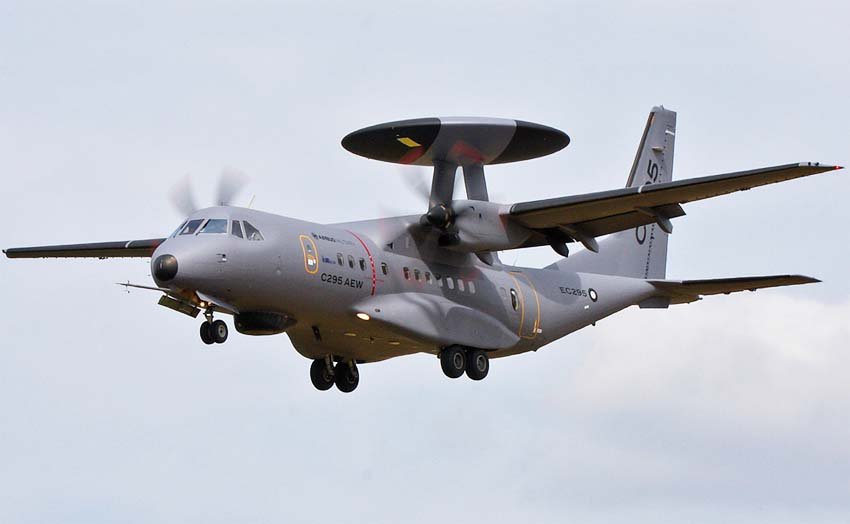 C.295AEW |
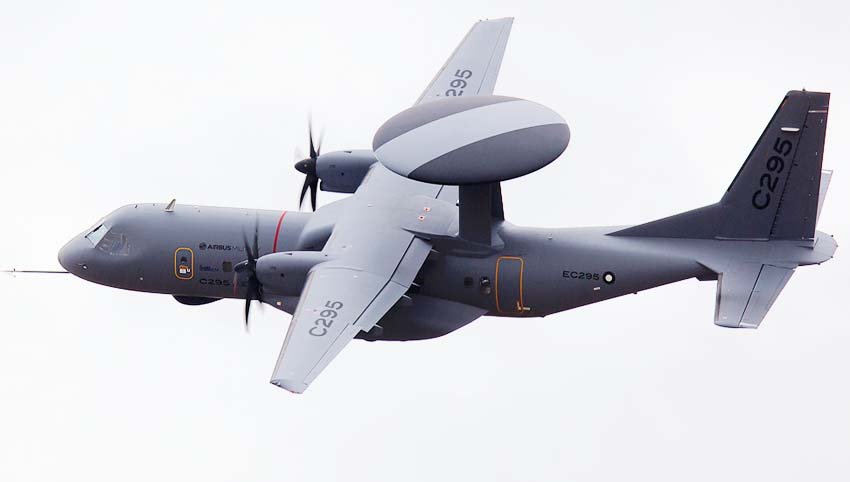 C.295AEW |
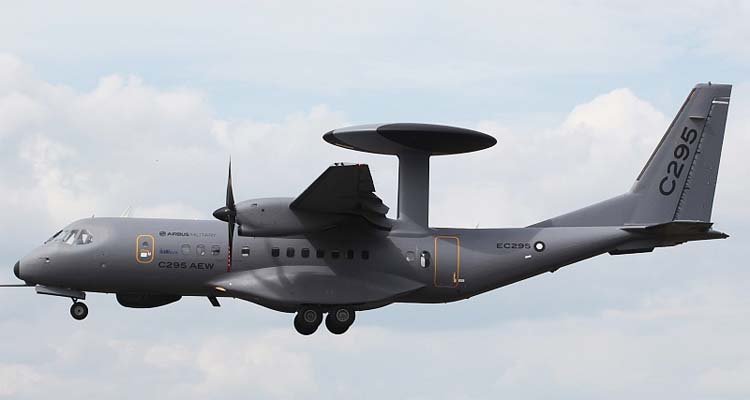 C.295AEW |
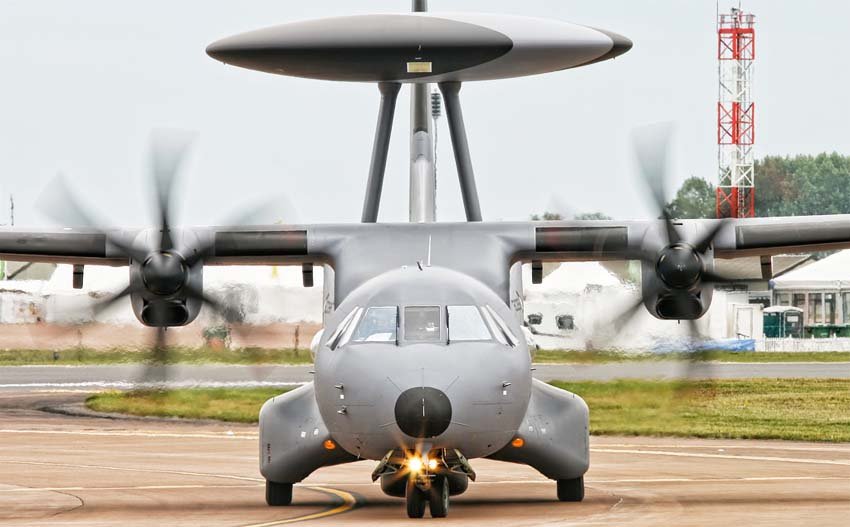 C.295AEW |
 C.295AEW |