
After the initial phase of the war in the Pacific Theater of Operations against Japan, the Americans recognized the need for a large military transport aircraft. Given the immense size of this region, the machine required not only high payload capacity but also a long flight range. In 1942, the “Douglas” company began developing an aircraft that met these requirements.
The first of 50 aircraft ordered by the US Army Air Forces, designated C-74 Globemaster I, took to the air only on September 5, 1945. This cantilever low-wing monoplane of all-metal construction featured a traditional empennage and a retractable tricycle landing gear with a nose wheel and twin wheels on each strut. It was powered by four Pratt & Whitney R-4360-27 radial piston engines, each producing 3000 hp, mounted on the wings.
Design and Capacity
The C-74’s large fuselage accommodated the crew and 125 soldiers, or 115 stretchers along with accompanying personnel, or up to 21,840 kg of cargo. After the victory over Japan, the contract was canceled, and only 14 Globemaster I aircraft were built. One of these, carrying 103 passengers and crew, flew from the USA to England on November 18, 1949, becoming the first aircraft in history to cross the North Atlantic with over 100 people on board.
Operational Milestones
The C-74 boasted outstanding technical characteristics, capable of transporting 125 soldiers or 16.5 tons of cargo over 5,470 km. When the C-74 entered service, it became the largest production combat aircraft in the world. It was 7.5 meters longer than the Boeing B-29, its wingspan exceeded it by 9.7 meters, its empty weight was 5.2 tons greater, and its maximum takeoff weight was 17.5 tons more.
Legacy and Civilian Adaptations
After the military concluded operations with the Globemaster I, some were purchased by civilian cargo companies. The aircraft remained in service until 1971. A civilian variant of the C-74, designated DC-7, was also proposed; in 1944, Pan Am placed an order for 26 machines, which was later canceled.
Technical Specifications
| Modification | S-74 |
| Wingspan, m | 52.81 |
| Length, m | 37.85 |
| Height, m | 13.34 |
| Wing area, m2 | 233.18 |
| Empty weight | 39087 |
| Maximum takeoff weight | 78018 |
| Engine type | 4 Piston engines Pratt & Whitney R-4360-69 |
| Power, hp | 4 x 3250 |
| Maximum speed, km/h | 528 |
| Cruising speed, km/h | 341 |
| Practical range, km | 5472 |
| Service ceiling, m | 6490 |
| Crew, crew members | 4-5 |
| Payload | up to 125 military personnel or 115 stretchers with attendants or 21841 kg of cargo |
Image and diagram gallery of the C-74 Globemaster I
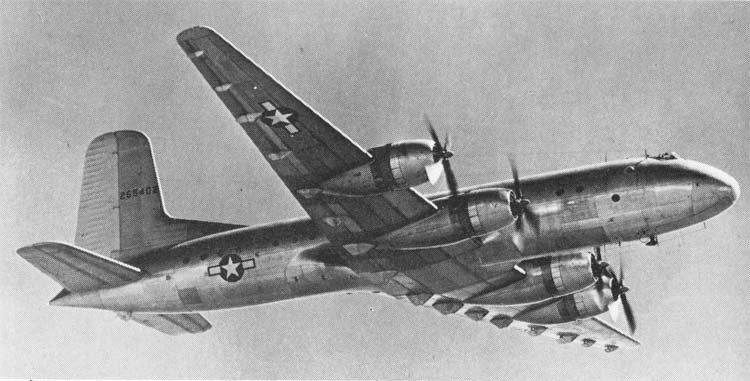 C-74 Globemaster I |
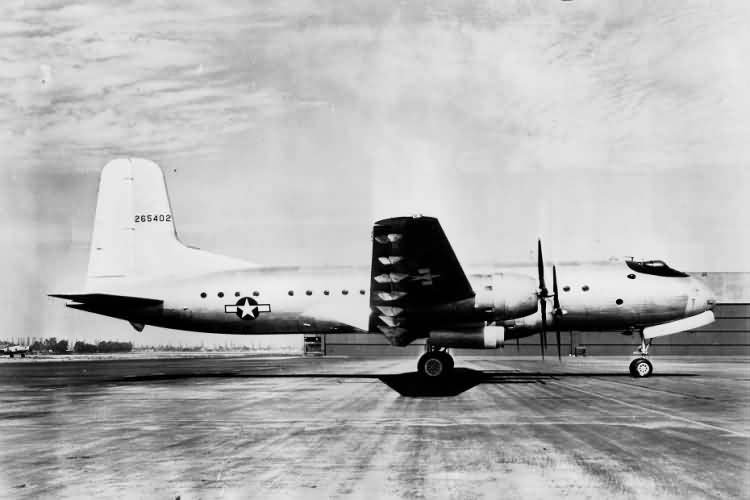 C-74 Globemaster I |
 C-74 Globemaster I |
 C-74 Globemaster I |
 C-74 Globemaster I |
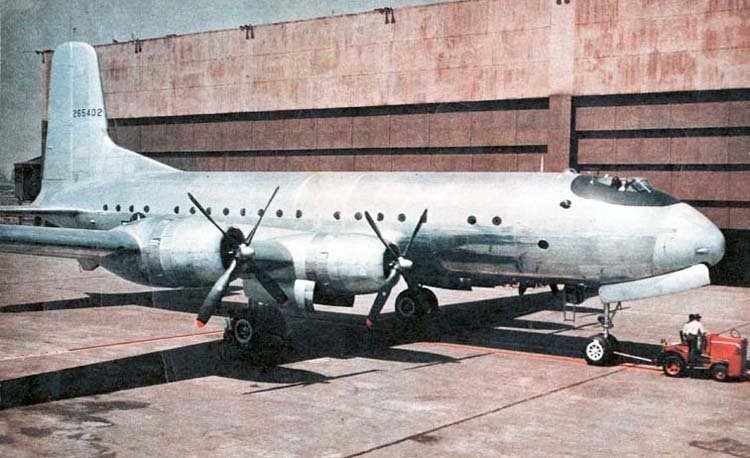 C-74 Globemaster I |
 C-74 Globemaster I |