
Early Development and Financial Challenges
Following the successful circular flights of the C-4, Juan de la Cierva proved the effectiveness of the autogyro principle. The next step was to refine the apparatus for practical application. However, problems arose again, this time not of a technical nature. De la Cierva, after graduating from the Higher School of Road Engineers, had not worked a single day in his profession and was financially dependent on his father, a circumstance that greatly burdened him, especially since he already had a family.
He understood that his economic capabilities would not allow him to effectively pursue the improvement of the autogyro, so he began to seek funding in Europe and America. Firms were cautious and slow to provide concrete answers, though they agreed the idea was very appealing. On March 10, 1923, de la Cierva filed for two patents: one for “Improvements in aeroplanes with rotating wings,” covering the achievement of centered lift through the flapping motion of the blades, and another for “Improvements in the wings of rotary-wing aircraft,” which protected a blade profile with an upward convex mean line and blades with an evolutive profile for increased useful output.
Despite financial difficulties, de la Cierva completed the construction of his fifth autogyro, the C-5. This was the last autogyro the inventor built at his own expense (considering modifications and overhauls, he built 30 autogyros). The C-5 had a three-bladed rotor and a 110 hp “Rhone” engine. Testing began in April 1923 but was interrupted by frequent breakdowns. Eventually, the aircraft suffered a serious accident: during taxiing, a blade spar broke due to fatigue. The inventor’s resources were exhausted, and the machine was not repaired.
The Cierva C.6: A Spanish Breakthrough
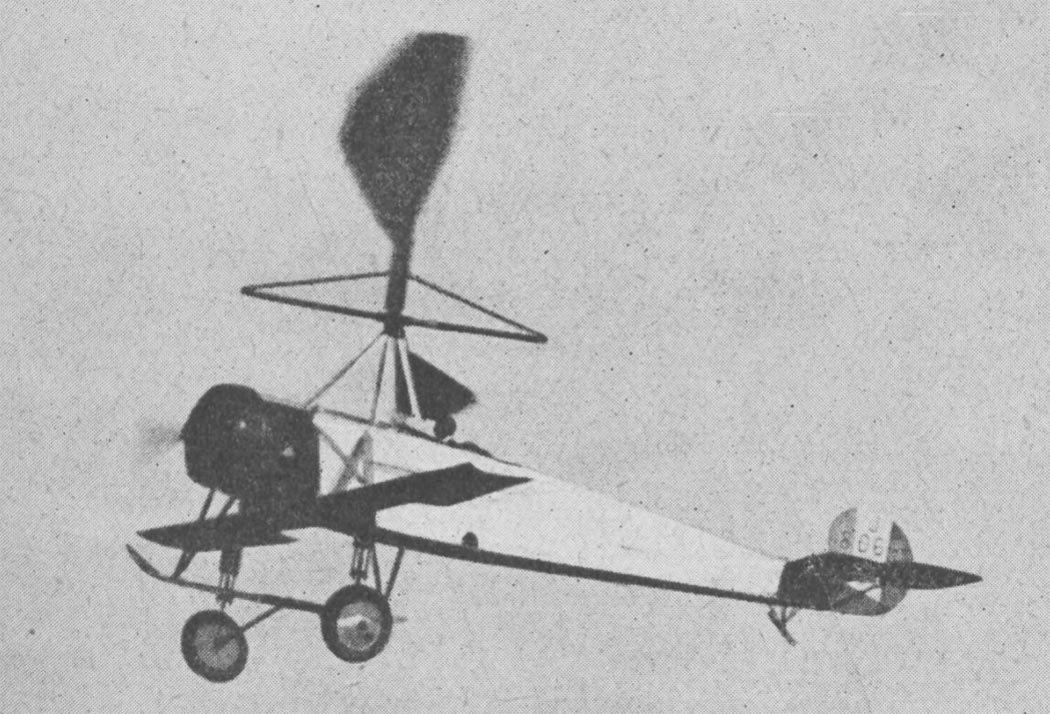
In August 1923, the Spanish military aviation decided to take over the development of this new type of aircraft, not out of philanthropic motives, but because the autogyro promised to become a new type of weapon in the colonial war in Morocco. De la Cierva received specific funds, and the sixth autogyro, the C-6, was built in the airfield workshops. Simultaneously, Major Herrera, in the airfield laboratory’s wind tunnel, experimentally determined the characteristics of its rotor. The wind tunnel, designed and built by Herrera himself, was a closed-cycle tunnel with a 3-meter working section, the largest in Europe at the time of its construction.
A 1:10 scale model of the C-6 rotor, with a 1.1 m diameter, was made for testing in the tunnel. Instead of hinges, its four blades were attached to the hub by flexible steel plates, allowing flapping motions. Tests, conducted in the autumn of 1923 and winter of 1924, showed a polar curve significantly different from a conventional aircraft wing, indicating a higher lift coefficient in a very narrow range of angles of attack and the autogyro’s ability to perform horizontal flight at low speeds.
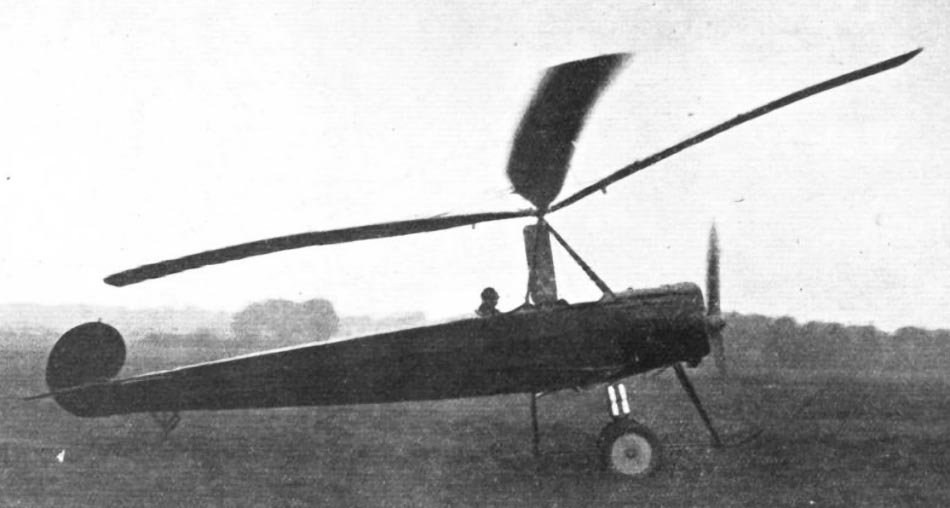
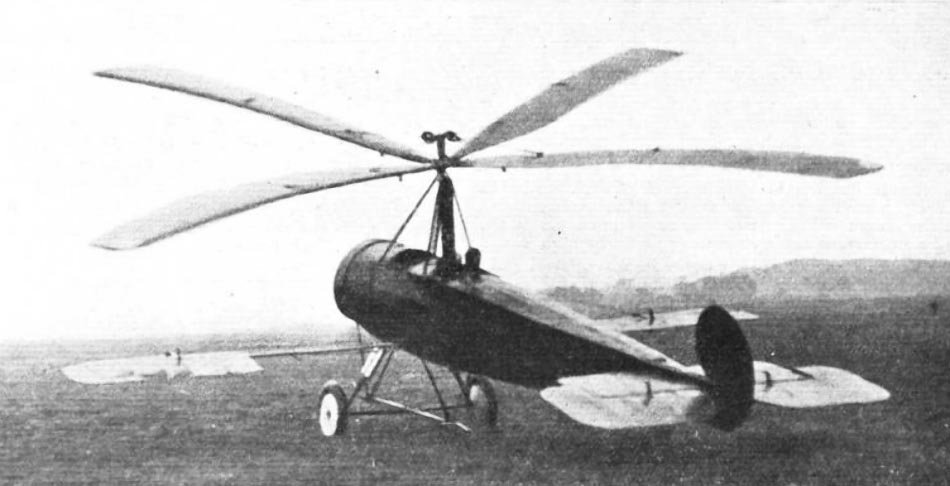
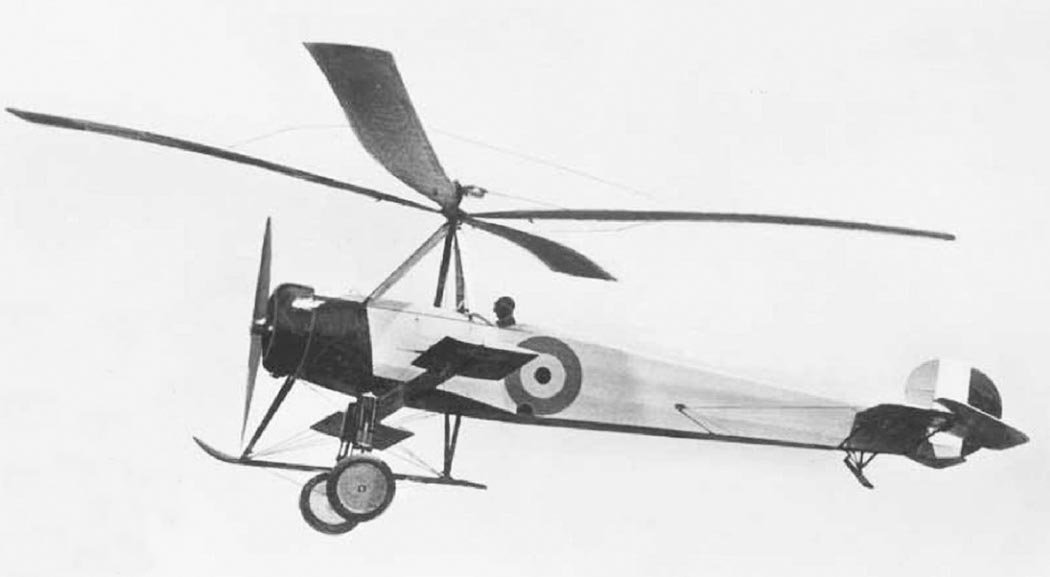
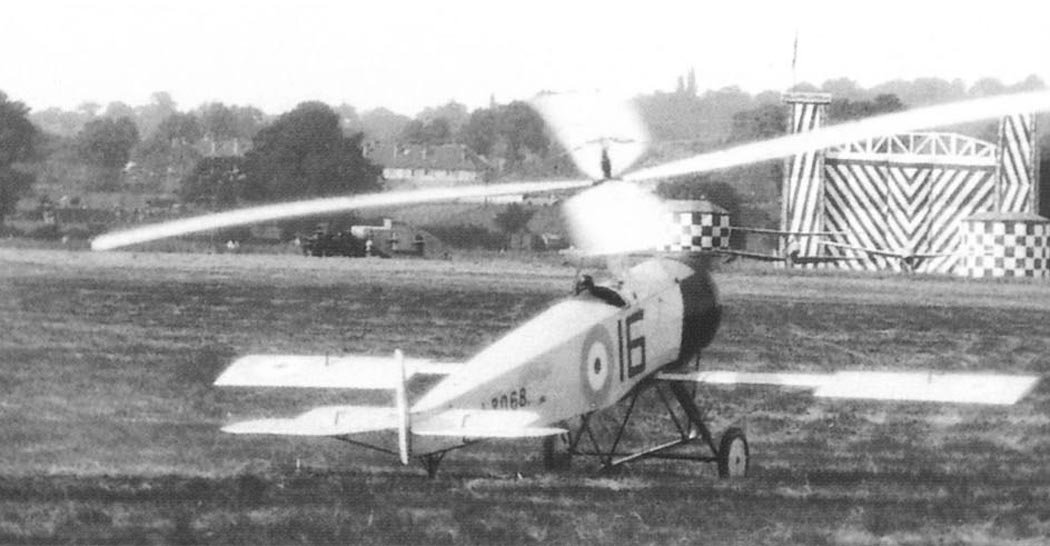
The construction of the C-6 was completed in January 1924, using a fuselage borrowed from an “Avro” 504K aircraft and a 110 hp “Rhone” engine, with the apparatus weighing 700 kg. Lateral control was achieved using ailerons on the boom. The rotor was four-bladed, with its axis located between two open cockpits. When stationary, the blades were held horizontally by rubber cords and interconnected by braces with lead weights in the middle. The autogyro was controlled from the rear cockpit.
As the C-6 was the property of Spanish military aviation, it was assigned to the experimental squadron of the aerodynamic laboratory. Flights demonstrated that the C-6 was much easier to pilot than its predecessors. Take-off required a run of 100-150 m, during which the rotor spun up to 70 rpm, necessary for lift-off. The climb rate was 1 m/s, and control was simple. The pilot could use only the throttle for altitude changes without moving the control stick, and the autogyro was insensitive to wind gusts. For turns, the pilot only used pedals, with the aircraft automatically entering a turn at a bank angle determined by centrifugal force. It could descend like a parachute at an 80° glide angle; by pulling the stick back sharply, the aircraft would brake in the air and descend, potentially vertically with a slight headwind.
At Cuatro Vientos airfield, pilot José Luis Ureta performed normal turns, figure eights, circular flights, and—most impressively—parachute descents that ended in soft, “bird-like” landings (airfield wits called such landings “tired hen landings”). Despite its clumsy appearance, the pilot was thrilled, believing the autogyro’s control was simpler than a car’s and required little intervention, offering inherent stability, stall resistance, and the ability to land with almost no horizontal speed. Testing continued until March 1924 when the pilot was recalled to active duty.
Meanwhile, Joaquín Loriga, one of Spain’s most knowledgeable and courageous pilots, arrived at Cuatro Vientos as the new commander of the pilot retraining squadron. Intrigued by the C-6, he offered his services to de la Cierva “purely for the love of the art.” After the inventor’s explanations, Loriga took off without familiarization runs, climbed to 200 m, made a large circle, then switched off the engine and landed almost without a run. The 8-minute flight marked significant progress. On December 11, Loriga made another FAI-certified flight, performing full turns and climbing over 100 m.
The next day, December 12, 1924, marked the first cross-country flight in rotary-wing aviation history. At 12:08, Loriga took off from Cuatro Vientos and landed in Getafe 8 minutes later, covering 10.5 km at an average speed of 77 km/h, with a landing roll of 23 m. An altimeter recorded flight altitudes between 40 and 60 m.
International Acclaim and Future Developments
Coinciding with the 9th Paris Air Show, Loriga’s flights were filmed. The film was presented in Paris to the FAI president and secretary, who recommended its showing at the French Air Navigation Society. Spectators were enthralled, recognizing the December 12 flight as a major step in aviation history, noting the autogyro’s emergence as an outstanding event since the advent of the aeroplane.
Based on the C-6’s testing experience, a second autogyro, the C-6 bis, was built with significant modifications and was ready for flight by May 1925. The original C-6 was sent to a motor and aviation exhibition in Barcelona. The C-6 bis significantly differed from its predecessor; to eliminate vibrations found in the C-6, de la Cierva designed a new, stiffer blade type for the C-6 bis, with a wooden leading edge and the rest covered in percale. The rotor diameter was 10.5 m, and the blade incidence angle remained two degrees. The blade suspension and bracing were unchanged, but the hub was modified with rolling bearings, substantially improving rotor operation.
The C-6 bis used the same 110 hp “Rhone” engine as the C-6, but its take-off weight was 900 kg. For the first time, a rotor pre-rotation device was implemented on the C-6 bis to shorten the take-off run. This device, where a cord wound around a spindle on each blade like a top, spun the rotor as the autogyro began its take-off roll, ensuring sufficient centrifugal forces to prevent dangerous coning angles or blade folding. To address the C-6’s insufficient pitch control effectiveness at low speeds, de la Cierva reduced the stabilizer area and increased the elevator area on the C-6 bis, while the rudder remained the same as the “Avro” 504K.
Loriga conducted the C-6 bis tests, where the autogyro demonstrated slightly higher flight speed and better climb performance than its predecessor. Thanks to the new blade design, rotor operation became smoother, even though its rotation frequency reached 140-160 rpm. Overall, the autogyro development work was progressing successfully.
On June 24, 1925, demonstration flights were held in the presence of the King of Spain and a large entourage. Loriga took off, climbed to 200 m, and after turns, figure eights, and “hills,” performed several low passes. Concluding the aerobatics, he executed a vertical landing using the wind. The King congratulated the designer and pilot on the successful development, which had significant consequences: the council of ministers allocated funds for a new autogyro model, and in late July, Juan de la Cierva was awarded the title of Knight of the Civil Order of Alfonso XII. The C-6 bis demonstration flights were widely reported by the press and attracted interest from business circles.
In the summer of 1925, de la Cierva received invitations to demonstrate his autogyro in England and France. In September 1925, with permission from Spanish military aviation, the C-6 bis was transported to Farnborough, England’s aviation experimental center. Initially, Spanish pilots were to perform the demonstration flights, but Loriga fell ill, and other pilots were unavailable, while the British were pressing for action. This forced de la Cierva to contract English pilot Frank Courtenay, considered one of the best English test pilots.
On Saturday, October 10, 1925, Courtenay flew the autogyro for the first time, finding the machine easy to control. In flights lasting up to half an hour, he climbed to 400 m, seemingly below the autogyro’s ceiling. With the engine off, the autogyro descended like a parachute at 4-5 m/s, with landing rolls not exceeding 4 m. In horizontal flight, with full throttle and nose up, the autogyro could reduce speed to 15 km/h, and further pulling the stick back increased descent speed without exceeding 4-5 m/s. The autogyro again demonstrated its reliability and ease of control, though its weaknesses were a maximum speed of no more than 108 km/h and a climb rate of 1.14 m/s.
On October 19, 1925, Courtenay performed several demonstration flights before aviation authorities and the press, making a strong impression. On October 22, de la Cierva presented his report, “The Development of the Autogyro,” to the Royal Aeronautical Society, detailing his testing of 32 autogyro variants. The journal “Flight” noted that “without risk it can be said that in the last few years no speaker at the Royal Aeronautical Society has attracted as many people as came last Thursday, October 22.”
De la Cierva successfully met all conditions promised to the British: the autogyro flew a 10 km closed circuit, landed with a run of less than 20 m, and performed a descent at a 45° angle. His reputation as a man whose words matched his deeds was publicly acknowledged. It was time to steer the autogyro’s future in the right direction. Although Spanish military aviation offered de la Cierva certain research opportunities, he realized Spain lacked the necessary infrastructure and, crucially, long-term funding sources. After initial contacts with interested parties in Western countries, he chose England, finding individuals ready to back the autogyro, who also held social influence and foresight. De la Cierva believed England offered the most favorable environment for developing his ideas. His father advised him to focus on the government rather than firms and to establish a joint-stock company where de la Cierva would be free from commercial or administrative duties, fully dedicating himself to creative work on autogyro improvement.
After the Farnborough tests, de la Cierva remained in England until December 1925 to organize the “Cierva Autogiro Company” and conclude contracts for preparing technical documentation for building four autogyros for the Royal Air Force. During this period, de la Cierva filed for several English patents for new inventions, as his contribution to the company consisted solely of his ideas, which were products of his continuous and intense intellectual work. His main patent for the flapping motion of blades in the vertical plane (No. 81406, February 15, 1922) had already been accepted in France and England, and later in the USA and Germany. In November 1925, de la Cierva filed for seven more patents, granted in early 1927, covering important practical ideas:
- Methods for rotor spin-up from the engine via a transmission, as well as a top-like method (Nos. 263988 and 265716).
- Various blade shapes, including a paddle shape used from 1926 to 1929 (No. 264965).
- A method for folding blades for convenient transport (No. 264968).
- The use of wings for additional lift and aileron attachment, as well as the deflection of the rotor axis via a worm gear for lateral control with manual or hydraulic drive (No. 264286).
- A second articulated joint with a vertical axis, and the reduction of blade oscillations in the plane of rotation using braces with centrifugal weights or rubber cords (No. 264963). This patent included a hub with axial and radial bearings and a lubrication system for the joints under centrifugal forces.
- A slight rotation of the horizontal hinge relative to the blade spar axis for damping blade oscillations in the vertical plane (No. 264753).
After preliminary negotiations, the head of the contracts department at the British Air Ministry sent de la Cierva a letter on December 1, 1925, meticulously outlining the terms. For 4000 pounds sterling, de la Cierva was to prepare drawings and production data for a manufacturer appointed by the Air Ministry to build five rotaplanes (later called “gyroplanes”). Four of these had to meet specific conditions: a rotaplane similar to the demonstrated C-6 bis; a two-seater C-6 bis type with a 180 hp Armstrong Siddeley Lynx engine, equipped with an engine-driven rotor pre-rotation device enabling 90% of horizontal flight RPM in winds up to 5 mph; a single-seater C-6 bis type with minimal size and weight; and a rotaplane for research purposes, with details to be clarified after consultations with the Aeronautical Research Committee.
The contract also provided for an exchange of ideas to improve the machines until the acceptance of the last of the five autogyros, with improvements to be implemented without additional payment. This was de la Cierva’s personal contract, as the company did not yet exist. Once all contract points were clarified and the agreement signed, de la Cierva returned home after several months in England, only to leave for Paris two weeks later. These long separations from his family, now including three sons, were a significant sacrifice for his vision.
The demonstration and test flights at Farnborough, along with de la Cierva’s presentation to the Royal Aeronautical Society in London, created a sensation in the aviation world: while the helicopter’s future was still uncertain, the autogyro was already flying with impressive success. France, Italy, and Holland showed interest. By arrangement with the French government, the C-6 bis was sent from England to the French Air Force’s aviation technical service base at Villacoublay. There, on February 26, 1926, Courtenay performed the first flight. The next day, official demonstration flights were scheduled, but after a trial flight and landing, a strong gust of wind overturned the autogyro. The left aileron and blades were damaged, but the pilot fortunately remained unharmed.
On February 28, the French Society of Air Navigation held a special session where de la Cierva was awarded the “Air” magazine prize for 1925, given annually to the person who made the greatest contribution to aviation development. At this meeting, de la Cierva presented a report with films shot in Farnborough and Villacoublay, including footage of the recent accident.
After a week-long repair, testing resumed. The C-6 bis was fitted with instruments for recording altitude, speed, and rotor RPM. French pilots participated in the tests, also concluding that piloting the autogyro was very simple. During the tests, the following results were obtained: average climb rate to 200 m was 1.1 m/s, and to 100 m was 3 m/s; maximum flight altitude was 450 m (speed readings were not accepted as the speed indicator was not properly calibrated); descent angle was 11°30′ from vertical; descent speed was 4.53 m/s.
Two flights were also made to a designated spot with a landing on a limited area. The French Navy was interested in the possibility of using the autogyro from a ship’s deck. In one landing, the C-6 bis rolled 1.5 m and stopped 30 cm from the control point; in another case, it touched the control point and rolled 1 m. Overall, the tests were successful, and the French Navy intended to place an order for two autogyros.
After the tests in France, de la Cierva returned to England, where the process of forming his company was nearing completion. The company was intended to sell the rights to de la Cierva’s patents and negotiate license sales to governments and firms, and potentially create companies in other countries to operate the patents under license. From the outset, de la Cierva ensured that the company’s rights did not extend to Spanish patents, allowing him to grant free licenses for autogyro production to Spanish military aviation as a gesture of gratitude for the initial help and support he received.
The company was established not as a design bureau, but as a consultative and research firm with specific commercial rights. Juan de la Cierva owned part of the shares for providing his patents to the company. The administrative board consisted of five people: James Weir (President), Hugh Kindersley (Technical Director), Juan de la Cierva (Technical Advisor), with de la Cierva to recommend advisors for the remaining two vacant positions. Frank Courtenay was the Technical Manager, Alston the Commercial Manager, and Reginald Blake the Secretary. The company was registered on March 20, 1926, and began operations four days later, initially at Bishopsgate, 80, then three weeks later at Bush House in central London, where it remained until its dissolution. Immediately after the company’s formation, Blake sent letters offering services to various aviation firms in England and France, as well as to the French Air Force’s technical service.
While the company was setting up, de la Cierva traveled to Spain to resolve issues related to the construction of Spanish autogyros, give several promised public speeches, and, of course, visit his family. De la Cierva met with Spanish military aviation leadership, who intended to build a new autogyro (named C-7), discussing funding, the type of autogyro, and production base issues. As the airfield workshops were fully occupied, the order was expected to be placed with one of three Spanish companies: Hispano, Loring, or CASA.
De la Cierva always sought to popularize his ideas and did not decline public speaking engagements. During his stay in his hometown of Murcia, he delivered a report to the Royal Economic Society on April 8, 1926, to the Murcian Society on April 10, and to the University of Madrid on April 15. Attendees included students, faculty, engineers, technicians, pilots, and curious individuals. De la Cierva gave a brief overview of the autogyro’s creation, discussed his goals and results, and concluded by addressing the autogyro’s future. Here, he first noted that rotor pre-rotation before take-off could be used for vertical take-off, which sounded fantastic at the time, but he proved its reality years later. Regarding future applications, he mentioned ship-based operations, the advantages of night use (referring to parachute descents and no-roll landings), and the development of the autogyro-car idea, which Pitcairn realized in the USA ten years later. Films of the autogyro tests were then shown, after which the audience applauded their compatriot in admiration.
The first three autogyros specified in the British contract were ordered from “A. V. Roe and Company” (AVRO), while the fourth order went to “George Parnall.” AVRO’s design office and experimental factory were located in Hamble, near Southampton, where an autogyro design section was established. The first autogyro ordered by the Air Ministry, named C-6c, differed little from the C-6 bis. It featured a new rotor hub design and other minor structural changes. Unlike the Spanish prototype, the C-6c also had small lifting surfaces. Initially, it was intended to use a “Rhone” engine on the C-6c, but it was later replaced with a 130 hp “Clerget.” The first English autogyro participated in the Royal Air Force review at Hendon airfield on July 3, 1926.
Construction of the C-8V was delayed again, and to ensure the company had an autogyro, it was decided to build a new aircraft based on the C-6c, named C-6D. It borrowed the fuselage from an “AVRO” 504K and was fitted with a 130 hp “Clerget” engine. The C-6D became the first autogyro with a wing and a new type of paddle-shaped blades. The landing gear had a wide track, with shock absorbers attached to the wing via struts. Like all “AVRO” aircraft, the C-6D had an anti-nose-over skid. The wing area was 6.5 m², and the rotor rotated at 120 rpm (the C-8V was later built with wings, a four-bladed rotor, and narrower paddle-shaped blades than the C-6D). The aircraft’s maximum take-off weight was 1150 kg, with a maximum speed of 160 km/h and a minimum of 35 km/h.
Courtenay made the first flight on the C-6D on July 29, 1926, and the next day the autogyro flew with a passenger for the first time, who was, naturally, de la Cierva. Tests revealed a deterioration in lateral stability compared to previous autogyros. It was found that the downwash caused by the rotor reduced the wing’s angle of attack, so the wing was trimmed by reducing the tip chord, leaving the ailerons unchanged. This C-6D was then disassembled and sent to Berlin, where de la Cierva was invited for an aviation event.
Technical Specifications
| Modification | С.6A |
| Main rotor diameter, m | 10.50 |
| Length, m | 8.98 |
| Normal takeoff weight | 900 |
| Engine type | 1 Piston engine Le Rhone 9Ja |
| Power, hp | 1 x 110 |
| Maximum speed, km/h | 108 |
| Crew | 1 |
Image and diagram gallery of the Cierva C.6 Autogyro
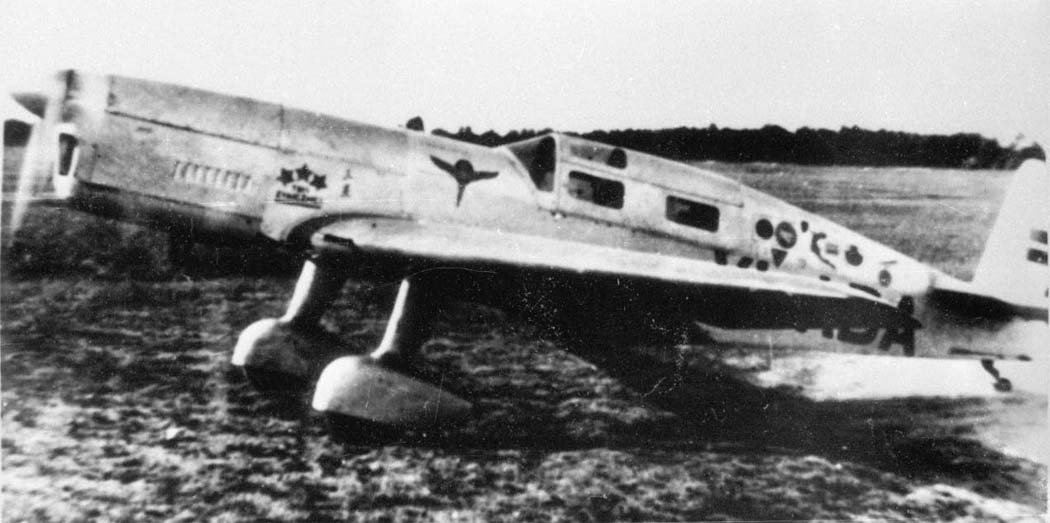 C.6 |
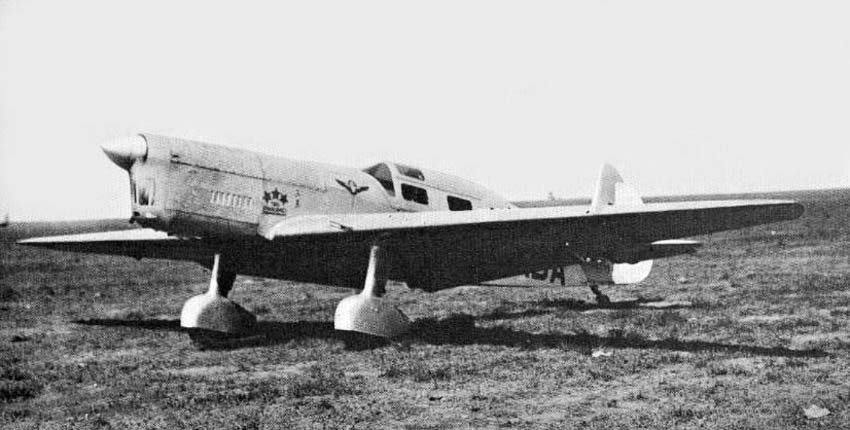 C.6 |
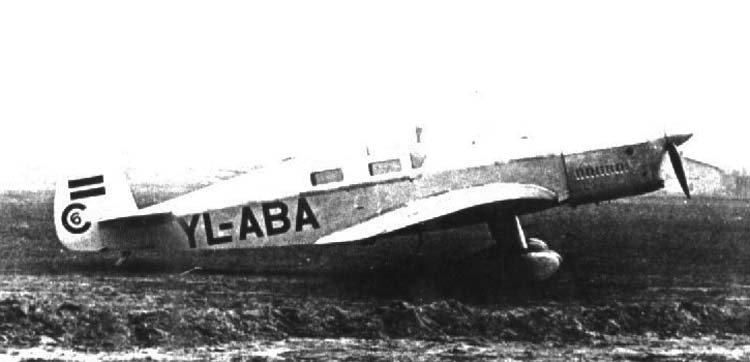 C.6 |
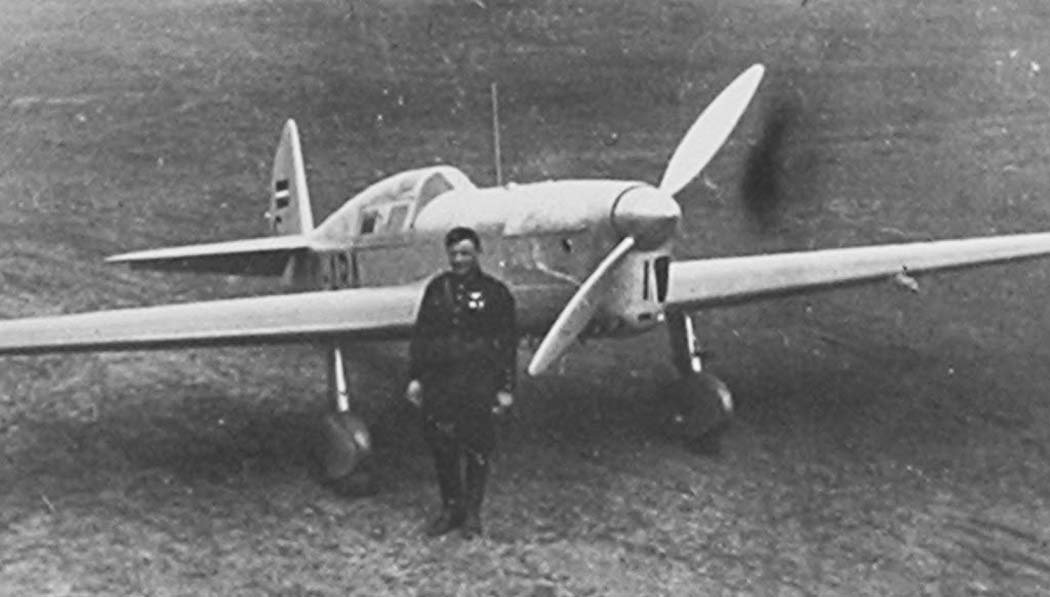 C.6 |
 C.6 |
 C.6 |
 C.6 |
 C.6 |
 C.6 |
 C.6 |
 C.6 |
 C.6 |
 C.6 |
 C.6 |
 C.6 |
 C.6 |